Ōtomo Yoshinao
Ōtomo Yoshinao (大友 能直, January 29, 1172 - December 20, 1223) was a Japanese samurai warlord of the early Kamakura period. He served as Governor of Buzen and Bungo Provinces, Defense Commissioner of the West and Lieutenant of the Left Division of Inner Palace Guards (Sakon no shōgen) under the Kamakura shogunate. He is the founder of the Ōtomo clan. He held the court rank of Junior Fifth Rank, Lower Grade.[1]
Ōtomo Yoshinao 大友能直 | |
|---|---|
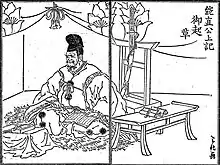 From Ōtomo Yoshinao Kō Go-Ichidaiki | |
| Born | January 29, 1172 |
| Died | December 20, 1223 (aged 51) |
| Nationality | Japanese |
| Other names | Ichihōshimaru |
| Occupation | samurai warlord |
| Spouse(s) | Shinmyō |
| Parents |
|
Life
Kondō Ichihōshimaru was born on January 29, 1172 as the son of Kondō Yoshishige, the head of Furushō township in Sagami Province. Regarding his parentage, there is a theory that he was an illegitimate son of Minamoto no Yoritomo, but this theory has been widely refuted by modern historians.[2] His mother, Tone no Tsubone, was the daughter of Hatano Tsuneie.[1]
After his elder sister married Nakahara Chikayoshi, Yoshinao became an adopted son of Chikayoshi, and became known as Nakahara Yoshinao. He succeeded the position of the head of Ōtomo township from his maternal side of family, and became known as Ōtomo Yoshinao, thus establishing the Ōtomo clan.[1]
From a young age, he served as a close retainer of shogun Minamoto no Yoritomo. After Yoshinao's genpuku (coming-of-age ceremony),[3] he succeeded the position of Defense Commissioner of the West previously held by his adoptive father Nakahara Chikayoshi,[3][1] and became the steward of Ōno Manor in Bungo Province (present-day Ōita Prefecture).[1]
According to the Ōtomo genealogy, Yoshinao was appointed Defense Commissioner of the West and Governor of Buzen and Bungo Provinces in Kenkyū era. However, this has been pointed out to be an error, and that all of these positions were handed to him by his adoptive father Nakahara Chikayoshi.[3]
Yoshinao died in Kyoto on December 20, 1223, aged 51.[1][3] He left his position of shoshiki to his children and wife Shinmyō.[3]
Genealogy
The Ōtomo clan claims descent from Emperor Seiwa (850-881) through the Seiwa Genji lineage of the Minamoto clan. Although the clan genealogy claims Yoshinao to be an illegitimate son of Minamoto no Yoritomo, it has been concluded that he was in fact a descendant of the Fujiwara clan, as the son of Kondō Yoshishige of the Kondō clan.[1]
Yoshinao's paternal uncle was Mutō Yorihira, and Yorihira's nephew (raised like his own son), Mutō Sukeyori, founded the Shōni clan. In addition, Kondō Kunihira, who was a gokenin of Minamoto no Yoritomo, was Yoshinao's second cousin, and the descendants of his younger brother, Tamura Nakanori, later became members of the Mizunoya clan.[4]
Ōtomo Yoshinao's descendants served as Governor of Buzen and Bungo Provinces for generations further establishing the power of Ōtomo clan in these two provinces.[1][5] The clan would expand their power in Bungo Province along with the Shiga clan, founded by Yoshinao's eighth son Shiga Yoshisato,[6][1] that had settled there earlier. Following the unrest of the Nanboku-chō period, the clan became an influential Shugo Daimyo family in Bungo, Buzen, and Chikugo Provinces during the Muromachi period. Yoshinaga, 19th generation descendant of Yoshinao, along with his son Yoshiaki further became Sengoku period Daimyos. At the time of 21st generation Yoshishige, the Ōtomo clan reached its zenith by expanding its power to Hizen, Higo, and Chikuzen Provinces.[1]
Yoritomo's Illegitimate Son Theory
Yoshinao's mother, Tone no Tsubone, was once a concubine of Minamoto no Yoritomo, and Yoshinao's adoptive father, Nakahara Chikayoshi, was a close retainer of Yoritomo. There is a theory that Yoshinao was an illegitimate son of Yoritomo because of his relationship with her mother, and in Ōtomo genealogy, Yoshinao is inscribed as an illegitimate son of Yoritomo.
In addition, there is a theory that Tone no Tsubone never was a concubine of Yoritomo as it is not described in the records at that time such as the Azuma Kagami. In the Kōan era Ōtomo genealogy, Yoshinao's paternal lineage goes straight from Fujiwara no Hidesato to Yoshinari, and states no differing theories to this lineage. From this, it has been pointed out that there was no theory about Yoshinao being an illegitimate son of Yoritomo in the late Kamakura period.
Furthermore, it has been said that this theory was created after Yoshinao's 7th generation descendant, Ōtomo Yasushi, and all his brothers, were taken in by Ashikaga Takauji as nephews (raised like his own son) during Takauji's revival campaign in Kyushu.[7] There is a viewpoint that this theory was created to recall the memories about the relationship of Yoritomo and Yoshinao for the fictitious parent-child relationship of Takauji and the Ōtomo brothers.[8]
Family
- Adoptive father: Nakahara Chikayoshi
- Father: Kondō Yoshishige
- Mother: Tone no Tsubone (daughter of Hatano Tsuneie)
- Wife: Shinmyō (daughter of Hatakeyama Shigeyoshi)
- Eldest son: Ōtomo Chikahide
- Eighth son: Shiga Yoshisato
- Son: Takuma Yoshihide
- Son: Ōtomo Tokinao
- Son: Motoyoshi Arinao
- Son: Ōtomo Chikanao
- Son: Ōtomo Satoyoshi
- Son: Ōtomo Asanao
- Son: Ichimada Tokikage
- Son: Washio Hidenao
- Son: Buzen Yoshimoto
- Son: Nakahara Yasuhiro
- Daughter: Hōjō Tomotoki's wife
References
- Nihon dai hyakka zensho = Encyclopedia Nipponica 2001. Shōgakkan, 小学館 (Shohan ed.). Tōkyō. 1989. 大友能直. ISBN 4-09-526001-7. OCLC 14970117.CS1 maint: others (link)
- Toyama, Mikio; 外山幹夫 (1986). Chūsei Kyūshū shakaishi no kenkyū. Tōkyō: Yoshikawa Kōbunkan. ISBN 4-642-02614-2. OCLC 15429069.
- Asashi Nihon rekishi jinbutsu jiten. Asahi Shinbunsha, 朝日新聞社. Tōkyō: Asahi Shinbunsha. 1994. 大友能直. ISBN 4-02-340052-1. OCLC 33014222.CS1 maint: others (link)
- Tōin, Kinsada. Sonpi Bunmyaku (尊卑分脈). 藤原北家秀郷流系図.
- Nihon dai hyakka zensho = Encyclopedia Nipponica 2001. Shōgakkan, 小学館 (Shohan ed.). Tōkyō. 1989. 大友氏. ISBN 4-09-526001-7. OCLC 14970117.CS1 maint: others (link)
- Kōdansha nihon jinmei daijiten. Masaaki Ueda, 上田正昭. Tōkyō: Kōdansha. 2001. 志賀能郷. ISBN 4-06-210800-3. OCLC 834665660.CS1 maint: others (link)
- 「建武3年2月15日付足利尊氏御判御教書案」(「大友文書」4-1-17号)『大分県史料』. 26. p. 161.
- Bungo Ōtomo-shi. Naoki Yagi, 八木直樹 (Shohan ed.). Tōkyō. 2014. ISBN 978-4-86403-122-6. OCLC 887972577.CS1 maint: others (link)