Cathedral of Saints Peter and Paul, Šiauliai
The Sts. Peter and Paul Cathedral[1] (Lithuanian: Šv. Apaštalų Petro ir Pauliaus katedra) also called Šiauliai Cathedral[2][3] is a religious building of the Catholic Church that serves as the cathedral in Šiauliai, a city in the European country of Lithuania,[4] and the seat of the Roman Catholic Diocese of Šiauliai.[5]

| Cathedral of Sts. Peter and Paul | |
|---|---|
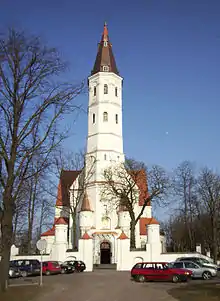 Šiauliai Cathedral | |
| Religion | |
| Affiliation | Roman Catholic |
| Ecclesiastical or organizational status | Cathedral |
| Leadership | Bishop Eugenijus Bartulis |
| Patron | Saint Peter and Saint Paul |
| Status | Active |
| Location | |
| Location | Šiauliai, Lithuania |
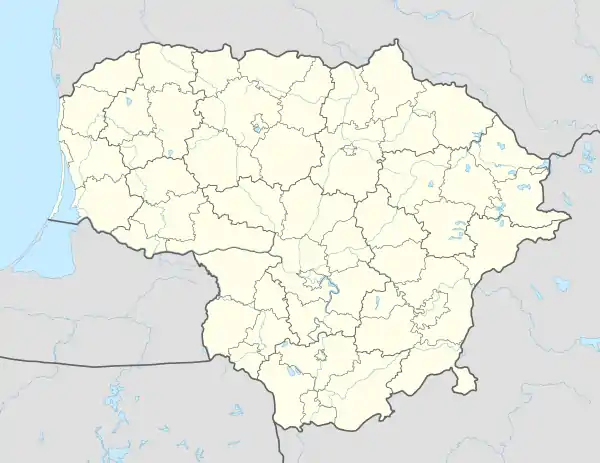  Shown within Lithuania | |
| Geographic coordinates | 55.9328°N 23.32°E |
| Architecture | |
| Style | Renaissance |
| Groundbreaking | 1585 |
| Completed | 1626 |
| Specifications | |
| Direction of façade | West |
| Spire(s) | One |
| Spire height | 70 m (230 ft) |
| Website | |
| http://www.siauliukatedra.lt/ | |
History
The Church of Saints Peter and Paul was built in the seventeenth century, between 1617 and 1626, and is a significant example of the Renaissance and Mannerism. In 1880, lightning struck a tower, so it was necessary to make repairs. The most significant damage occurred after World War II. In 1944 the church was in a sorry state, but already during the Soviet era, the church was restored.
Simultaneously with the creation of the Diocese of Siauliai on May 28, 1997, the Church of Saints Peter and Paul was elevated to the status of cathedral by Pope John Paul II.
Architecture[6]
The church has a Latin cross plan, a single nave with a transept and a presbytery ending in a hexagon. Around the presbytery are two sacristies of equal size (the northern one used to be called a treasure), and on the other side of the transept are two chapels. Sacristy and Chapel in 1924 rebuilt and expanded.
The most expressive western facade of the church. The tower in the middle dominates here. The first tower was five steps, narrowing upwards. The Renaissance era is especially characterized by the division of the tower into stages by horizontal lines - cornices. Each stage is different. Above the brick part of the tower stood an ornate profiled helmet. It was bell-shaped, in two parts. Bottom gracefully curved, wavy contour, tapering at the top, smaller at the top, elongated and pierced. In the middle was a wooden openwork rotunda, open on all sides, for observation and, if necessary, for observing the environment or the enemy.
1880 when lightning struck the church tower, its wooden top burned. The top of the tower was rebuilt differently: it lost its graceful, green-painted bell-shaped helmet and was covered by a much simpler, high octagonal pyramid-shaped spike with skylights and triangular pediments. The brick part was raised by one stage - a sixth octagonal stage was built, divided into semicircular niches and smaller windows. The shelter is surrounded by a fairly bright cornice.
Both side facades of the church are the same. They are characterized by a stark contrast between the large main volume and the tall tower. The tiled roof and the steep gable pediments stand out. The walls are divided by tall and rather narrow pilasters. At the top, they are connected by double semicircular arches, supported in the middle by elongated brackets that taper downwards and pass into circular window keys.
The windows of the church are twofold. Bottoms of medium height, with semicircular lintels. The upper ones are circular, illuminating the interior gallery. The latter are not the same everywhere: larger on the side facades, smaller on the rear.
References
- Cathedral of Sts. Peter and Paul in Šiauliai
- Pazos, Antón M. (2016-04-22). Redefining Pilgrimage: New Perspectives on Historical and Contemporary Pilgrimages. Routledge. ISBN 9781317069911.
- Soviet Life. Embassy of the Union of the Soviet Socialist Republics in the USA. 1988-01-01.
- Baltrušienė, Doloresa (1999-01-01). Pažintis su Lietuva. Kraštotvarka.
- "Šiaulių vyskupija". Siauliuvyskupija.lt (in Lithuanian). Retrieved 2 May 2021.
- "Pastato Architektūra". Šiaulių Katedra (in Lithuanian). Retrieved 2021-12-08.
Authority control  | |
|---|---|
| General | |
| National libraries | |
| Other | |