14-X
The 14-X is a Brazilian hypersonic glide vehicle (HGV) developed by the Aerothermodynamics and Hypersonics Laboratory Henry T. Nagamatsu of the Institute for Advanced Studies (IEAv) and the Brazilian Air Force as part of the PropHiper project (Portuguese: Projeto de Propulsão Hipersônica 14-X),[5][6] equipped with three liquid hydrogen powered scramjet engines,[6] launched by a VSB-30 rocket, reaching 100,000 feet of altitude[7] and a maximum speed of Mach 10.[7] The name is a reference to the 14-bis, of the Brazilian inventor and aviation pioneer Alberto Santos-Dumont.[8] The 14-X is expected to make its first qualification test flight from Alcântara Space Center in 2021-22.[9][2][3]
| 14-X | |
|---|---|
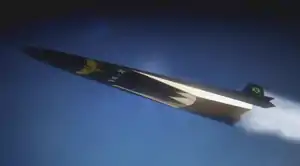 | |
| 14-X in computer graphics | |
| Role | Hypersonic glide vehicle |
| National origin | Brazil |
| Manufacturer | See list
|
| First flight | 2021-22 (planned)[1][2][3] |
| Status | In final test campaign[4] |
| Primary user | Brazilian Air Force |
History
Brazil conducts studies in the field of aspirated hypersonics since 1990s,[5] but an development plan was conceived only in 2007, through the PropHiper project, made official by the Air Force in 2008,[10] when the engineer-captain of the Brazilian Air Force, Tiago Cavalcanti Rolim started a master's degree at the Instituto Tecnológico de Aeronáutica (ITA) and was approved with a thesis on the waverider configuration.[8] The development of the project started with an experimental model by the Institute for Advanced Studies in the same year.[8] Testing of the hypersonic engine started in October 2009.[6]
On 2 December 2021, the Air Force's Department of Aerospace Science and Technology (DCTA), announced the beginning of Cruzeiro Operation with purpose to conduct the first flight of the 14-X,[4] that will be carried out from the Alcântara Space Center in Alcântara, Maranhão. 14-X will be monitored by the tracking station of the Barreira do Inferno Launch Center in Rio Grande do Norte state with route and target towards the Atlantic ocean,[10] the flight date was kept confidential.[4]
Project details
The 14-X use as launcher the VSB-30 (Portuguese: Veículo de Sondagem Booster – 30), a sub-orbital two-stage solid fuel sounding rocket developed in early 2000s by Brazil's Institute of Aeronautics and Space (IAE).[11]
Purpose
The technology is considered by Brazil as one of the most efficient means of accessing space in the near future, and could be used to place satellites in orbit and make suborbital flights.[8][6] It can also be used in other areas such as the development of intercontinental ballistic missiles or in civil aviation.[6]
Launch history
A list with planned and conducted flights of the 14-X:
| Date | Vehicle | Mission | Payload | Results | Ref |
|---|---|---|---|---|---|
| 2021-22 | 14-X (XS VSB-30 V32) | Qualification (Cruzeiro Operation) | — | Planned | [12][4] |
Specifications
Data from Brazilian Air Force[5] Gizmodo[7] DefesaBR[6]
General characteristics
- Length: 2.0 m (6 ft 7 in)
- Wingspan: 0.83 m (2 ft 9 in)
- Empty weight: 250 kg (551 lb)
- Max takeoff weight: 400 kg (882 lb)
- Powerplant: 3 × Scramjet
Performance
- Maximum speed: 12,000 km/h (7,500 mph, 6,500 kn)
- Maximum speed: Mach 10
- Service ceiling: 30,480 m (100,000 ft)

References
- "O CLA e Sua Agenda de Lançamentos Até 2022". Brazilian Space. 21 June 2019.
- "Concluída mais uma etapa do projeto de desenvolvimento de um veículo hipersônico". Brazilian Air Force (in Portuguese). 21 February 2019.
- "Brasil pondrá a prueba el 14-X en la Operación Cruzeiro". Infodefensa.com (in Spanish). 3 March 2020.
- "DCTA envia ao CLA preparativos da Operação Cruzeiro". Brazilian Air Force (in Portuguese). 2 December 2021.
- "Propulsão Hipersônica: Projeto 14-X". Brazilian Air Force (in Portuguese). 11 December 2021.
- "O 14-X HIPERSÔNICO UM FUTURO PARA A FAB". DEFESABR (in Portuguese). 5 March 2007. Archived from the original on 2007-03-05.
- "Brasil prepara 14-X, uma nave hipersônica, para voar em 2013". Gizmodo (in Portuguese). 19 April 2011.
- "Do 14-bis ao 14-X". ISTOÉ (in Portuguese). 28 March 2013.
- "O CLA e Sua Agenda de Lançamentos Até 2022". Brazilian Space. 21 June 2019.
- "Projeto 14-X – O Brasil na era da Propulsão Hipersônica". Defesa Aerea e Naval (in Portuguese). 11 December 2021.
- "Veículo suborbital VSB-30 terá modelo modernizado". Defesa Net. 31 March 2017.
- "O CLA e Sua Agenda de Lançamentos Até 2022". Brazilian Space. 21 June 2019.