1918 protest in Zagreb
The 5 December 1918 protest in Zagreb, also referred to as the December Victims (Croatian: Prosinačke žrtve) in Croatia was an armed clash fought by the National Guards established as an armed force of the National Council of the State of Slovenes, Croats and Serbs supported by Sokol volunteers, on one side, against the soldiers of the 25th Regiment of the Royal Croatian Home Guard and the 53rd Regiment of the former Austro-Hungarian Common Army. It took place on 5 December 1918, four days after proclamation the Kingdom of Serbs, Croats and Slovenes, when the soldiers were stopped by the National Guardsmen at the Ban Jelačić Square in Zagreb.
| 1918 protest in Zagreb | |||
|---|---|---|---|
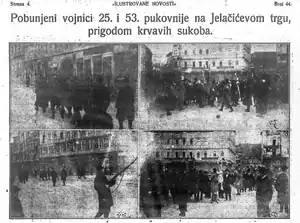 Contemporary newspaper coverage | |||
| Date | 5 December 1918 | ||
| Location | 45°48′47″N 15°58′38″E | ||
| Caused by | Method of unification of the State of Slovenes, Croats and Serbs with the Kingdom of Serbia or the unification itself | ||
| Goals | Establishment of a republic | ||
| Resulted in | Protest suppressed | ||
| Parties to the civil conflict | |||
| |||
| Lead figures | |||
| |||
| Number | |||
| |||
| Casualties and losses | |||
| |||
| 1 Royal Serbian Army soldier killed | |||
Reasons for the protest and the conflict are not very well documented, but the soldiers who marched down Ilica Street from the Rudolf barracks towards the central city square shouted slogans against the King Peter I of Serbia and in support of republicanism and the Croatian People's Peasant Party leader Stjepan Radić. Once the soldiers reached the Ban Jelačić Square, brief negotiations took place, and then an armed clash afterwards. Eighteen people were killed in the clash – most of the casualties were the soldiers. In the aftermath of the clash, the authorities moved first to disband the two regiments and then to disband all former Austro-Hungarian units based in the new state as potentially unreliable. The National Council then relied on the Royal Serbian Army to establish units to replace the recently disbanded ones.
The event was used by the Frankist faction of the Party of Rights to build the "Culture of Defeat" meant to portray creation of a common South Slavic kingdom and other events of 1918 as humiliation – offering disenchanted people and ignored former Austro-Hungarian officers a chance to redeem themselves for their perceived failures. Thus the "Culture of Defeat" contributed to the rise of Ustaše as far-right paramilitaries and later World War II Nazi collaborators.
Background
Collapse of Austria-Hungary and civil disorder
In the final days of the World War I, on 5–6 October 1918, political parties representing Croats, Slovenes, and Serbs living in Austria-Hungary organised the Zagreb-based National Council of Slovenes, Croats and Serbs tasked with achieving independence from the empire. The National Council proclaimed the State of Slovenes, Croats and Serbs encompassing the Slovene Lands, Croatia-Slavonia, Dalmatia, and Bosnia and Herzegovina,[1] and authorised the Yugoslav Committee, an interest group advocating unification of previously Habsburg South Slavic and Serbia, to represent the council abroad.[2] The National Council president Anton Korošec left Zagreb for a conference in Geneva with Serbian representatives to discuss the method of unification.[3]
At the time, the countryside saw increased level of banditry associated with the Green Cadres – deserting Austro-Hungarian soldiers.[4] By September 1918, there were about 50,000 Green Cadres among the Croats, Serbs, and Bosniaks. Most of them were active in Croatia-Slavonia,[5] where violence peaked between 24 October and 4 November.[6] The period also saw an army rebellion in Požega, and a clash in nearby Orahovica,[7] where parts of two regiments mutinied.[8] The violence quickly spread and elements of the 23rd Regiment and the 28th Regiment of the Royal Croatian Home Guard joined looting of Osijek.[7] Mutinied army units also looted Petrovaradin, Pakrac, Daruvar, and Županja were led by rebelling army units, but most of the pillaging and looting was done by peasants and the (mostly peasant) Green Cadres.[7]
The National Council hesitated in condemning the violence,[6] and its attempts to stop the looters by deploying the ad-hoc locally raised militia were ineffective since much of its members were looting as well.[9] Therefore the National Council relied on Serbian prisoners of war (captured by the Austro-Hungarian Army during the war) to combat looting, and sent a delegation to the Royal Serbian Army command on 5 November to request its troops to restore order in Croatia-Slavonia.[10] The National Council, by then dominated by Svetozar Pribičević-led Croat-Serb Coalition,[11] was quick to assign at least a part of the blame for the unrest on Bolsheviks and the Stjepan Radić-led Croatian People's Peasant Party (HPSS). The association of the HPSS with the popular discontent later helped propel the HPSS to the position of the most successful political party among the Croats in the interwar period.[12] Even though the peasants understood republicanism as abolition of military and taxes – the October–November unrest set it as their ultimate political objective.[13]
Federation vs centralised union with Serbia
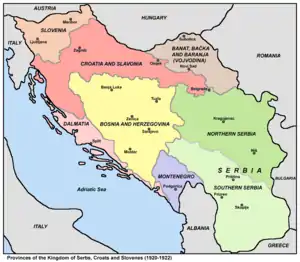
There were two main approaches to the method of unification of the South Slavs. While the Ante Trumbić-led Yugoslav Committee advocated a federal system of government, the Prime Minister of Serbia Nikola Pašić wanted a centralised state, [14] and threatened conquest and outright annexation of Serb-inhabited territories through fulfilment of plans to create Greater Serbia unless Trumbić accepted creation of a centralised state.[15] Under pressure from the Triple Entente, Pašić acquiesced to creation of a federal South Slavic state during the November 1918 conference in Geneva,[16] but the agreement was repudiated by Serbia either through pressure from Prince Regent Alexander,[17] or in a scheme devised by Pašić to deflect Entente pressure and undermine Korošec's authority to achieve his political objectives.[18]
Shortly after the conclusion of the Geneva conference, the National Council announced it had thwarted an attempted coup d'état in what became known as the Lipošćak affair and arrested General of the Infantry Anton Lipošćak.[19] The National Council was also under pressure caused by the advancing Italian Army which seized Rijeka and approached Ljubljana.[20] Having no means to stop thir advance, the National Council feared that the Italian presence on the eastern shores of the Adriatic would become permanent.[21] Pressed by the combined threats, the National Council dispatched a delegation to Prince Regent to arrange urgent unification in a federation. The delegation ignored the instructions regarding demanding constitutional safeguards when it addressed the Prince Regent on 1 December. The Prince Regent accepted the unification offer on behalf of Peter I of Serbia,[22] and the Kingdom of Serbs, Croats and Slovenes was established without any agreement on the conditions of the union.[23]
Armed forces in Zagreb
The National Council first formally established the National Guard on 27 October 1918 as its armed force. The move was made in preparation of the Croatian Sabor meeting which declared secession from Austria-Hungary two days later. It consisted of volunteers drawn through university guard organisation and Croatian and Serb Sokol associations. It was subordinated to the Commission for Public Order and Security in Zagreb headed by Budislav Grga Angjelinović and directly commanded by Lav Mazzura. The force was augmented by a detachment of former Austro-Hungarian Navy sailors.[24] Attempts to organise the National Guards in the countryside to combat civil disorder proved ineffective.[9]
The State of Slovenes, Croats and Serbs formally established its military on 1 November, three days after establishment of the state. The process meant taking over previously Austro-Hungarian units based in the territory of the new state. On 6 November the 25th Regiment of the Royal Croatian Home Guard and the 53rd Regiment of the Common Army based in Zagreb swore an oath of allegiance to the National Council. The council deemed the soldiers returning from the war after that date also bound by the same oath.[25] The 25th Regiment had just returned from fighting in to capture Međimurje on behalf of the National Council, and both regiments maintained security in Zagreb without incident. Nonetheless, support for a republic was present among the soldiers based in Zagreb – spreading under influence of Radić and returnees from Russia in the aftermath of the October Revolution.[26] In early December 1918, the 25th Regiment commanded by Colonel Milivoj Kućak[27] had 210 officers and 578 soldiers stationed in Zagreb barracks of the Royal Home Guard in the Ilica Street, while the 53rd Regiment had 442 troops stationed in the city, in the Rudolf barracks.[28] The 53rd Regiment was commanded by Colonel Mirko Petrović.[29] There was also the 37th Field Artillery Regiment of the former Common Army and the 6th Field Artillery Regiment of the Home Guard stationed in the city.[30] The 37th Field Artillery Regiment had 22 officers and 142 soldiers, while the 6th Field Artillery Regiment had 46 officers and 21 soldiers in Zagreb.[31] The National Council-established National Guard had about 500 armed members in Zagreb at the time,[32] augmented by a 1254-strong regiment composed of former Serbian Army prisoners-of-war.[33] In November, Lieutenant Colonel Dušan Simović was assigned to Zagreb as the envoy of the Serbian Army,[34] and the 3rd Battalion of the 7th Regiment of the Serbian Army arrived in Zagreb by the end of the month.[35]
Prelude
On 3 December, the National Council promulgated the Unification Act.[36] Together with Zagreb local authorities, it sponsored several public celebtratory events to mark the occasion. They were meant to match the mass celebrations of declaration of independence of the State of Slovenes, Croats and Serbs from Austria-Hungary from late October. According to historian Rudolf Horvat, the festivities were organised carelessly and there were instances of provocative behaviour offending "everything held dear and sacred by the Croatian people". The same day, there were reports from the nearby town of Bjelovar that the army troops stationed there were mutinous after announcement of the unification. It was reported by a National Council representative in the town that the soldiers could be heard shouting slogans against the King and cheering on the idea of a republic.[37] After the unification was announced to the troops stationed in Zagreb barracks, Kućak and Petrović informed the deputy defence commissioner of the National Council Nikola Winterhalter of the pro-republican mood in their units.[38]
Seizing on widespread disenchantment with the process of South Slavic unification, the Party of Rights drew up and started distributing a proclamation condemning the process of unification as undemocratic on 2 December.[36] The proclamation was published two days later in party's daily Hrvatska (Croatia), stating the Party of Rights would continue to advocate unification of free and independent states of Slovenes, Croats, and Serbs in a federal republic. In response, the authorities confiscated the issue and banned Hrvatska. The party distributed the manifest as a leaflet instead.[39] In the morning of 5 December, a Te Deum service was held in the Zagreb Cathedral as a part of celebration of establishment of the Kingdom of Serbs, Croats and Slovenes.[28]
Timeline
From barracks to the Ban Jelačić Square
In the afternoon of 5 December some soldiers of the 53rd Regiment left the Rudolf barracks in the west of Zagreb and set out towards the Ban Jelačić Square.[28] En route, they stopped before the Home Guard Barracks in Ilica Street where a part of the soldiers of the 25th Regiment joined them.[40] In addition to rifles, the soldiers took two machine guns from each barracks with them.[41] The soldiers were joined by a number of civilians.[25] They intended to declare a free Croatian republic, spurred on by perceived provocative behaviour at celebrations of unification.[37] According to initial reports issued by authorities in Zagreb, the march to the central city square involved about 200 soldiers of the two regiments, accompanied by twelve-strong military band of the 25th Regiment.[28] Subsequent indictment for the act of mutiny specified 250 participants, but the actual number is likely to be about 400 – about 200 drawn from each regiment.[42]
Protesting the unification with Serbia,[36] the soldiers were carrying a flag of Croatia,[43] walking down Ilica Street and shouting "Long live the republic!", "Long live Radić!", "Down with King Peter!", "Down with the dynasty!", "Long live the peasant party!", "Down with militarism!",[37] "Long live Croatian republic!", and "Long live Bolshevik republic!". Authorities later also reported that the demonstrators called out for release of General Lipošćak.[44] It remains unclear if the soldiers were protesting against the unification itself or the method it was carried out. The degree in which the protest was influenced by widespread poverty and anarchy in the country and by Italian intelligence services remains unclear.[45]
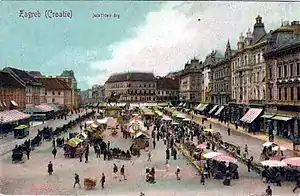
Most sources agree that the protesting soldiers reached Ban Jelačić Square at 2 p.m.[46] Some troops loyal to the government were deployed at the end of Ilica to prevent people from entering the square, but they quickly gave way.[27] Upon reaching the square, the soldiers of the 25th and the 53rd regimetns set up two machine guns at the centre of the square, and two at the start of Ilica – near the Gajeva Street and Oktogon respectively.[47] The military band took position at the square near the Duga Street (Radićeva Street today) and played Lijepa naša domovino.[48]
Armed clash on the square
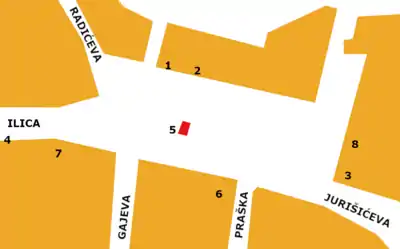
The authorities were informed about the planned protest at the latest at 11:30 a.m. on the day of the protest,[49] and cleared the square of people before the soldiers arrived.[50] Armed National Guardsmen and Sokol volunteers were waiting for the soldiers and civilians who joined the protest en route at the square, taking cover in the surrounding buildings.[46] According to contemporary government reports, there were 60 National Guardsmen deployed on the north side of the square, in House Popović (then at number 4, the numbers have changed since) and at house number 6 – with a machine gun set up in each building. According to that report, 20 troops were at the House Popović, while the rest, together with Angjelinović, took up positions at the other building.[51] In 1926, Sergeant Dragutin Mačuka attached to the intelligence service of the National Defence Department of the National Council testified about his participation in the events. According to Mačuka, the government deployed 160 troops (National Guards and Sokol volunteers) to the square. The headquarters were set up in the house at number 6 with additional troops at the House Popović and the House Feller (at number 21, at the corner of the Jurišićeva Street) on the east side of the square.[52] Mačuka's claim of the force size is supported by testimony of a Sokol volunteer, Branko Kojić – who said 60 Sokol volunteers and 100 National Guardsmen were deployed.[53] First there were brief negotiations.[46] According to witness statements, Kućak accompanied by Lieutenant Colonel Slavko Kvaternik arrived to the House Popović and attempted to calm the situation down. According to Kvaternik, they persuaded Mazzura to tell the National Guardsmen in that house not to fire. Kvaternik's statement is contradicted by others who identified civilian Zdravko Lenac as the person in command of the National Guardsmen at the House Popović.[54]
According to trial testimony, the soldiers of the 25th and the 53rd regiments captured the House Popović and the machine gun placed there. There was some confusion in various testimonies if the second machine gun was placed at a balcony of the adjacent house (number 5) or at the house number 6[lower-alpha 1] as indicated in official contemporary reports. The witnesses agree that the soldiers moved from the House Popović to capture another machine gun, but they were stopped in that second building as a gunfight erupted inside, and the machine gun fired on soldiers in the square.[56] A later inspection of bullet pockmarks left on facades revealed that the house number 6 was the main target of the soldiers' fire, and other testimonies placed Angjelinović in that house, commanding the machine gun crew to fire on the soldiers.[57] Kvaternik and other witnesses indicated that there was a third machine gun firing at the soldiers in the square. According to those testimonies, it was placed in the House Feller and shots fired from that building killed a soldier manning a machine gun set up by the mutineers at the foot of the Josip Jelačić monument on the square.[58][59] In his 1947 testimony, Kvaternik said the National Guards had a machine gun set up on the south side of the square at the house number 27 at the corner of present-day Praška Street, but no other source supports that claim.[58]
The skirmish ended at about 3 p.m.[46] Most of the protesters scattered and fled, but some survivors were captured.[28] Eighteen people died in the gunfight or from suffered wounds. Those include two dead National Guardsmen (both were Sokol members), and an unidentified Serbian soldier who was, according to Simović, accidentally found at the scene and not an active participant in the clash.[60] Initial government reports specified four civilians were killed, but identified the two killed National Guardsmen as two of the four dead civilians.[61] On 7 December, Simović requested his superiors to deploy the rest of the 7th Infantry Regiment to Zagreb for security reasons.[62] Military prosecutor's and forensic experts' reports of 6 December indicated 15 killed and 13 wounded. Three of the injured died of their wounds after the report was published.[63] A subsequent trial identified Lance Corporal Rudolf Sentmartoni as the ringleader of the soldiers' protest, together with Sergeant Ivan Perčić, Corporal Martin Murk, an unnamed lance corporal in the 6th Field Artillery Regiment and an unidentified civilian. None of them were apprehended except Perčić who was sentenced to six years in prison.[64] There were erroneous reports of machine gun fire from the roof of House Gnezda nextdoor to the House Feller and of a machine gun placed atop a hospital (since replaced by 1 Ilica Street building).[65]
Legacy
The 25th and the 53rd regiments were disbanded on the evening of 5 December,[26] and the National Council used the clash and the Lipošćak affair to restrict participation of Croatian officers who previously served in the Austro-Hungarian armed forces in building of the new army as undependable.[44] On 10 December, the National Council disbanded all armed units formally under its command including all former Croat units within the Austro-Hungarian Army and Navy. On 10 Dcecember, it authorised a Serbian Army mission to establish new units to replace the disbanded ones.[66] The mission proceeded to establish new structures integrated with the rest of the new kingdom.[67]
On 5 December, the National Council imposed censorship and banned the last remaining opposition newspaper – the HPSS-published Dom.[68] The authorities also arrested Ivo Elegović and Vladimir Sachs Petrović as the leaders of the faction of the Party of Rights supporting republicanism known as the Frankists (named after Josip Frank). The Frankists sought to use the events of 5 December as evidence of Croat refusal to form a common state with Serbia and portrayed the soldiers' revolt as vindication of Frankists' political opposition to the Kingdom of Serbs, Croats and Slovenes. Anniversary of the event was subsequently used by the opposition as a counterweight to official celebrations of unification held every 1 December. The soldiers of the 25th and the 53rd regiments who died on the Ban Jelačić Square became referred to as the December Victims, and portrayed as martyrs for independence of Croatia.[26] Attempting to capitalise on perceived widespread opposition to the new union, the Frankists went on to establish emigré Croatian Committee designed to increase anti-Serb sentiment with the aim of having free elections in Croatian lands,[69] and emphasised that the Party of Rights, specifically Frankists, are championing the cause for which the December Victims fell.[70] The 5 December protest and killings contributed to the Frankists' efforts to develop a "Culture of Defeat" depicting the events of 1918 as a humiliation which must be avenged. This allowed the Frankist leaders in 1920s, notably Ante Pavelić to offer disgruntled people and forgotten former Austro-Hungarian officers a chance to "redeem" themselves for the humiliation through far-right Ustaše paramilitaries (and later Nazi collaborators).[71]
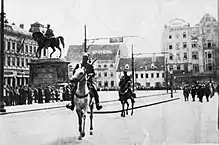
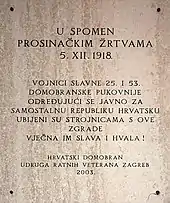
The two killed National Guardsmen were buried with honours at the Mirogoj Cemetery in Zagreb.[72] In 1932, the Croatian Woman Society launched an initiative to transfer bodies of the killed soldiers and civilians (not the National Guardsmen) from their individual graves at the Mirogoj to a common crypt.[73] The society built a monument to the killed at the cemetery,[74] but the transfer of remains was only allowed in December 1941 – after establishment of the Ustaše-ruled Independent State of Croatia (NDH) as a Nazi puppet state during the World War II.[73] On 26 August 1941, on orders by Pavelić, "600 revolutionaries" involved in the 5 December 1918 protest were declared a Reserve Battalion of the Ustaše Militia – originally set up as a ceremonial unit. The unit's name was subsequently renamed the Honor Battalion.[75] It was commanded by Ivan Perečić.[76] The NDH regime wanted to portray the December Victims as a symbol of resistance to the union with Serbia, but Nazi Plenipotentiary-General to the NDH Edmund Glaise-Horstenau complained that the event was essentially a communist affair.[77] In 1942, commemorative medals were authorised for participants of the protest and the right to wear them was awarded to 402 people (25 posthumously).[78] In 1943, a monument was erected at the Ban Jelačić Square to commemorate the 25th anniversary of the protest.[79] The Ban Jelačić Square was cleared of all monuments by 1947 when the equestrian monument to Josip Jelačić was removed.[80] A plaque was placed on the former House Feller (now number 11) at the Ban Jelačić Square in 2003 to commemorate the 1918 protest.[81]
Notes
- The house at number 6 is also variously referred to using names of its contemporary owners as the House Rosia-Fonsier, or former owners as House Gavella.[55]
References
- Ramet 2006, pp. 42–43.
- Matijević 2008a, p. 50.
- Matijević 2008a, pp. 56–59.
- Beneš 2017, p. 220.
- Beneš 2017, p. 217.
- Banac 1992, pp. 289–290.
- Banac 1992, pp. 296–297.
- Štambuk-Škalić & Matijević 2008, p. 108.
- Banac 1992, pp. 297–298.
- Banac 1984, p. 131.
- Janković 1964, pp. 251–252.
- Banac 1992, pp. 303–304.
- Banac 1992, p. 300.
- Pavlowitch 2003, pp. 33–34.
- Šepić 1968, p. 38.
- Janković 1964, pp. 246–247.
- Ramet 2006, p. 43.
- Banac 1984, pp. 134–135.
- Zorko 2003, pp. 892–895.
- Ramet 2006, p. 44.
- Pavlović 2019, p. 275.
- Ramet 2006, pp. 44–45.
- Pavlović 2019, p. 276.
- Gabelica 2005, p. 468.
- Gabelica 2005, p. 469.
- Newman 2015, p. 132.
- Gabelica & Matković 2018, pp. 180–181.
- Huzjan 2005, pp. 455–456.
- Gabelica & Matković 2018, pp. 121–122.
- Gabelica & Matković 2018, pp. 245–248.
- Gabelica & Matković 2018, p. 250.
- Gabelica & Matković 2018, p. 255.
- Gabelica & Matković 2018, p. 252.
- Zorko 2003, p. 893.
- Gabelica 2005, n. 11.
- Banac 1992, pp. 215–216.
- Martan 2016, pp. 23–24.
- Gabelica & Matković 2018, pp. 122–123.
- Matijević 2008b, p. 1116.
- Gabelica & Matković 2018, p. 137.
- Gabelica & Matković 2018, p. 190.
- Gabelica & Matković 2018, p. 186.
- Gabelica & Matković 2018, p. 139.
- Zorko 2003, p. 900.
- Gabelica 2005, pp. 469–470.
- Gabelica 2005, p. 470.
- Gabelica & Matković 2018, pp. 192–193.
- Gabelica & Matković 2018, p. 196.
- Gabelica & Matković 2018, p. 220.
- Gabelica & Matković 2018, p. 187.
- Gabelica & Matković 2018, pp. 156–159.
- Gabelica & Matković 2018, pp. 171–173.
- Gabelica & Matković 2018, p. 178.
- Gabelica & Matković 2018, pp. 166–167.
- Gabelica & Matković 2018, n. 423.
- Gabelica & Matković 2018, pp. 159–161.
- Gabelica & Matković 2018, pp. 170–171.
- Gabelica & Matković 2018, pp. 169–170.
- Gabelica & Matković 2018, p. 177.
- Gabelica 2005, pp. 475–476.
- Gabelica 2005, pp. 470–472.
- Gabelica & Matković 2018, p. 251.
- Gabelica 2005, pp. 474–475.
- Gabelica 2005, p. 474.
- Gabelica & Matković 2018, pp. 177–182.
- Banac 1984, p. 216.
- Ramet 2006, p. 49.
- Gabelica 2005, p. 472.
- Newman 2015, pp. 132–133.
- Newman 2018, p. 167.
- Newman 2018, p. 170.
- Gabelica 2005, p. 475.
- Gabelica 2005, p. 476.
- Newman 2015, p. 174.
- Geiger & Barić 2002, pp. 835–836.
- Geiger & Barić 2002, p. 837.
- Geiger & Barić 2002, p. 838.
- Geiger & Barić 2002, p. 842.
- Geiger & Barić 2002, p. 844.
- Mataušić 2001, p. 128.
- Plančić 2003.
Sources
- Banac, Ivo (1984). The National Question in Yugoslavia: Origins, History, Politics. Ithaca: Cornell University Press. ISBN 0-8014-1675-2.
- Banac, Ivo (1992). "'Emperor Karl Has Become a Comitadji': The Croatian Disturbances of Autumn 1918". The Slavonic and East European Review. London: Modern Humanities Research Association. 70 (2): 284–305. ISSN 0037-6795.
- Beneš, Jakub S. (2017). "The Green Cadres and the Collapse of Austria-Hungary in 1918". Past & Present. Oxford: Oxford University Press. 236 (1): 207–241. ISSN 0031-2746.
- Gabelica, Mislav (2005). "Žrtve sukoba na Jelačićevom trgu 5. prosinca 1918" [Victims of the Clash on Jelačić Square on December 5, 1918]. Časopis za suvremenu povijest (in Croatian). Zagreb: Croatian Institute of History. 37 (2): 467–477. ISSN 0590-9597.
- Gabelica, Mislav; Matković, Stjepan (2018). Petoprosinačka pobuna u Zagrebu 1918: prva vojna akcija protiv jugoslavenske države [Fifth of December Revolt in Zagreb in 1918: The First Military Action Against the Yugoslav State] (in Croatian). Zagreb: Naklada Pavičić P.I.P. ISBN 9789537949099.
- Geiger, Vladimir; Barić, Nikica (2002). "Odjeci i obilježavanja 5. prosinca 1918. u Nezavisnoj Državi Hrvatskoj" [Commemorations and Views About the December 5, 1918 Events During the Independent State of Croatia]. Časopis za suvremenu povijest (in Croatian). Zagreb: Croatian Institute of History. 34 (3): 833–850. ISSN 0590-9597.
- Huzjan, Vladimir (2005). "Raspuštanje Hrvatskog domobranstva nakon završetka Prvog svjetskog rata" [The Demobilization of the Croatian Home Guards After the End of the First World War]. Časopis za suvremenu povijest (in Croatian). Zagreb: Croatian Institute of History. 37 (2): 445–465. ISSN 0590-9597.
- Janković, Dragoslav (1964). "Ženevska konferencija o stvaranju jugoslovenske zajednice 1918. godine" [Geneva Conference on Creation of the Yugoslav Community in 1918]. Istorija XX veka [History of the 20th Century] (in Serbian). V. Belgrade: Institute of Legal History of the University of Belgrade Faculty of Law. pp. 225–262. OCLC 67000822.
- Martan, Željko (2016). "Nemiri u Hrvatskoj od proglašenja Države Slovenaca, Hrvata i Srba do Prosinačkih žrtava" [Riots in Croatia from the declaration of the State of Slovens, Croats and Serbs to the December victims]. Povijest u nastavi (in Croatian). Zagreb: Društvo za hrvatsku povjesnicu. 14 (27): 1–30. ISSN 1334-1375.
- Mataušić, Nataša (2001). "A gdje je spomenik banu?" [Where Is the Ban's Monument?]. Informatica museologica (in Croatian). Zagreb: Museum Documentation Centre. 32 (1–2): 127–129. ISSN 0350-2325.
- Matijević, Zlatko (2008a). "The National Council of Slovenes, Croats and Serbs in Zagreb (1918/1919)". Review of Croatian History. Zagreb: Hrvatski institut za povijest. 4 (1): 51–84. ISSN 1845-4380.
- Matijević, Zlatko (2008b). "Stranka prava (frankovci) u doba vladavine Narodnoga vijeća Slovenaca, Hrvata i Srba (listopad – prosinac 1918.)" [The Party of Right (Frankists) During the Rule of the National Council of the Slovenes, Croats, and Serbs (October–December 1918)]. Časopis za suvremenu povijest (in Croatian). Zagreb: Croatian Institute of History. 40 (3): 1105–1118. ISSN 0590-9597.
- Newman, John Paul (2015). Yugoslavia in the Shadow of War: Veterans and the Limits of State Building, 1903–1945. Cambridge: Cambridge University Press. ISBN 9781107070769.
- Newman, John Paul (2018). "Shades of Empire: Austro-Hungarian Officers, Frankists, and the Afterlives of Austria-Hungary in Croatia, 1918–1929". In Miller, Paul; Morelon, Claire (eds.). Embers of Empire: Continuity and Rupture in the Habsburg Successor States after 1918. New York: Berghahn Books. pp. 157–176. ISBN 9781789200232.
- Pavlović, Vojislav G (2019). "Italy and the Creation of Yugoslavia. Delenda Austria?". In Pavlović, Vojislav G. (ed.). Serbia and Italy in the Great War. Belgrade: Institute for Balkan Studies. pp. 245–278. ISBN 9788671791038.
- Pavlowitch, Kosta St. (2003). "The First World War and Unification of Yugoslavia". In Djokic, Dejan (ed.). Yugoslavism: Histories of a Failed Idea, 1918–1992. London: C. Hurst & Co. pp. 27–41. ISBN 1-85065-663-0.
- Plančić, Nikola (26 September 2003). "Otkrivena spomen ploča "prosinačkim žrtvama"" [Commemorative Plaque to December Victims Unveiled]. Nacional (in Croatian). ISSN 1330-9048. Archived from the original on 11 October 2021. Retrieved 11 October 2021.
- Ramet, Sabrina P. (2006). The Three Yugoslavias: State-building and Legitimation, 1918–2005. Bloomington: Indiana University Press. ISBN 9780253346568.
- Šepić, Dragovan (1968). "The Question of Yugoslav Union in 1918". Journal of Contemporary History. SAGE Publishing. 3 (4): 29–43. ISSN 0022-0094.
- Štambuk-Škalić, Marina; Matijević, Zlatko, eds. (2008). "Narodno vijeće Slovenaca, Hrvata i Srba u Zagrebu 1918–1919. (izabrani dokumenti)" [National Council of Slovenes, Croats and Serbs in Zagreb 1918–1919 (Selected Documents)]. Fontes : izvori za hrvatsku povijest (in Croatian). Zagreb: Croatian State Archives. 14 (1): 71–596. ISSN 1330-6804.
- Zorko, Tomislav (2003). "Afera Lipošćak" [The Lipošćak Affair]. Časopis za suvremenu povijest (in Croatian). Zagreb: Croatian Institute of History. 35 (3): 887–902. ISSN 0590-9597.