1985 Algarrobo earthquake
An earthquake that was registered 7.4 on the Richter scale struck Santiago Chile on March 4, 1985 and ended up killing 82 people and injuring about 2,000 other. This earthquake was not a short felt one nor a minor one as, "The earthquake shook an 800-mile- long stretch of Chile, which hugs South America's southern Pacific coast. People across the Andes Mountains in Argentina, especially in cities in the foothills, also felt the quake"(Press, The Associated).[2] This earthquake was being felt between the northern Antofagasta Region and the southern Araucaria Region, meaning that central Chile felt most of the power from the earthquake. This power and damage correlates with its rating on the Mercalli intensity scale as the earthquake was felt with a, "Maximum intensity of VIII in the Mercalli intensity scale"(Press, The Associated).[2]
 | |
   | |
| UTC time | 1985-03-03 22:47 |
|---|---|
| ISC event | 529084 |
| USGS-ANSS | ComCat |
| Local date | 3 March 1985 |
| Local time | 19:47 UTC-3 |
| Magnitude | 8.0 Mw[1] |
| Depth | 33.0 km (20.5 mi) |
| Epicenter | 33.135°S 71.871°W |
| Areas affected | Chile |
| Max. intensity | VIII (Severe) |
| Landslides | Yes |
| Casualties | 177 dead, 2,575 injured |
Damage and effects
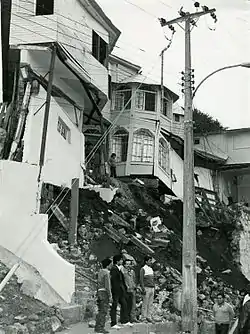
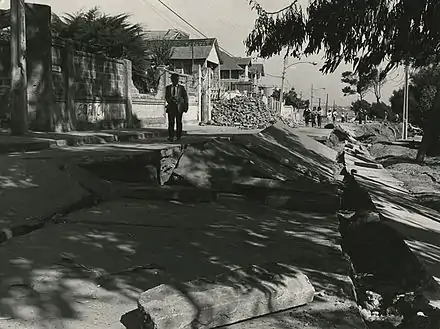
The quake left 177 people dead, 2,575 injured, 85,358 houses damaged or destroyed and about a million people homeless.[3] Many landslides were registered too, pavement breaks with the destruction of Pan-American highway in several points, broken-down bridges and considerable damage in affected town's infrastructure, with a long interruption on basic services. The damage was valued in more than 1 billion US dollars.[4]
| Region | Deaths | Injuries | Homeless | Houses | |||
|---|---|---|---|---|---|---|---|
| Refugees | Non-refugees | Total | Destroyed | Minor damage | |||
| Valparaíso | 68 | 923 | 3849 | 252 800 | 256 649 | 17 257 | 28 242 |
| O'Higgins | 28 | 254 | 322 | 190 144 | 190 466 | 6661 | 12 374 |
| Maule | 2 | 60 | 7 | 43 411 | 43 418 | 2079 | 5549 |
| Santiago | 80 | 1338 | 7936 | 488 075 | 496 011 | 59 361 | 63 814 |
| Total | 178 | 2575 | 12 114 | 974 430 | 986 544 | 85 358 | 109 979 |
Reports by local residents in the coastal area from Matanzas to several kilometers north of Algarrobo indicated unusually low tides for a period of 3 to 5 days following the earthquake. After this, the tides reportedly returned to normal. This suggests that there was earthquake-related uplift along parts of the coast which was recovered in 3 to 5 days after the earthquake. Near Algarrobo, an estimate of the change is about 20 cm uplift. [2]
Tectonic Setting
The earthquake that occurred on March 4, 1985 was not a unique event nor is it an event that will not take place again. The reason behind this is because Chile lies on the boundary between the Nazca plate of the South Pacific continental plate. This causes Chile to be one of the most seismically active regions in the world, meaning that Chile will continue to face earthquakes that are above 6 on the Richter scale, "It can be seen that on average, a magnitude 8 earthquake or greater (classified as a great event) occurs in the region about once every 25 years"(CA, Taylor. The Institution of Structural Engineers – IStructE). Meaning that there is an expectation that a similar earthquake will happen in Chile in the future every 25 years. The main shock was actually made up of at least two shocks, with the initial motion beginning at approximately 11:00 PM followed by a greater event soon after. The magnitudes of the first and second shocks were calculated to be 5.2 and 6.9 respectively. The calculated proportion of energy released as aftershocks vs the main shock was relatively high, most likely due to the M=7.2 Aftershock on April 9th following the event.
Location & Time
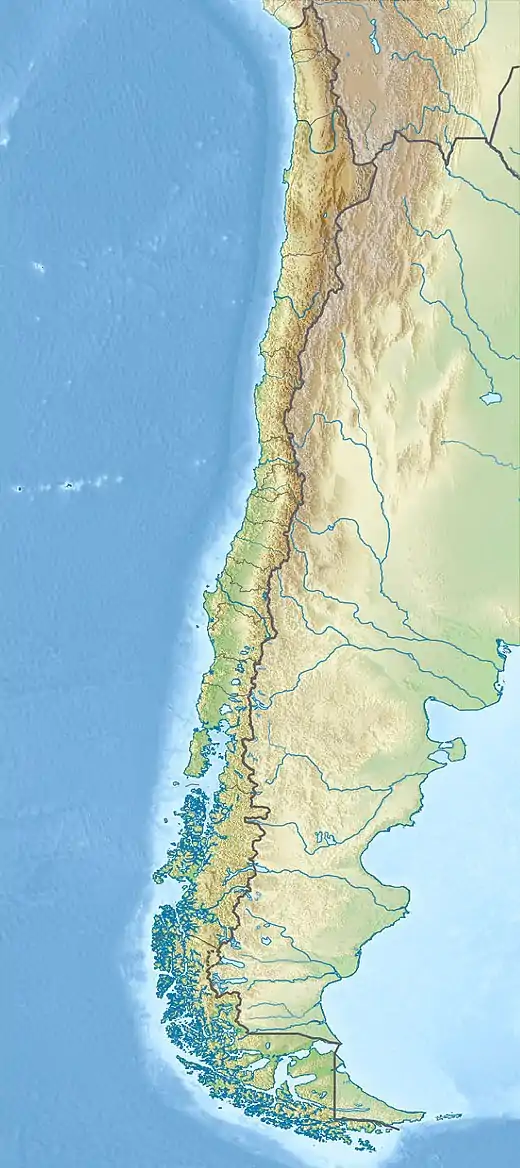
The 1985 Algarrobo earthquake occurred on 3 March at 22:47 UTC (19:47 local time). Its epicenter was located on the south coasts of Valparaíso Region, Chile, close to the beach of Algarrobo.
Scientific Understanding
The 1985 Algarrobo earthquake was seen as a particular powerful earthquake that garnered the attention of the United States, as they sent a team of geologists to study the effects of the earthquake and the overall information that could be gained from studying the earthquake could give better understandings overall of these powerful earthquakes. This earthquake in particular was considered extremely important in the understanding of earthquakes as, "The earthquake was very significant as a geophysical event and that the scientific and engineering study of this major shock would be of great value in improving' our understanding of plate margin earthquakes, the distribution of strong ground motion, resulting building damage and geologic effects such as soil liquefaction and landsliding"(Algermissen, S. T. “USGS.”). The 1985 Algarrobo earthquake shows a clear example of how these types of natural phenomenon can be studied and be used to better help humanity in the future in order to minimize the damages to both infrastructure and human lives. The precautions that Chile takes now in order to mitigate future risks is to educate its citizens in drills on how to react, having better building codes, and studying seismic data, this is stated by seismologist Dr.Sergio Barrientos, "Authorities of Chile have put this problem in the right perspective and have been establishing the right and proper tools to provide more information to citizens and to provide better safety conditions for communities by teaching, and, as I told you, by means of drills"(Welle (www.dw.com))[5].
References
- Servicio Sismológico Universidad de Chile, Sismos importantes o destructivos desde 1570 Archived 29 June 2012 at archive.today
- Press, The Associated (4 March 1985). "A QUAKE IN CHILE KILLS AT LEAST 82 AND INJURES 2,000". The New York Times. ISSN 0362-4331. Retrieved 1 December 2021.
- Pinochet, Augusto (11 September 1985). "Mensaje Presidencial: 11 de septiembre de 1984-11 de septiembre de 1985". Memoria Chilena.
- El Mercurio, Grandes terremotos en Chile
- Welle (www.dw.com), Deutsche. "Earthquake preparedness: What can we learn from Chile? | DW | 16.11.2020". en-GB. Retrieved 30 November 2021.
Further reading
- Bravo, F.; Koch, P.; Riquelme, S.; Fuentes, M.; Campos, J. (2019), "Slip Distribution of the 1985 Valparaíso Earthquake Constrained with Seismic and Deformation Data", Seismological Research Letters, doi:10.1785/0220180396
External links
 |
Wikimedia Commons has media related to 1985 Santiago earthquake. |
- The International Seismological Centre has a bibliography and/or authoritative data for this event.
Authority control: National libraries  |
|---|