1st Lithuanian Dragoon Regiment
1st Lithuanian Dragoon Regiment was a Lithuanian dragoon regiment in service of the Kingdom of Prussia, which was formed in 1717. It was disbanded 202 years later, in 1919. This regiment was one of the eldest in the whole Prussian army. The regiment was recruited almost exclusively from volunteers from its immediate homeland, i.e. Lithuania Minor, and was well reputed in the army at all times for having the best horses and riders.[1] In the memoirs of the inhabitants of Lithuania Minor it is written that they were proud of serving in this regiment.[2]
| 1st Lithuanian Dragoon Regiment | |
|---|---|
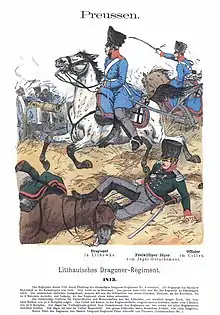 Lithuanian Dragoons in 1813 | |
| Active | 1717-1919 |
| Country | Kingdom of Prussia |
| Type | Dragoons |
18th century
On 19 April 1717, King Frederick William I of Prussia ordered major general Heinrich Jordan von Wuthenau to form a regiment from 780 Saxon cavalrymen and dragoons, which Augustus II the Strong gifted the Prussian King. Already in May, von Wuthenau divided the regiment into eight companies.[1] The uniform consisted of a white coat with light blue embroidering, because of which the regiment was called the "Porcelain regiment". In December, the regiment was ordered to march to Įsrūtis, Tilžė, Ragainė, Geldapė, Stalupėnai and Pilkalnis. In 1718, the whole regiment was assembled in its entirety to a single place for military exercise in Įsrūtis and by the August of that year, the regiment already had ten companies. In 1725, it was established that every company would have 110 dragoons, and each company was renamed to squadrons.
When general von Wuthenau died in 1727, the regiment was divided in two regiments, which were that of von Cosel and von Dockum. The regiment von Cosel maintained the same uniform and was assigned all of the same garrisons except Tilžė. The dragoon regiment von Dockum remained in Tilžė with its five squadrons and received white coats with red embroidering. After a year, the regiment received silver timpani. The dragoon regiment von Dockum was later called the 7th Dragoon regiment.
In the period between 1734 and 1746, the regiment was often relocated to various places such as Berlin, Magdeburg, Potsdam ir Tilžė. Finally, in 1746, Tilžė was established as the regiment's permanent garrison.
First Silesian War (1740-1742)
During the First Silesian War, the regiment fought in the Battle of Chotusitz with the Imperial and Royal von Birkenfeld Cuirassier regiment. The dragoon regiment's Leibstandarte was lost when the enemies grenadiers seized it from the seriously wounded junker von Roop. The regiment lost four officers and 152 soldiers, with six officers and 71 soldiers being wounded. In addition, three officers and 280 soldiers were made prisoners of war.
Second Silesian War (1744–1745)
During the Second Silesian War, adjutant lieutenant von Blankenburg lost the timpani and flag in the skirmish near Niederzehren. However, in the battle of Kesselsdorf, the dragoon regiment attacked the Saxon Karabiniers-garde and mounted grenadiers. The Lithuanian dragoon regiment defeated the Saxon Foot Guard and also the Saxon infatry regiment Niesemeuschel. The victorious regiment took away the flags of both of these regiments. In addition, the regiment seized the flag and silver timpani of the Saxon Karabiniers-garde.
19th century
Napoleonic wars
After the Treaties of Tilsit and the cabinet's order of 14 September 1808, regiments were no longer named after their commanders. During the Prussian Army's reorganization, the regiment was initially called the East Prussian Dragoon Regiment (Ostpreußisches Dragoner-Regiment), and after the cabinet's order of 14 September 1808, the regiment was called the 3rd Dragoon Regiment. The Lithuanian Dragoon Regiment was at first established in Tilžė and Įsrūtis.
Two of the regiment's squadrons were made part of the 1st Mobile Dragoon Regiment, which was part of Yorck's Auxiliary Prussian Corps. This Corps fought on Napoleon's side in the French invasion of Russia in 1812. Later, the regiment fought in Germany and France in 1813 and 1814.
After the Napoleonic wars
Circa 1815–1816, the regiment's soldiers were dispersed into other parts of the Prussian Kingdom, i.e. Berlin, Demmin or Tilžė. In between 1860 and 1866, the regiment was garrisoned in different parts of East Prussia, e.g. Įsrūtis or Ragainė. Finally, from 1879, the regiment was located only in Tilžė.
20th century
World War I
Even until the end of the First World War, the signs outside the soldiers' barracks were in Lithuanian and German languages.[3]
Legacy
A statue commemorating the regiment's fallen soldiers was built after World War I.[3]
References
Sources
- Rėklaitis, P. (November 1968). "Mažosios Lietuvos Dragūnų Pulkas". Karys (in Lithuanian). 9: 307–311.
- Jakužaitis, Hermanas, ed. (1952). "Prūsų Lietuvių Pulkai ir Batalionai". Keleivis (in Lithuanian). 1–2: 7.
- Goetzke, Harry (2003). "Das Dragoner-Regiment Prinz Albrecht von Preußen (Litthauisches) Nr. 1 in Tilsit". Tilsiter Rundbrief (in German). 33. Archived from the original on 2014-01-17.
- "Die neuen preußischen Regimenter 1808 - 1918 ; Dragoner" (in German). Archived from the original on 6 July 2005.