2011 Colombian student protests
The 2011 student protests in Columbia consisted of a series of demonstrations led by students, some teachers, university employees, and unions, starting on October 12th. These demonstrations took place throughout the Columbian territory in protest against the draft of the Higher Education Reform Project presented by the National Government to the Congress of the Republic in October of 2011. [1]

Student leader Jairo Rivera have claimed that Colombian education is drifting toward "the Chilean model" something he warned against and said that "the Chilean model is the one to not follow".[2]
2011 Colombian student protest and 2011 Chilean student protests leaders have announced a joint bi-national student protest for November 24 of 2011.[3] Chilean newspaper The Clinic have pointed out that these two student protests have in common that they broke out in the only two South American countries ruled by right-wing presidents.[2]
Causes and antecedents
Proposal for the reform of higher education
The Higher Education Reform Project presented by the government of Juan Manuel Santos and his Minister of Education, María Fernanda Campo, aimed to modify Law 30 of 1992, which regulates higher education in Columbia. The draft was presented for the first time in front of the deans of some universities on March 10th, 2011, and in the following months it circulated throughout the community of universities.[4] The proposal included various points that didn’t sit well with the teachers’ union who alleged that the reform didn’t guarantee the right to an education, since it didn’t offer universities the resources necessary to operate.[5]
For-Profit Universities
3,606,532 high school graduates in Columbia were not admitted into college between 2001 and 2010. To solve this problem, the reform proposal considered the creation of for-profit universities. This was the aspect of the proposal that caused the most upset among the community of universities. They argued that, while the enrollment numbers have increased in countries where this model was implemented, like Brazil, the collateral effect has been a severe diminution of the quality of the institutions.
Faced with the proposal of for-profit universities, the student movement began the organization of multiple demonstrations on the national territory. Among these was the massive march of April 7th. These initial demonstrations led to the government’s discontinued interest in creating for-profit universities on August 23rd, however the proposal for reform continued provoking rejection from the community of universities.
Educational Credits
The draft of the law considered a major investment in student loans through the Columbian Institute of Student Loans and Technical Studies Abroad. These loans would be paid by the beneficiaries once they finish their studies and enter the workforce, with the possibility of debt forgiveness for outstanding grades.
This aspect of the proposal was criticized by the community of universities, considering it was detrimental to public education and only favored the private universities who receive the students with loans. In addition, the reform permitted coercive collection in order to guarantee debt payment acquired by the students.
Other Contested Issues
The draft for the reform of higher education also aimed to:
- Establish economic autonomy for the public universities, while the university autonomy would continue to be compromised given that the school board would be primarily composed of outside stakeholders.
- Establish the same legislation for universities and higher education institutions, requiring that they offer careers and courses in a flexible manner, regardless of their denomination.
- Make it possible to declare Corporate Insolvency in state and private institutions.
- Establish the rationalization and optimization of human, physical, technical, and financial resources as a primary objective of state universities.
- Apply the administrative system of private institutions to the mixed higher education institutions.
- Permit the formation of teacher unions for hourly workers.
- Permit the government to allocate public resources to private universities.
- Allow each higher education institution to determine their own protocol for imposing sanctions of any type, from warnings to suspensions and expulsions.
- Diversify the funds that the state institutions of higher education should provide, forcing them to compete for public resources and sustain themselves through service sales and tuition increases.
- Establish deadlines for the improvement of the quality and services in the higher education institutions in order to either approve or deny their nomination.
- Increase the enrollment capacity in public and private institutions of higher education.
- Temporarily limit the resources allocated to state institutions of higher education, keeping in mind the increase of the GDP and its repercussions.
The March of April 7th
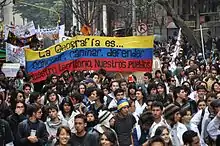
On April 7th, 2011 the first large protest of unions, teachers, and students took place during the governance of Juan Manuel Santos; during which they demanded better salaries for teachers, pensioners, and employees, as well as improvements in labor and trade union rights. They also rejected the reform of higher education presented by the government, the National Plan of Development from 2010-2014, the privatization of the Telecommunications Company of Bogotá, the Initial Employment Law , the fiscal sustainability, Law 100 of 1993, and the Free Trade Agreements.
The marches developed over a large part of the national territory and more than one hundred organizations participated: all of the public universities, some private universities, the Trade Union Association of University Professors, some public and private high schools, the World Organization of Students (WOS), the Columbian Student Organization, the Federation of University Students, the Association of Columbian University Students, the National Student Identity Process, the Red Revolt, the National University Federation, the Student Union (Six Columbia), the Red Independents, the Collective Critical Thought, and a number of student groups, in addition to the Central Workers Union, the Columbian Federation of Educators, the Workers Union of the Telecommunications Company of Bogotá (SINTRATELÉFONOS), and the workers of the Aqueduct and Sewer Company of Bogotá, among others.
The marches developed across the country and more than one hundred organisations participated including:
- All public universities
- Some private universities
- World Organisation of Students (Organización Mundial de Estudiantes-OME)
- Colombian Organisation of Students (Organización Colombiana de Estudiantes-OCE)
- Federation of University Students (Federación de Estudiantes Universitarios-FEU)
- Colombian Association of University Students (Asociación Colombiana de Estudiantes Universitarios-ACEU)
- National Student Identity Process (Proceso Nacional Identidad Estudiantil)
- Revolt Network (Red Revuelta)
- National Federation of Universities (Federación Universitaria Nacional-FUN)
- The Student Union (Sies Colombia)
- The Independent Network (La Red Independientes)
- The Critical Thought Collective (el Colectivo Pensamiento Crítico)
- Central Union of Workers (Central Unitaria de Trabajadores-CUT)
- Colombian Federation of Educators (Federación Colombiana de Educadores-FECODE)
- Trade Union of ETB Workers (SINTRATELÉFONOS)
- The workers of the Bogota Bureau of Aqueducts and Sewage (Empresa de Acueducto y Alcantarillado de Bogotá-EAAB)
- Numerous student collectives
See also
References
- "Reforma a la Ley de Educación Superior ya está en el Congreso para su trámite". Semana (Colombia). October 3, 2011. Retrieved November 18, 2011.
- “El modelo chileno es el ejemplo a no seguir”, The Clinic. October 18th, 2011.
- Estudiantes rechazan negociaciones entre gobierno y oposición y ratifican marcha binacional, La Tercera
- Espectador, El (2011-03-11). "ELESPECTADOR.COM". ELESPECTADOR.COM (in Spanish). Retrieved 2021-10-08.
- Espectador, El (2011-08-25). "ELESPECTADOR.COM". ELESPECTADOR.COM (in Spanish). Retrieved 2021-10-08.