2020s in European political history
The political history of Europe during the 2020s covers political events on the continent from 2020 onwards.
General history
During the early 2020s, a major concern was the pandemic of Covid-19, and different concerns and restrictions, as countries sought ways to prevent or limit the spread of the disease.
History by country
Austria
The Greens became a governing party for the first time in January 2020 as part of a coalition deal with the right-wing Austrian People's Party.[1] On 6 October 2021, Austrian anti-corruption prosecutors conducted a raid on the offices of Federal Chancellor Sebastian Kurz, the headquarters of the Austrian People's Party and the Federal Ministry of Finance.[2] Kurz has been accused of embezzlement and bribery, along with nine high-profile politicians and newspaper executives.[2] As a result of the raid, Kurz has sustained heavy criticism from his junior The Greens, as well as the opposition.[3] On 9 October 2021, Kurz announced his resignation,[4] with Alexander Schallenberg to serve as his replacement.[5] As a result of the resignation, Kogler announced his intention to continue the governing coalition.[5]
Belarus
The 2020 Belarusian presidential election was held on Sunday, 9 August 2020. Early voting began on 4 August and ran until 8 August.[6] Incumbent Alexander Lukashenko was reelected to the sixth term in office, with official results crediting him with 80% of the vote. Lukashenko has won every presidential election since 1994,[7] with all but the first being labelled by international monitors as neither free nor fair.[8]
Opposition candidate Sviatlana Tsikhanouskaya claimed to have won a decisive first-round victory with at least 60% of the vote, and called on Lukashenko to start negotiations. Her campaign subsequently formed the Coordination Council to facilitate a transfer of power and stated that it was ready to organize "long-term protests" against the official results.[9][10] All seven members of the Coordination Council Presidium were subsequently arrested or went into exile. Numerous countries refused to accept the result of the election, as did the European Union, which imposed sanctions on Belarusian officials deemed to be responsible for "violence, repression and election fraud".[11]
The largest anti-government protests in the history of Belarus began in the lead-up to and during the election. Initially moderate, the protests intensified nationwide after official election results were announced on the night of 10 August, in which Lukashenko was declared the winner. Following the forced landing of Ryanair Flight 4978 to arrest opposition activist and journalist Roman Protasevich and his girlfriend Sofia Sapega, the European Union agreed to ban EU-based airlines from flying through Belarusian airspace, to ban Belarusian carriers from flying into EU airspace, and to implement a fresh round of sanctions.[12]
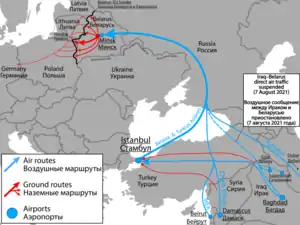
The 2021 Belarus–European Union border crisis was a migrant crisis manifested in a massive influx of Middle Eastern and African migrants (mainly from Iraq) to Lithuania, Latvia, and Poland via those countries' borders with Belarus. The crisis was triggered by the severe deterioration in Belarus–European Union relations, following the 2020 Belarusian presidential election, the 2020–2021 Belarusian protests, the Ryanair Flight 4978 incident, and the attempted repatriation of Krystsina Tsimanouskaya. The three EU nations have described the crisis as hybrid warfare by human trafficking of migrants, waged by Belarus against the European Union, and called on Brussels to intervene.[13][14]
Belgium
The foreign minister Sophie Wilmès was treated in intensive care after contracting COVID-19 in November, 2020.[15]
Bulgaria
The 2020–2021 Bulgarian protests were a series of demonstrations held in Bulgaria, mainly in the capital Sofia, as well as cities with a large Bulgarian diaspora, such as Brussels,[16] Paris,[16] Madrid,[16] Barcelona,[16] Berlin[16] and London.[16] The protest movement was the culmination of long-standing grievances against endemic corruption and state capture, particularly associated with prime minister Boyko Borisov's governments, in power since 2009.
Snap parliamentary elections were held in Bulgaria on 11 July 2021 after no party was able or willing to form a government following the April 2021 elections.[17] The populist party There Is Such a People (ITN), led by musician and television host Slavi Trifonov, narrowly won the most seats over a coalition of the conservative GERB and Union of Democratic Forces parties. ITN's success was propelled primarily by young voters.
Estonia
Kaja Kallas became the first female Prime Minister after the previous government fell after a corruption scandal.[18]
France
The murder of Samuel Paty reignited the controversy surrounding depictions of Muhammad, and was followed by the 2020 Nice stabbing committed by another jihadist, as well as a far-right attack in Avignon on the same day.[19] Before the attacks, the Charlie Hebdo depiction had been republished on September 1, and the trial over the Charlie Hebdo shooting in 2015 had begun on September 2.[20] There had also been a second attack on Charlie Hebdo's former headquarters in Paris on September 25, and on October 2, President Emmanuel Macron had called Islam a 'religion in crisis'.[20] Following Macron's remarks, the Turkish president Recep Tayyip Erdoğan suggested he needed "mental treatment", leading France to withdraw its ambassador.[21] Saudi Arabia and Iran condemned France, while tens of thousands marched against in protest in Bangladesh.[22] The French government demanded that the representative body for the religion in the country accept a 'charter of republican values', rejecting political Islam and foreign interference, as well as establishing a system of official licenses for imams.[23] Overseas, the French military intervention in the Sahel continued fighting against the Islamic State in the Greater Sahara.[24]
The former president Nicolas Sarkozy was charged with corruption in 2020.[25] Sarkozy, was found guilty in 2021 and sentenced to three years in jail for corruption.[26][27] Two years of this sentence are suspended, and one to be served in prison.[27]
On 17 September 2021, Macron and his foreign minister Jean-Yves Le Drian recalled the French ambassadors to the U.S. and Australia after the formation of the AUKUS defense technology between the U.S., Australia, and UK (from which France was excluded). As part of the 2021 security agreement, the U.S. decided to provide nuclear-powered submarines to Australia, to counter China in the Pacific and Indo-Pacific region, and Australia canceled a US$66 billion (A$billion) deal from 2016 to purchase twelve French-built conventionally powered (diesel) submarines.[28][29][30] The French government was furious at the cancellation of the submarine agreement and said that it had been blindsided, calling the decision a 'stab in the back'.[28][29][30] On September 22, Biden and Macron pledged to improve the relationship between the two countries.[31]
Greece
Following a surge of migrant arrivals from Turkey, Greece suspended all asylum applications in March 2020.[32] The freeze was lifted a month later.[33]
The 2021 Greek protests broke out in response to a proposed government bill that would allow police presence on university campuses for the first time in decades.
Italy
During the 2021 Italian government crisis, the Conte II Cabinet fell after Matteo Renzi, leader of Italia Viva (IV) and former Prime Minister, that he would revoke IV's support to the government of Giuseppe Conte.[34] On 18 and 19 January, Renzi's party abstained and the government won the key confidence votes in the Chamber and in the Senate, but it failed in reaching an absolute majority in the Senate.[35] On 26 January, Prime Minister Conte resigned from his office, prompting President Sergio Mattarella to start consultations for the formation of a new government. On 13 February, Mario Draghi was sworn in as Prime Minister, leading to the Draghi Cabinet.[36]
Ireland
The 2020 Irish general election resulted in a historic win for the Sinn Féin, making it the second largest party of the Dáil Éireann.[37] The result was seen as a historic shift in Ireland's political landscape, effectively ending the two-party system of Fine Gael and Fianna Fáil.[38] The reason for the electoral upset for these parties was believed to be in voter dissatisfaction on issues of health, housing and homelessness.[39] Sinn Féin won 37 seats, Fianna Fáil won 38, and Fine Gael won 35.[40] Seán Ó Fearghaíl was re-elected to Ceann Comhairle at the first sitting of the 33rd Dáil on 20 February 2020.[41][42]
On 27 June 2020, Micheál Martin was elected as Taoiseach, in an historic coalition agreement that saw his party Fianna Fáil go into government with the Green Party and Fianna Fáil's historical rivals, Fine Gael. A majority of 93 members of the Dáil voted in favour of him taking the role, while 63 members voted against him.[43][44]
Lithuania
Ingrida Šimonytė became the second-ever female Prime Minister of Lithuania in 2020.
Poland
On 7 August 2020, a protest against the arrest of LGBT activist Margot led to a confrontation with police in central Warsaw and resulted in the arrest of 47 others, some of whom were peacefully protesting and others who were bystanders to the event, dubbed "Polish Stonewall" in an analogy to the 1969 Stonewall riots.
The October–December 2020 Polish protests, commonly known as the Women's Strike (Polish: Strajk Kobiet), are the ongoing anti-government demonstrations and protests in Poland that began on 22 October 2020, in reaction to a ruling of the Constitutional Tribunal, mainly consisting of judges who were appointed by the ruling Law and Justice (Polish: Prawo i Sprawiedliwość, PiS) dominated United Right, which tightened the law on abortion in Poland. The ruling made almost all cases of abortion illegal, including those cases in which the foetus had a severe and permanent disability, or an incurable and life-threatening disease.[45][46] It was the biggest protest in the country since the end of the People's Republic during the revolutions of 1989.[47][48]
Romania
A political crisis began in Romania on 1 September 2021 engulfing both major coalition partners of the Cîțu Cabinet, namely the conservative-liberal National Liberal Party (PNL) and the progressive-liberal Save Romania Union (USR), then USR PLUS.[49] The crisis was sparked by disagreements over the so-called Anghel Saligny investment program meant to develop Romanian settlements,[50] which was supported by Prime Minister Cîțu but was severely criticized by USR PLUS (referring to it as a "brand new OUG 13 abuse")[51][52] whose ministers boycotted a government meeting.[50] In response, Prime Minister Cîțu sacked Justice Minister Stelian Ion (USR)[53] and named Interior Minister Lucian Bode (PNL) as interim, igniting a crisis.[54][55] In retaliation, USR PLUS submitted a motion of no confidence (also known as a motion of censure) against the Cîțu Cabinet together with the nationalist opposition party Alliance for the Unity of Romanians (AUR)[56][57] and by 7 September, all USR PLUS ministers resigned on their own.[58] Negotiations between PSD, PNL and UDMR for a new majority took place throughout most of November 2021, after which Ciucă was designated again by Iohannis as Prime Minister on 22 November. The crisis finally ended on 25 November, with the Ciucă Cabinet taking office.
Russia
The entire Russian cabinet resigned in January 2020, with a new Prime Minister Mikhail Mishustin soon sworn in.[59] Following this, a constitutional referendum was held in Russia in 2020.[60] The draft amendments to the Constitution were submitted to a referendum in accordance with article 2 of the Law on Amendments to the Constitution.[61] The referendum was criticized for extending the rule of Vladimir Putin, as well as for not following the normal rules for referenda in Russia (by being labelled an "all-Russian vote" instead).[62][63]
The anti-corruption activist and politician Alexei Navalny was the target of an attempted assassination by the Russian Federal Security Service, whose members involved in the attempt he exposed together with the investigative journalism outlet Bellingcat.[64] Following his return to Russia, he was arrested and immediately placed in pre-trial detention.[65] This, and the release of his film A Palace for Putin, led to the 2021 Russian protests. Navalny was ultimately sentenced to two-and-a-half years in a penal colony.[66] A court ordered the Anti-Corruption Foundation, linked to Navalny, to cease its activities.[67]
In late 2021, the Russian buildup of forces on its border with Ukraine caused major world concerns. [68] [69] [70] [71] [72] [73] [74] [75]
Serbia
On 7 July 2020, a series of protests and riots began over the government announcement of the reimplementation of the curfew and the government's allegedly poor handling of the COVID-19 situation, as well as being a partial continuation of the "One of Five Million" movement. The initial demand of the protesters had been to cancel the planned reintroduction of curfew in Serbia during July, which was successfully achieved in less than 48 hours of the protest.[76] Among other causes, the protests were driven by the crisis of democratic institutions under Aleksandar Vučić's rule and the growing concern that the President is concentrating all powers in his hands at the expense of the parliament.[77]
Slovenia
A series of protests broke out after the formation of Janez Janša's government in early 2020, with protestors demanding Janša's resignation and early elections.[78]
Janez Janša has been accused of eroding freedom of media since assuming office. According to a report by International Press Institute Slovenia has experienced a swift downturn in media and press freedom. IPI accused Janša of creating a hostile environment for journalists by his tweets, which IPI described as "vitriolic attacks".[79][80] He has also been accused of usurping power and corruption and is often compared to Viktor Orbán.[81][82]
Sweden
A government crisis started on 21 June 2021 in Sweden after the Riksdag ousted Prime Minister Stefan Löfven with a no-confidence vote.[83][84] This was the first time in Swedish history a Prime Minister was ousted by a no-confidence vote.[85][86] Löfven was narrowly re-elected to stay in power later.[87] In November, the Riksdag voted for Social Democrat leader Magdalena Andersson to become the first female prime minister of Sweden. However, Andersson resigned several hours later, after the Green Party quit the coalition. The Greens quit the coalition after the opposition budget was approved by the Riksdag.[88][89]
United Kingdom
Under Boris Johnson's government, the UK left the EU on 31 January 2020; trade deal negotiations continued to within days of the scheduled end of the transition period on 31 December 2020 CET. The effects of Brexit will in part be determined by the EU–UK Trade and Cooperation Agreement which was agreed on 24 December 2020 and ratified by the UK Parliament on 30 December 2020 and was "provisionally" applied by the EU from 31 December 2020.[90]
Loyalists and unionists argued that post-Brexit trading arrangements have created barriers between Northern Ireland and the rest of the United Kingdom.[91] The Loyalist Communities Council, which represents paramilitary groups including the Ulster Volunteer Force and the Ulster Defence Association withdrew their support for the Good Friday Agreement (which brought to an end The Troubles) until the sea border is removed.[92] A series of riots in loyalist areas of Northern Ireland began in Waterside, Derry, on 30 March 2021. First Minister Arlene Foster announced her resignation after losing the support of her Democratic Unionist Party in the aftermath of the riots.[93]
On 15 October 2021, Sir David Amess, a British Conservative Party politician and Member of Parliament (MP) for Southend West, died after being stabbed multiple times at his constituency surgery at Belfairs Methodist Church Hall in Leigh-on-Sea, Essex. Ali Harbi Ali, a 25-year-old British man, was arrested at the scene and was later charged with murder and the preparation of terrorist acts.
References
- "A new right-wing-Green coalition takes office in Austria". The Economist. 2020-01-09. ISSN 0013-0613. Retrieved 2021-06-20.
- "Mehrere Razzien: Kurz werden Untreue und Beihilfe zur Bestechlichkeit vorgeworfen". Der Standard (in German). Retrieved 2021-10-09.
- "Grüne verlangen "untadelige Person" anstelle von Kurz". Die Presse (in German). 2021-10-08. Retrieved 2021-10-09.
- Murphy, Francois (2021-10-10). "Austria's Kurz steps down over corruption probe to save coalition". Reuters. Retrieved 2021-10-12.
- "Sebastian Kurz "macht Platz" und zieht sich als Kanzler zurück". Der Standard (in German). Retrieved 2021-10-09.
- "Belarus Authorities Cancel Opposition Campaigning Ahead Of Election". RadioFreeEurope/RadioLiberty. Retrieved 2020-08-05.
- "As Belarus Elects New Parliament, Lukashenka Says He Will Seek Another Presidential Term". RadioFreeEurope/RadioLiberty. 17 November 2019. Retrieved 2020-02-05.
- "Opposition Wins No Seats in Belarus Election". Civil Rights Defenders. 22 November 2019. Retrieved 2020-08-05.
- "Belarus election: Exiled leader calls weekend of 'peaceful rallies'". BBC News. 14 August 2020.
- "Тихановская объявила себя победителем президентских выборов и предложила переговоры Лукашенко". meduza.io. Retrieved 2020-08-10.
- "Belarus: EU imposes sanctions as Lukashenko orders police to clear the streets". Sky News. Retrieved 2020-08-19.
- "EU leaders agree on Belarus sanctions after plane diversion". AP NEWS. 24 May 2021. Archived from the original on 2021-05-24. Retrieved 2021-05-25.
- Whitmore, Brian (30 June 2021). "Belarus dictator weaponizes illegal migrants against EU". Atlantic Council.
- "Latvia and Lithuania act to counter migrants crossing Belarus border". The Guardian. 2021-08-10. Retrieved 2021-08-10.
- "Belgian Foreign Minister Sophie Wilmès in intensive care for COVID-19". POLITICO. 2020-10-22. Retrieved 2020-11-16.
- "More and more Bulgarians abroad want governance model changed". www.bnr.bg. Retrieved 2020-07-22.
- Bulgaria faces fresh elections as Socialists refuse to form a government Reuters, 1 May 2021
- "Estonia to get first female prime minister | DW | 24.01.2021". Deutsche Welle. Retrieved 2021-02-03.
- "Despite the horrors in Vienna and Paris, jihadism has declined". The Economist. 2020-11-03. ISSN 0013-0613. Retrieved 2020-11-15.
- "Timeline: A series of attacks in France amid a debate over Islam". www.aljazeera.com. Retrieved 2020-11-23.
- "France recalls ambassador after Erdoğan attacks Macron over Islam". POLITICO. 2020-10-24. Retrieved 2020-11-16.
- Siddiqui, Usaid. "Muslim world's falling-out with France deepens: Live news". www.aljazeera.com. Retrieved 2020-11-23.
- "France's Macron asks Muslim leaders to back 'republican values' charter". BBC News. 2020-11-19. Retrieved 2020-11-23.
- "France's thankless war against jihadists in the Sahel". The Economist. 2020-11-12. ISSN 0013-0613. Retrieved 2020-11-16.
- "Sarkozy stands trial accused of seeking to bribe judge". www.ft.com. Retrieved 2020-11-24.
- "Sarkozy: Former French president sentenced to jail for corruption". BBC News. Retrieved 2021-11-28.
- Corbert, Sylvie (1 March 2021). "France's Sarkozy convicted of corruption, sentenced to jail". Associated Press. Retrieved 2021-03-01.
- Shear, Michael D. (17 September 2021). "France recalls its ambassadors to the U.S. and Australia to protest Biden's submarine deal". The New York Times.
- Rick Noack (September 17, 2021). "Why the French are so furious at the Biden administration over a derailed submarine deal". The Washington Post.
- Angelique Chrisafis & Daniel Boffey (September 16, 2021). "'Stab in the back': French fury as Australia scraps submarine deal". The Guardian.CS1 maint: uses authors parameter (link)
- Salama, Vivian; Norman, Laurence (22 September 2021). "Biden, Macron Vow to Work to Ease Diplomatic Spat". Wall Street Journal. Retrieved 2021-09-22.
- Stevis-Gridneff, Matina (2020-03-01). "Greece Suspends Asylum as Turkey Opens Gates for Migrants". The New York Times. ISSN 0362-4331. Retrieved 2020-03-02.
- "Greece ends month-long freeze on asylum applications". InfoMigrants. 2020-04-03. Retrieved 2020-12-28.
- Conte offre un patto, Renzi ritira le ministre. La crisi è servita, Huffington Post Italia
- Italy's Conte wins Senate vote to keep fragile government afloat: final tally, Reuters
- Italy: Ex-EU bank chief Mario Draghi sworn in as PM, Deutsche Welle
- Carroll Ireland, Rory (2020-02-11). "Sinn Féin declares victory in Irish general election". The Guardian. ISSN 0261-3077. Retrieved 2020-02-11.
- "Sinn Fein shatters Ireland's political landscape to become second largest party". www.timesofisrael.com. Retrieved 2020-02-11.
- "What is driving Sinn Féin's electoral surge in Ireland?". www.ft.com. Retrieved 2020-02-11.
- "General Election 2020 Results". RTÉ News. 9 February 2020.
- "Selection of the Ceann Comhairle". www.oireachtas.ie. Retrieved 2020-02-28.
- "Seán Ó Fearghaíl has been re-elected Ceann Comhairle of Dáil Éireann". thejournal.ie. Retrieved 2020-02-28.
- "Micheál Martin becomes new Irish PM after historic coalition deal". BBC News. 27 June 2020. Retrieved 2020-06-28.
- "33rd Dáil elects Micheál Martin as new Taoiseach". Irish Examiner. 27 June 2020. Retrieved 2020-06-27.
- "Trybunał Konstytucyjny: Planowanie rodziny, ochrona płodu ludzkiego i warunki dopuszczalności przerywania ciąży". 22 October 2020.
- "Dz.U. 1993 nr 17 poz. 78, Ustawa z dnia 7 stycznia 1993 r. o planowaniu rodziny, ochronie płodu ludzkiego i warunkach dopuszczalności przerywania ciąży". Sejm of the Polish Republic (in Polish).
- Tilles, Daniel (2020-10-29). "Polish prosecutors seek charges against organisers of abortion protests for endangering public". Notes From Poland. Retrieved 2020-10-30.
- Magdziarz, Anatol; Santora, Marc (2020-10-30). "Women Converge on Warsaw, Heightening Poland's Largest Protests in Decades". The New York Times. ISSN 0362-4331. Retrieved 2020-10-30.
- "USR PLUS revine la denumirea de USR şi la vechea siglă". Știrile Pro TV. 3 October 2021. Retrieved 2021-10-03.
- "Scandal uriaș în Guvern. Cîțu a vrut să bage proiectul Saligny pe ordinea de zi suplimentară, USR PLUS amenință cu moțiunea de cenzură". Digi24.
- "USR PLUS, după adoptarea programului "Anghel Salingy": Un nou abuz marca OUG 13". Digi24.
- "Trei ani de la OUG 13: istoria unui act normativ cu dedicație". PSnews. 31 January 2020. Retrieved 2021-10-02.
- "Dan Barna, după demiterea ministrului Justiției, Stelian Ion: "Florin Cîţu trebuie să plece"". Ziarul Unirea. September 2021.
- "Ultima Oră Cîțu își arată forța - îl demite pe ministrul Justiției, pentru blocarea Programului național de investiții "Anghel Saligny". Pentru ce sunt alocate cele 50 miliarde lei în dispută document". Profit.ro.
- "Romania lurches into another political crisis as Florin Citu clings to power". Euronews. 10 September 2021.
- "Oficial! USR PLUS și AUR au depus moțiune de cenzură împotriva premierului Cîțu / Cum arată calculele". Mediafax.
- "Document. Moțiunea de cenzură USR PLUS - AUR: "Demiterea Guvernului Cîțu, singura șansă a României de a trăi!"". Digi24.
- "Miniștrii USR-PLUS din Guvernul Florin Cîțu au demisionat în bloc". DW.
- Mary Ilyushina and Sheena McKenzie. "Russian government resigns as Putin proposes reforms that could extend his grip on power". CNN. Retrieved 2020-12-14.
- "Голосование по поправкам в Конституцию пройдет 22 апреля". Ведомости. Retrieved 2020-02-26.
- "№885214-7 Законопроект :: Система обеспечения законодательной деятельности :: Закон Российской Федерации о поправке к Конституции Российской Федерации". sozd.duma.gov.ru. Retrieved 2021-11-28.
- "Putin strongly backed in controversial Russian reform vote". BBC News. 2020-07-02. Retrieved 2021-02-02.
- Noble, Ben. "Vladimir Putin secures constitutional changes allowing him to rule until 2036 – what this means for Russia". The Conversation. Retrieved 2021-02-02.
- "Russia menaces Alexei Navalny after he exposed its agents' ineptitude". The Economist. 2021-01-02. ISSN 0013-0613. Retrieved 2021-02-02.
- "The world must not accept the jailing of Alexei Navalny". The Economist. 2021-01-23. ISSN 0013-0613. Retrieved 2021-02-02.
- "Russian opposition leader Alexei Navalny sentenced to prison". Deutsche Welle. 2020-02-02. Retrieved 2021-02-03.
- "Russia suspends activities of Alexei Navalny's campaign groups". Deutsche Welle. 2021-04-26. Retrieved 2021-05-02.
- Russia Ukraine: EU to warn Moscow against action, December 16, 2021, bbc.com.
- What’s behind the conflict between Russia and Ukraine?, By Mansur Mirovalev, 16 Dec 2021, Al JAzeera website.
- Russia could invade us ‘in the blink of an eye,’ Ukrainian foreign minister warns' Thu, Dec 16 2021, Holly Ellyatt, CNBC website.
- NATO Signals Support for Ukraine in Face of Threat From Russia, By Michael Schwirtz, Dec. 16, 2021, New York Times.
- Jittery Ukrainian villagers ‘fear that a big war will start’ By INNA VARENYTSIA and YURAS KARMANAU, December 16, 2021, AP News.
- EU warns Russia: If you invade Ukraine, there will be a high price to pay, by Silvia Amaro, Thu, Dec 16 2021, CNBC website.
- EU, Germany, UK send new warnings to Russia over Ukraine, December 15, 2021, Al Jazeera website.
- Opinion: To deter a Russian attack, Ukraine needs to prepare for guerrilla warfare, by Max Boot, December 15, 2021, Washington Post.
- "Serbian President Retracts COVID-19 Curfew After 60 Hurt in Violence". www.voanews.com. Voice of America. Retrieved 2020-08-14.
- Svetski mediji o protestima u Srbiji: Protesti spontani, nedostaju institucije (Serbian) Media and Reform (in Serbian), retrieved 2020-07-11.
- "Slovenia's Marathon Anti-Govt Protests Enter 23rd Week". Balkan Insight. 2020-09-25. Retrieved 2020-10-30.
- "Zašto Slovenci protestuju na biciklima". BBC News na srpskom (in Serbian). Retrieved 2020-10-30.
- "Jansa is Eroding Press Freedom in Slovenia, IPI Warns". Balkan Insight. 2020-09-02. Retrieved 2020-10-30.
- "Will Janez Janša take Slovenia down the same populist road as Hungary?". euronews. 2020-10-28. Retrieved 2020-10-30.
- "In a Hungarian Corner of Slovenia, a Homegrown Orban". Balkan Insight. 2020-01-30. Retrieved 2020-10-30.
- "Sweden faces political uncertainty as PM Lofven ousted by parliament". Reuters. 2021-06-21. Retrieved 2021-06-21.
- "Stefan Löfven fälls av riksdagen - Nyheter (Ekot)". sverigesradio.se (in Swedish). Retrieved 2021-06-21.
- "Historiskt: Riksdagen saknar förtroende för Stefan Löfven". bulletin.nu (in Swedish). Retrieved 2021-06-21.
- "Regeringen faller efter historisk omröstning". www.aftonbladet.se (in Swedish). Retrieved 2021-06-21.
- "Stefan Löfven reappointed Swedish Prime Minister after parliament vote". euronews. 2021-07-06. Retrieved 2021-07-11.
- Sweden, Radio (2021-11-24). "Andersson clears vote to become Sweden's first female prime minister". Sveriges Radio. Retrieved 2021-11-28.
- Johnson, Simon; Ahlander, Johan (2021-11-25). "New Swedish PM resigns on first day in job, hopes for swift return". Reuters. Retrieved 2021-11-28.
- Tom Edgington (31 January 2020). "Brexit: What is the transition period?". BBC News. Archived from the original on 2020-01-31. Retrieved 2020-02-01.
- Blackall, Molly (3 April 2021). "Northern Ireland's first minister joins calls for calm after Belfast riots". The Guardian. Retrieved 2021-04-03.
- "Loyalist group withdraws support for Good Friday Agreement". BBC News. 4 March 2021. Retrieved 2021-04-05.
- "N.Ireland First Minister Foster Announces Resignation". UrduPoint. Retrieved 2021-05-02.