2021–22 South Pacific cyclone season
The 2021–22 South Pacific cyclone season is the period of the year when most tropical cyclones form within the South Pacific Ocean to the east of 160°E. The season officially started from November 1, 2021, and will end on April 30, 2022, however a tropical cyclone could form at any time between July 1, 2021 and June 30, 2022 and would count towards the season total. During the season, tropical cyclones will be officially monitored by the Regional Specialized Meteorological Center (RSMC) in Nadi, Fiji and the Tropical Cyclone Warning Centers in Melbourne, Australia and Wellington, New Zealand. The United States Armed Forces through the Joint Typhoon Warning Center (JTWC) will also monitor the basin and issue unofficial warnings for American interests. RSMC Nadi attaches a number and an F suffix to tropical disturbances that form in or move into the basin while the JTWC designates significant tropical cyclones with a number and a P suffix. RSMC Nadi, TCWC Wellington and TCWC Melbourne all use the Australian Tropical Cyclone Intensity Scale and estimate windspeeds over a period of ten minutes, while the JTWC estimated sustained winds over a 1-minute period, which are subsequently compared to the Saffir–Simpson hurricane wind scale (SSHWS).
| 2021–22 South Pacific cyclone season | |
|---|---|
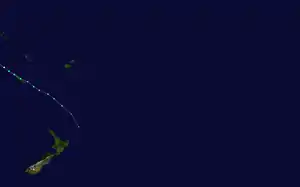 Season summary map | |
| Seasonal boundaries | |
| First system formed | December 13, 2021 |
| Last system dissipated | Season ongoing |
| Strongest storm | |
| Name | Ruby |
| • Maximum winds | 110 km/h (70 mph) (10-minute sustained) |
| • Lowest pressure | 975 hPa (mbar) |
| Seasonal statistics | |
| Total disturbances | 2 |
| Total depressions | 1 |
| Tropical cyclones | 1 |
| Total fatalities | None |
| Total damage | None |
| Related articles | |
Seasonal forecasts
| Source/Record | Tropical Cyclone |
Severe Tropical Cyclone |
Ref |
|---|---|---|---|
| Record high: | 1997–98: 16 | 1982–83: 10 | [1] |
| Record low: | 1990–91: 2 | 2008–09: 0 | [1] |
| Average (1969-70 - 2019-20): | 7 | 3 | [2] |
| NIWA October | 9–12 | 3–4 | [3] |
| Fiji Meteorological Service | 4–6 | 1–3 | [2] |
| Region | Chance of above average |
Average number |
Actual activity |
| Western South Pacific (142.5°E—165°E; includes Australian basin) |
59% | 4 | |
| Eastern South Pacific (165°E—120°W) |
46% | 6 | |
| Source:BOM's South Pacific Tropical Cyclone Season Outlook[4] | |||
Ahead of the cyclone season formally starting, the Fiji Meteorological Service (FMS), Australian Bureau of Meteorology (BoM), New Zealand's MetService and National Institute of Water and Atmospheric Research (NIWA) and various other Pacific Meteorological services, all contributed towards the Island Climate Update tropical cyclone outlook that was released during October 2021.[3] The outlook took into account the ENSO neutral conditions that had been observed across the Pacific and analog seasons, that had ENSO neutral and El Nino conditions occurring during the season.[3] The outlook called for a near-average number of tropical cyclones for the 2021–22 season, with nine to twelve named tropical cyclones, predicted to occur between 135°E and 120°W, compared to an average of just over 10.[3] At least four of the tropical cyclones were expected to intensify further and become severe tropical cyclones, while it was noted that a Category 5 severe tropical cyclone could occur during the season.[3]
In addition to contributing towards the Island Climate Update outlook, the FMS and the BoM issued their own seasonal forecasts for the South Pacific region.[2][4] The BoM issued two seasonal forecasts for the Southern Pacific Ocean, for their self-defined eastern and western regions of the South Pacific Ocean.[4] They predicted that the Western region between 142.5°E and 165°E, had a 59% chance of seeing activity above its average of 4 tropical cyclones. The BoM also predicted that the Eastern Region between 165°E and 120°W, had a 46% chance of seeing activity above its average of 6 tropical cyclones.[4] Within their outlook the FMS predicted that between four and six tropical cyclones would occur within the basin compared to an average of around 7.[2] At least one of these tropical cyclones was expected to intensify further and become a Category 3 or higher severe tropical cyclone.[2]
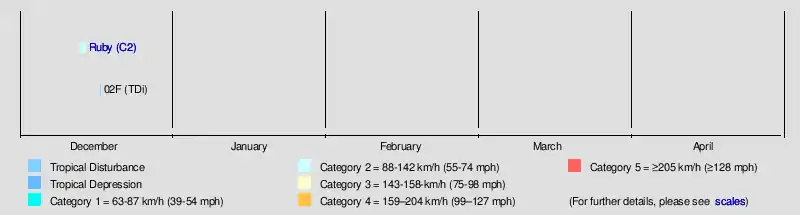
Seasonal summary
Systems
Tropical Cyclone Ruby
| Category 2 tropical cyclone (Australian scale) | |
| Category 1 tropical cyclone (SSHWS) | |
  | |
| Duration | December 13 (Entered basin) – December 14 |
|---|---|
| Peak intensity | 110 km/h (70 mph) (10-min) 975 hPa (mbar) |
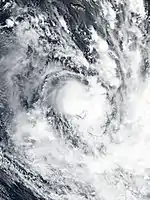
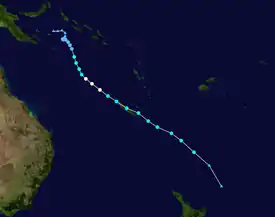
On December 13, Tropical Cyclone Ruby moved into the basin from the Australian region, as a Category 2 tropical cyclone on the Australian scale.[5][6]

Storm names
Within the Southern Pacific a tropical depression is judged to have reached tropical cyclone intensity should it reach winds of 65 km/h, (40 mph) and it is evident that gales are occurring at least halfway around the center. With tropical depressions intensifying into a tropical cyclone between the Equator and 25°S and between 160°E - 120°W named by the RSMC Nadi. However should a tropical depression intensify to the south of 25°S between 160°E and 120°W it will be named in conjunction with RSMC Nadi by TCWC Wellington. Should a tropical cyclone move out of the basin and into the Australian region it will retain its original name. The next 10 names on the naming list are listed here below.[7]
|
|
If a tropical cyclone enters the South Pacific basin from the Australian region basin (west of 160°E), it will retain the name assigned to it by the Australian Bureau of Meteorology. The following storms were named in this manner:
Season effects
This table lists all the storms that developed in the South Pacific to the east of longitude 160°E during the 2021–22 season. It includes their intensity on the Australian tropical cyclone intensity scale, duration, name, landfalls, deaths, and damages. All data is taken from RSMC Nadi and/or TCWC Wellington, and all of the damage figures are in 2021 or 2022 USD.
| Name | Dates active | Peak classification | Sustained wind speeds |
Pressure | Areas affected | Damage (USD) |
Deaths | Refs |
|---|---|---|---|---|---|---|---|---|
| Ruby | December 13 – 14 | Category 2 tropical cyclone | 110 km/h (70 mph) | 975 hPa (28.79 inHg) | New Caledonia | None | None | |
| 02F | December 17 – Present | Tropical disturbance | Not specified | 1006 hPa (29.71 inHg) | None | None | None | |
| Season aggregates | ||||||||
| 2 systems | December 13 – Season ongoing | 110 km/h (70 mph) | 975 hPa (28.79 inHg) | None | None | |||
See also
- List of Southern Hemisphere cyclone seasons
- Tropical cyclones in 2021 and 2022
- Atlantic hurricane seasons: 2021, 2022
- Pacific hurricane seasons: 2021, 2022
- Pacific typhoon seasons: 2021, 2022
- North Indian Ocean cyclone seasons: 2021, 2022
- 2021–22 South–West Indian Ocean cyclone season
- 2021–22 Australian region cyclone season
References
- Climate Services Division (October 26, 2010). Tropical Cyclone Guidance for Season 2010/11 for the Fiji and the Southwest Pacific (PDF) (Report). Fiji Meteorological Service. Archived from the original (PDF) on February 27, 2012. Retrieved October 17, 2016.
- 2021/22 RSMC Nadi Tropical Cyclone Outlook (PDF) (Report). Fiji Meteorological Service. October 15, 2020. Archived (PDF) from the original on October 20, 2020. Retrieved October 20, 2020.
- Southwest Pacific Tropical Cyclone Outlook - October 2020 (Report). National Institute of Water and Atmospheric Research. October 20, 2020. Archived from the original on October 20, 2020. Retrieved October 20, 2020.
- "http://www.bom.gov.au/climate/cyclones/south-pacific/archive/20211012.archive.shtml". Australian Bureau of Meteorology. December 14, 2021. External link in
|title=(help) - "Tropical Cyclone Forecast Map Number 1 for Tropical Cyclone Ruby". met.gov.fj. Fiji Meteorological Service. 13 December 2021. Archived from the original on 13 December 2021. Retrieved 13 December 2021.
- "Hurricane Warning 009 for Tropical Cyclone Ruby". met.gov.fj. Fiji Meteorological Service. 12 December 2021. Archived from the original on 13 December 2021. Retrieved 13 December 2021.
- RA V Tropical Cyclone Committee (November 18, 2016). Tropical Cyclone Operational Plan for the South-East Indian Ocean and the Southern Pacific Ocean 2016 (PDF) (Report). World Meteorological Organization. pp. I–4 – II–9 (9–21). Archived (PDF) from the original on November 20, 2016. Retrieved November 20, 2016.
External links
 |
Wikimedia Commons has media related to 2021-22 South Pacific cyclone season. |
- World Meteorological Organization
- Australian Bureau of Meteorology
- Fiji Meteorological Service
- New Zealand MetService
- Joint Typhoon Warning Center
Tropical cyclones of the 2021–22 South Pacific cyclone season | ||
|---|---|---|
| ||
| ||

