24th Texas Cavalry Regiment
The 24th Texas Cavalry Regiment was a unit of mounted volunteers that fought in the Confederate States Army during the American Civil War. The regiment organized as cavalry in April 1862 and dismounted to fight as infantry in July 1862. The regiment was captured at the Battle of Arkansas Post in January 1863. After being sent to a Northern prison camp, the unit was exchanged in April 1863. Assigned to the Army of Tennessee, the unit was consolidated with three Texas cavalry regiments. In 1863, the consolidated unit fought as infantry at Liberty Gap, Chickamauga, Missionary Ridge, and Ringgold Gap. In 1864, the unit fought in the Atlanta campaign, at Franklin, and at Nashville. It also fought at Bentonville in the Carolinas campaign before surrendering in April 1865.
| 24th Texas Cavalry Regiment 2nd Texas Lancers | |
|---|---|
| Active | 16 April 1862 – 26 April 1865 |
| Country | .svg.png.webp) Confederate States of America Confederate States of America |
| Allegiance | Confederate States of America,  Texas Texas |
| Branch |  Confederate States Army Confederate States Army |
| Type | Cavalry and Infantry |
| Size | Regiment |
| Nickname(s) | Wilkes' Cavalry, 2nd Lancers |
| Engagements |
|
| Commanders | |
| Notable commanders | Col. Franklin C. Wilkes |
Formation
In the spring of 1862, George Washington Carter received permission from the Confederate States Army to form a regiment of Texas lancer cavalry. The recruitment effort was well-publicized and many Texans preferred to serve in the cavalry rather than the infantry. The number of recruits was so large that three regiments were formed, the 1st, 2nd, and 3rd Lancers. These became the 21st Texas Cavalry, 24th Texas Cavalry, and 25th Texas Cavalry Regiments, respectively. Carter became the colonel of the 21st Texas Cavalry.[1] Franklin Collet Wilkes was appointed colonel commanding the 24th Texas Cavalry. Robert Reese Neyland became lieutenant colonel and Patrick H. Swearingen became major.[2] The regiment was organized at Camp Carter near Hempstead, Texas[3] and about 900 soldiers were enrolled in the regiment by mid-September 1862.[4]
The regiment recruited men from the counties listed in the table below, plus others from Brazos, Fayette, Karnes, Live Oak, McCulloch, Milam, and Nueces Counties. There were also recruits from what later became Waller County,[3] but was part of Austin County until 1873.[5]
| Company | Main Recruitment Area |
|---|---|
| A | Tyler County |
| B | Montgomery County |
| C | Comanche County |
| D | Washington County |
| E | Jasper County |
| F | Fort Bend County |
| G | various |
| H | San Saba County |
| I | Lavaca County |
| K | DeWitt County |
History
1862–1863
Because so many Texans volunteered to serve in cavalry units, there were not enough infantry units to defend Arkansas.[7] Therefore, on July 28, 1862, Thomas C. Hindman ordered that the regiment be dismounted to serve as infantry at El Dorado, and the order was reiterated on September 1 while the regiment was stationed at Camp Holmes near Pine Bluff.[3] The dismounted 24th and 25th Texas Cavalry were both assigned to Garland's infantry brigade. Confederate cavalrymen were supposed to provide their own horses and the order to dismount was very unpopular, with many soldiers threatening to desert or writing home about how they were mistreated. Hindman's heavy-handed efforts resulted in a respectable number of Confederate troops available to defend Arkansas, but it also resulted in Hindman's replacement as department commander by Theophilus H. Holmes on July 26, 1862.[8]
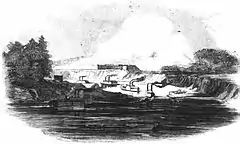
Robert R. Garland's brigade was assigned to defend Arkansas Post under the overall command of Thomas J. Churchill. Garland's brigade consisted of the 6th Texas Infantry Regiment, the 24th and 25th Texas Cavalry Regiments (dismounted), and Hart's Arkansas Battery.[9] Arkansas Post was located on the Arkansas River about 50 mi (80 km) upstream from its confluence with the Mississippi River. The Confederates repulsed a Union attempt to capture Vicksburg, Mississippi at the Battle of Chickasaw Bayou in late December 1862. John Alexander McClernand soon assumed command of the Union army and determined to capture Arkansas Post. With 13 gunboats and 50 transports, David Dixon Porter's flotilla steamed up the Arkansas River and landed McClernand's 30,000 troops on January 9, 1863. As the Federal forces began surrounding Arkansas Post and Fort Hindman on January 10, Churchill received orders to hold at all costs. On January 11, a combined assault by the Union fleet and army forced the Confederate defenders to surrender in the Battle of Arkansas Post. Union casualties numbered 1,061 but they captured 4,791 Confederates.[10]
At Arkansas Post, the 24th Texas Cavalry suffered 54 casualties. The Confederate prisoners were sent north to Camp Butler, near Springfield, Illinois. Many men died while in the prison camp before the men were sent to Petersburg, Virginia where they were released in a prisoner exchange in April 1863. When the regiment joined the Army of Tennessee at Wartrace, Tennessee, it was consolidated with the dismounted 17th Texas, 18th Texas, and 25th Texas Cavalry Regiments. The consolidated regiment fought at the Battle of Liberty Gap during the Tullahoma campaign.[3]
At the Battle of Chickamauga on September 19–20, 1863, the 17th-18th-24th-25th Texas was assigned to James Deshler's brigade in Patrick Cleburne's division. The other units in the brigade were the consolidated 19th and 24th Consolidated Arkansas Infantry Regiment and the consolidated 6th-10th-15th Consolidated Texas Regiment. Wilkes was wounded in the fighting and replaced by Lieutenant Colonel John T. Colt, then Major W. A. Taylor. The brigade lost 52 killed and 366 wounded.[11] On the first day, Cleburne's division launched an attack near the Winfrey Field at 6:00 pm, only 10 minutes before sunset.[12] Deshler's brigade lost track of the rest of the division, moving too far to the left. In the dark forest, Deshler's skirmish line blundered into a Federal brigade and the men were nearly all captured. However, in the darkness and confusion, some of the skirmishers escaped and one of Deshler's units helped capture some Union soldiers.[13] On the second day, Deshler's brigade attacked Union soldiers that were protected by breastworks. Like the previous brigade that attacked, when they reached the crest of a rise, Deshler's men were stopped by murderous fire that inflicted severe casualties and the soldiers went to ground. Cleburne ordered Deshler to hold on as long as possible while the other brigade fell back to reform. As Deshler was moving along the line, he was hit by a shell and killed; he was replaced in command by Roger Q. Mills. Soon afterward, a soldier from the 24th Texas reported to Mills that Wilkes was wounded in the right leg by shrapnel. For two and a half hours, the brigade held its position, while suffering severe losses. Finally, Mills pulled the brigade back out of the line of fire while the crest was manned only by sharpshooters. The 17th-18th-24th-25th Texas suffered 200 casualties during the ordeal.[14]
Notes
- Bailey 2011.
- Oates 1994, p. 176.
- Derbes 2011.
- Oates 1994, p. 44.
- Christian & Leffler 2021.
- Williams 2021.
- Oates 1994, p. 45.
- Oates 1994, pp. 47–48.
- Battles & Leaders 1987a, p. 460.
- Boatner 1959, pp. 24–25.
- Battles & Leaders 1987a, p. 674.
- Cozzens 1996, pp. 266–267.
- Cozzens 1996, pp. 274–279.
- Cozzens 1996, pp. 348–349.
References
- Bailey, Anne J. (April 11, 2011). "Twenty-First Texas Cavalry". Handbook of Texas. Retrieved December 13, 2021.
- Battles and Leaders of the Civil War. 3. Secaucus, N.J.: Castle. 1987a [1883]. ISBN 0-89009-571-X.
- Battles and Leaders of the Civil War. 4. Secaucus, N.J.: Castle. 1987b [1883]. ISBN 0-89009-572-8.
- Boatner, Mark M. III (1959). The Civil War Dictionary. New York, N.Y.: David McKay Company Inc. ISBN 0-679-50013-8.
- Castel, Albert E. (1992). Decision in the West: The Atlanta Campaign of 1864. Lawrence, Kansas: University Press of Kansas. ISBN 0-7006-0562-2.
- Christian, Carol E.; Leffler, John (April 1, 2021). "Waller County". Handbook of Texas. Retrieved December 14, 2021.
- Cozzens, Peter (1994). The Shipwreck of their Hopes: The Battles for Chattanooga. Urbana, Ill.: University of Illinois Press. ISBN 0-252-01922-9.
- Cozzens, Peter (1996). This Terrible Sound: The Battle of Chickamauga. Urbana, Ill.: University of Illinois Press. ISBN 0-252-06594-8.
- Derbes, Brett J. (April 11, 2011). "Twenty-Fourth Texas Cavalry". Handbook of Texas. Retrieved December 11, 2021.
- Oates, Stephen B. (1994) [1961]. Confederate Cavalry West of the River. Austin, Tex.: University of Texas Press. ISBN 0-292-71152-2.
- Williams, James E. (2021). "A Revised List of Texas Confederate Regiments, Battalions, Field Officers, and Local Designations". jamesewilliams.tripod. Retrieved December 11, 2021.