33rd Infantry Division "Acqui"
The 33rd Infantry Division "Acqui" (Italian: 33ª Divisione di fanteria "Acqui") was an infantry division of the Royal Italian Army during World War II. The Acqui was classified as a mountain infantry division, which meant that its artillery was moved by pack mules instead of the horse-drawn carriages of line infantry divisions. Italy's real mountain warfare divisions were the six alpine divisions manned by Alpini mountain troops. The division was formed in August 1939 from the parts of 14th and 11th infantry brigades, and mobilized for war in October 1939. It was named for the city of Acqui.
| 33rd Infantry Division "Acqui" | |
|---|---|
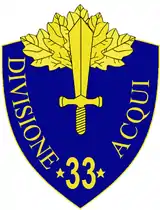 33rd Infantry Division "Acqui" insignia | |
| Active | 1939–1943 |
| Country | .svg.png.webp) Kingdom of Italy Kingdom of Italy |
| Branch | Royal Italian Army |
| Role | Infantry |
| Size | Division 12,000 soldiers |
| Part of | XXVI Army Corps |
| Garrison/HQ | Meran |
| Engagements | World War II |
| Commanders | |
| Notable commanders | Ernesto Chiminello Antonio Gandin |
| Insignia | |
| Identification symbol |       Acqui Division gorget patches |
The division is notable for having been massacred with remarkable cruelty after surrendering to the Germans on 21 September 1943. The main detachments of the Acqui division in the islands of Cephalonia and Corfu were officially dissolved 24 September 1943.[1][2]
History
The division's lineage begins with the Brigade "Acqui" established on 21 December 1821, which on 25 October 1831 split to form the 1st and 2nd infantry regiments under the brigade's command. On 4 May 1839, the two regiments were re-numbered as 17th and 18th infantry regiments.[3]
Invasion of France and fighting the Greeks
The Acqui division was deployed in 1940 as part of II Army Corps to defend a line of Maddalena Pass-Argentera-Colle del Ferro on the French border.[4] After France surrendered to Germany in the evening of 22 June 1940,[5] it received orders to advance to cross the border 23 June 1940. Meeting weak opposition it descended to La Condamine-Châtelard. 24 June 1940, it also reached the Ubaye Valley, but at this point a Franco-Italian Armistice came into effect and the Acqui division was immediately sent back to Veneto region. Casualties in this campaign amounted to 32 dead, 15 missing, 90 wounded and 198 frostbitten. On 6 December 1940, the division received an orders to move to Albanian-Greek border. It reached a coastal area north-west of Vuno in Himarë municipality 18 December 1940, and immediately ordered to reinforce positions of 51st Infantry Division Siena at Shushice river valley. Because of the overall deterioration of Italian positions in Greco-Italian War, 19 December 1940 it already encountered a Greek force trying to capture Vlorë. The Acqui division then fought defensively until the end of December, 1940. Only attacks to improve the defence positions were made. In January 1941, the bitter fight for the Qafa e Hazërit mountain trail started. The Qafa e Hazërit trail changed hands several times. In February 1941, the division was pulled back to Smokthinë in Shushice river valley. It was re-deployed in Kakoz, Albania in March 1941. In the course of the German-led Battle of Greece the Acqui division started an attack at Bolenë, Horë-Vranisht and Maja e Mesimerit 14 April 1941. The Greek army began an organized retreat on April 16, and the Acqui took the direct route to the border town of Konispol and a Greek province of Filiates beyond. The city of Igoumenitsa and a coastal town Syvota were captured 20 April 1941.
Between 20 December 1940 and 23 April 1941, the casualties in the Acqui Division were 481 killed, 1,163 missing, 1,361 wounded and 672 frostbitten.[6] After the end of Greco-Italian War the Acqui division has become the part of the occupation force on the islands of Corfu, Lefkada, Zakynthos and Cephalonia. To reinforce the thinly spread troops, on 14 November 1941 it received a 317th infantry regiment. During 1942, the division headquarters were briefly relocated to Lefkada before settling on Cephalonia in May 1943.
Massacres
Following the Italian surrender in September 1943, thousands of soldiers from the division were executed on the islands during Operation Achse, in what became known as the "Cephallonia massacre". One of the largest prisoner of war massacres of the war,[7][8] and one of the largest-scale German atrocities to be committed by Wehrmacht troops,[9] this event provided the historical background to the novel Captain Corelli's Mandolin, which later became a Hollywood film.[10][11][12]
The events in Cefalonia were repeated, to a lesser extent, elsewhere. In Corfu, the 8,000-strong Italian garrison comprised elements of three divisions, including the Acqui's 18th Regiment. On 24 September, the Germans landed a force on the island, and by the next day they were able to induce the Italians to capitulation.[13] All 280 Italian officers on the island were executed during the next two days on the orders of General Hubert Lanz, in accordance with Hitler's directives.[13] The bodies were loaded onto a ship and disposed of in the sea.[13] Similar executions of officers also occurred in the aftermath of the Battle of Kos, when the Italian commander and 90 of his officers were shot.[14]
Aftermath
- On 28 September 1943, the ship P.fo Ardena have either struck a naval mine or was intentionally scuttled by explosive charge. Of the 840 Italian prisoners-of-war on board, 720 perished.[15]
- On 10 October 1943, the Italian ship Mario Roselli in Corfu bay was bombed and severely damaged by allied aircraft. Out of more than 5000 Italian prisoners-of-war and German crew, 1302 perished.
- On 13 October 1943, the ship P.fo Marguerita [16] was sunk, presumably by naval mine, after departing from Argostoli, Cephalonia. 544 men perished.
Organization
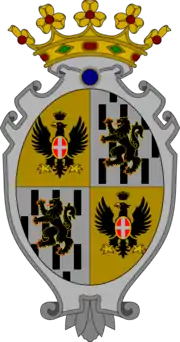
- 33rd Infantry Division "Acqui", in Meran[1][2]
- 17th Infantry Regiment "Acqui", in Schlanders
- Command Company
- 3x Fusilier battalions
- Support Weapons Company (65/17 infantry support guns)
- Mortar Company (81mm Mod. 35 mortars)
- 18th Infantry Regiment "Acqui", in Meran
- Command Company
- 3x Fusilier battalions
- Support Weapons Company (65/17 infantry support guns)
- Mortar Company (81mm Mod. 35 mortars)
- 317th Infantry Regiment "Acqui" (raised on 1 November 1941 by the depot of the 18th Infantry Regiment "Acqui", joined the division in Greece in May 1942)[17]
- Command Company
- 3x Fusilier battalions
- Support Weapons Company (47/32 anti-tank guns)
- Mortar Company (81mm Mod. 35 mortars)
- 33rd Artillery Regiment "Acqui", in Trento
- Command Unit
- I Group (100/17 howitzers)
- II Group (75/27 field guns)
- III Group (75/27 field guns)
- 33rd Anti-aircraft Battery (20/65 Mod. 35 anti-aircraft guns)
- 333rd Anti-aircraft Battery (20/65 Mod. 35 anti-aircraft guns)
- Ammunition and Supply Unit
- XXXIII Mortar Battalion (81mm Mod. 35 mortars)
- 33rd Anti-tank Company (47/32 anti-tank guns)
- 31st Engineer Company
- 33rd Telegraph and Radio Operators Company
- 3rd Medical Section (replaced in Greece by the 44 Medical Section)
- 5th Supply Section
- 33rd Truck Section
- 143rd Transport Section
- 9th Bakers Section
- 27th Carabinieri Section
- 30th Carabinieri Section
- 2nd Field Post Office
- 17th Infantry Regiment "Acqui", in Schlanders
Attached to the division from early 1940 to 14 November 1940:[2]
- 23rd CC.NN. Legion
- XX CC.NN. Battalion
- XXIII CC.NN. Battalion
- 23rd CC.NN. Machine Gun Company
Attached to the division from 14 November 1940 until early 1942:[2]
- 18th CC.NN. Legion
- XIX CC.NN. Battalion (remained attached to the division until September 1943)
- XXVII CC.NN. Battalion
- 18th CC.NN. Machine Gun Company
Attached to the division in 1943:[2]
- CX Machine Gun Battalion
- VII Artillery Group
- XCIV Artillery Group
- CLXXXVIII Artillery Group
- III Anti-aircraft Artillery Group
Military honors
For their conduct after the announcement of the Armistice of Cassibile on Cephalonia and Corfu the President of Italy awarded on 16 February 1948 to the regiments of the 33rd Infantry Division "Acqui" Italy's highest military honor, the Gold Medal of Military Valour.
Commanding officers
The division's commanding officers were:[1][2]
- Generale di Divisione Francesco Sartoris (August 1939 - 19 September 1940)
- Colonel Domenico Bonaccorsi (acting, 20 September - 9 October 1940)
- Generale di Brigata Adamo Mariotti (10 October 1940 - 13 February 1941)
- Generale di Divisione Luigi Mazzini (14 February 1941 - 25 October 1942)
- Generale di Divisione Ernesto Chiminello (26 October 1942 - 20 June 1943)
- Generale di Divisione Antonio Gandin (21 June 1943 - 24 September 1943; executed by the Germans)
Division "Acqui"
In 2002 the Italian Army activated three division commands, with one of the three always readily deployable for NATO missions. Each division was given the traditions of a division that had served with distinction in World War II. Therefore on 31 December 2002 the 3rd Italian Division in San Giorgio a Cremano was renamed Division Command "Acqui".
References
- "33ª Divisione di fanteria "Acqui"". Regio Esercito. Retrieved 30 October 2021.
- Bollettino dell'Archivio dell'Ufficio Storico N.II-3 e 4 2002. Rome: Ministero della Difesa - Stato Maggiore dell’Esercito - Ufficio Storico. 2002. p. 272. Retrieved 30 October 2021.
- Voghera, Enrico (1909). Annuario militare del regno d'Italia. I. Rome. p. 388.
- Jowett, Philip S. The Italian Army 1940–45 (1): Europe 1940–1943. Osprey, Oxford – New York, 2000, pg. 5, ISBN 978-1-85532-864-8
- "Armistice Agreement Between Germany and France, 22 June 1940". www.kbismarck.com.
- Storia fotografica della Divisione Acqui.
- "Massacres and atrocities of WWII". Archived from the original on 17 August 2000. Retrieved 11 April 2009.
Almost unknown outside of Italy, this event ranks with Katyn as one of the darkest episodes of the war" also "The German 11th Battalion of Jäger-Regiment 98 of the 1st Gebirgs (Mountain) Division, commanded by Major Harald von Hirschfeld, arrived on the island and soon Stukas were bombing the Italian positions
- "Rizospastis" (in Greek). 3 September 2000.
Πρέπει να σημειωθεί πως τα βιβλία για τη σφαγή των Ιταλών στρατιωτών της Κεφαλονιάς (η μεγαλύτερη σφαγή αιχμαλώτων του Β' Παγκοσμίου Πολέμου), εκτός αυτού του Μπερνιέρ, είναι το ένα καλύτερο από το άλλο. Translation: It must be noted that the books about the massacre of the Italian soldiers in Kefalonia (the biggest massacre of prisoners of war in WWII), except the one by Bernier, are one better than the other.
- "Mörder unterm Edelweiß – noch immer unter uns ("Murderers under the Edelweiss — still among us")" (in German).
- Holmes, Professor Richard. "The 'D-Day Dodgers'". BBC.
...the massacre of the Acqui division on the island of Cephalonia, the background to Louis de Bernières’ Captain Corelli’s Mandolin, was a cruel fact
- "Corelli's comrades".
That same day, military records show, the German Gen. Hubert Lanz reported from Cephalonia to Berlin: ‘Final mopping up... is under way. General Gandin and his staff were captured. Special treatment in compliance with Fuhrer Order.’
- "Hollywood goes to Italy".
Historical Context: Italy invaded Greece on 28 October 1940 with 7 divisions of the 9th and 11th Armies. By 22 November, the Italians were pushed back into Albania. The Germans had to come to their aid. But when the Italian government decided to negotiate a surrender to the Allies, the German Army tried to disarm the Italians in what they called Operation ACHSE. On 29 September 1943, on the island of Cephalonia, the Germans fought the Italians of the 33rd "Aqui" Division. A total of 1315 were killed in battle, 3,000 were drowned when the German ships taking them to concentration camps were sunk by mines, and 5,325 were executed. In general, the Germans did not battle or massacre the Italians in other areas.
- "Kriegsverbrechenm der1". www.lexikon-der-wehrmacht.de.
- "Massacres and Atrocities of WWII in Western Europe". members.iinet.net.au. Archived from the original on 17 August 2000. Retrieved 11 April 2009.
- "P.fo ARDENA affonda il 28 settembre 1943-720 morti". www.marenostrumrapallo.it.
- "Lero l'ultima isola". digilander.libero.it.
- "317° Reggimento di fanteria "Acqui"". Regio Esercito. Retrieved 14 December 2021.
- "17° Reggimento Fanteria "Acqui"". President of Italy. Retrieved 26 October 2021.
- "18° Reggimento Fanteria "Acqui"". President of Italy. Retrieved 26 October 2021.
- "317° Reggimento Fanteria "Acqui"". President of Italy. Retrieved 26 October 2021.
- "33° Reggimento Artiglieria "Acqui"". President of Italy. Retrieved 26 October 2021.
- Paoletti, Ciro (2008). A Military History of Italy. Greenwood Publishing Group. ISBN 978-0-275-98505-9.