37th Infantry Division "Modena"
The 37th Infantry Division "Modena" (Italian: 37ª Divisione di fanteria "Modena") was a infantry division of the Royal Italian Army during World War II. The Modena was classified as a mountain infantry division, which meant that the division's artillery was moved by pack mules instead of the horse-drawn carriages of line infantry divisions. Italy's real mountain warfare divisions were the six alpine divisions manned by Alpini mountain troops. The division was formed on 25 March 1939 with units of the 5th Territorial Division "Imperia" and named for the city of Modena. The division was made up entirely of men from the city of Genoa and the surrounding Liguria region. The division's regimental depots were shared with the 63rd Infantry Division "Cirene", which was based in Benghazi in Libya and recruited its men from and trained them in Liguria.[1][2]
| 37th Infantry Division "Modena" | |
|---|---|
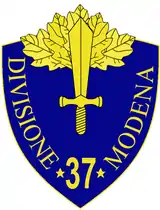 37th Infantry Division "Modena" insignia | |
| Active | 1939–1943 |
| Country | .svg.png.webp) Kingdom of Italy Kingdom of Italy |
| Branch | Royal Italian Army |
| Type | Infantry |
| Size | Division |
| Garrison/HQ | Savona |
| Engagements | World War II Italian invasion of France Greco-Italian War |
| Commanders | |
| Notable commanders | General Alessandro Gloria |
| Insignia | |
| Identification symbol |       Modena Division gorget patches |
History
The division's lineage begins with the Brigade "Modena" established on 1 August 1859 with the 1st Regiment "Cacciatori della Magra" and 2nd Regiment "Cacciatori della Magra" of the Army of the United Provinces of Central Italy. On 25 March 1860 the Brigade "Modena" entered the Royal Sardinian Army three days after the Kingdom of Sardinia had annexed the United Provinces of Central Italy. Already before entering the Royal Sardinian Army the brigade's two infantry regiments had been renumbered on 30 December 1859 as 41st Infantry Regiment and 42nd Infantry Regiment.[3]
Italian invasion of France
10 June 1940, the Modena division was placed at Sanremo city as part of XV Army Corps.,[4] securing a border section from Monte Grammondo to north. The division has crossed a border 21 June 1940 near the Cima di Anan and mount Aine to east of Breil-sur-Roya, aiming to fortified pass of Col de Brouis and pass Col du Perus. 26 June 1940, the Modena division was recalled to Belluno.
Greco-Italian War
After the invasion of France the Modena was sent to Albania and joined the Italian XXV Corps which took part in the Greco-Italian War. It was gathered on staging grounds of Derviçian south of Gjirokastër, together with 47th Infantry Division Bari on right flank of 23rd Infantry Division Ferrara. It has relived the embattled 23rd Infantry Division Ferrara on 3 December 1940. The Modena division was able to repel the initial Greek attack on Maja e Buzë Derrit until 6 December 1940. But the Greek have shifted attacks to Progonat-Golëm sector 12 December 1940, immediately making a dangerous breakthroughs. Reserves were brought to front-line and all initial positions were regained by night – to no avail. The Italian positions at mountain pass of Golëm has been overrun by Greek 13 December 1940. The Greek forces have advanced over 10 kilometers to mount Mali i Pleshevices, which barely held off the attack. 15 December 1940, the Modena division have lost Progonat. At about the same time, the loss of mount Maja e Buzë Derrit by Modena have endangered the positions of the remnants of 23rd Infantry Division Ferrara on left flank, forcing Ferrara to perform a numerous costly counter-attacks. 19 December 1940, the Modena made a stand between Gusmar and Lekdush villages in Kurvelesh municipality, managing to stop a Greek advance. The positions of Modena were reinforced at the north by 232nd regiment of 11th Infantry Division Brennero 10 January 1941, and later, during defence of Tepelenë, by 18th regiment of 33rd Mountain Infantry Division Acqui.
In January–February 1941, the Modena division found itself holding a nearly impassable terrain. Although it simplified defence, the supply was also inadequate, with large fraction of supplies delivered by aircraft. 9–10 March 1941, the Modena division have performed a diversion attacks near Progonat to tie up an opposing Greek units and prevent reinforcements reaching Kolonjë, Gjirokastër, where other Italian units have made a main strike. As Greek resistance collapsed, the Modena division have advanced to Golëm and Mali i Thate, Tepelenë District, 13–14 April 1941.
Occupation of Greece
After the Greek surrender it remained in Greece as an occupying force in the Epirus area, from Ioannina to Preveza. Its duties have included the defence of the Preveza airstrip. Following the Armistice of Cassibile 8 September 1943, the Modena division have disintegrated under unclear circumstances and was officially dissolved 21 September 1943.
Organization
- 37th Infantry Division "Modena", in Savona[1][2]
- 41st Infantry Regiment "Modena", in Savona
- Command Company
- 3x Fusilier battalions
- Support Weapons Company (65/17 infantry support guns)
- Mortar Company (81mm Mod. 35 mortars)
- 42nd Infantry Regiment "Modena", in Genoa
- Command Company
- 3x Fusilier battalions
- Support Weapons Company (65/17 infantry support guns)
- Mortar Company (81mm Mod. 35 mortars)
- 341st Infantry Regiment "Modena" (raised on 1 November 1941 by the depot of the 41st Infantry Regiment "Modena", transferred to the LI Special Brigade "Lecce" on Crete in May 1942)[5]
- Command Company
- 3x Fusiliers battalions
- Support Weapons Company (47/32 anti-tank guns)
- Mortar Company (81mm Mod. 35 mortars)
- 29th Artillery Regiment "Modena", in Albenga
- Command Unit
- I Group (100/17 howitzers)
- II Group (75/27 field guns)
- III Group (75/27 field guns)
- 1x Anti-aircraft battery (20/65 Mod. 35 anti-aircraft guns)
- Ammunition and Supply Unit
- XXXVII Mortar Battalion (81mm Mod. 35 mortars)
- 37th Anti-tank Company (47/32 anti-tank guns)
- 19th Engineer Company
- 37th Telegraph and Radio Operators Company
- 48th Medical Section
- Supply Section
- Transport Section
- 44th Pack Animal Section
- 10th Bakers Section
- 15th Carabinieri Section
- 76th Carabinieri Section
- 37th Field Post Office
- 41st Infantry Regiment "Modena", in Savona
Attached to the division in June 1940:[2]
- 36th CC.NN. Legion "Cristoforo Colombo"
- XXXIV CC.NN. Battalion
- XXXVI CC.NN. Battalion
- 36th CC.NN. Machine Gun Company
Attached to the division in 1943:[2]
- V Carabinieri Battalion
- CX Machine Gun Battalion
- DXVIII Mobile Territorial Battalion
- CC.NN. Group "Etna"
- XXXII Artillery Group
- CXVI Artillery Group
- CLIV Artillery Group
Commanding officers
The division's commanding officers were:[1][2]
- Generale di Divisione Carlo Rossi (general)Carlo Rossi
- Generale di Divisione Alessandro Gloria
- Colonel Francesco Sclavo (acting)
- Generale di Brigata Luigi Trionfi (acting)
- Generale di Brigata Giovani Magli (acting)
- Generale di Divisione Alessandro Gloria
- Generale di Divisione Mario Guassardo
- Generale di Divisione Italo Caracciolo (1943)
- Generale di Brigata Ernesto Papini
References
- "37ª Divisione di fanteria "Modena"". Regio Esercito. Retrieved 30 October 2021.
- Bollettino dell'Archivio dell'Ufficio Storico N.II-3 e 4 2002. Rome: Ministero della Difesa - Stato Maggiore dell’Esercito - Ufficio Storico. 2002. p. 277. Retrieved 30 October 2021.
- Voghera, Enrico (1909). Annuario militare del regno d'Italia - Volume I. Rome. p. 412.
- "Invasion of France (20 June 1940)". Commando Supemo. Archived from the original on 21 May 2009. Retrieved 23 April 2009.
- "341° Reggimento di fanteria "Modena"". Regio Esercito. Retrieved 14 December 2021.
- Paoletti, Ciro (2008). A Military History of Italy. Greenwood Publishing Group. ISBN 978-0-275-98505-9.