38th Infantry Division "Puglie"
The 38th Infantry Division "Puglie" (Italian: 38ª Divisione di fanteria "Puglie") was a infantry division of the Royal Italian Army during World War II. The Puglie was classified as a mountain infantry division, which meant that the division's artillery was moved by pack mules instead of the horse-drawn carriages of line infantry divisions. Italy's real mountain warfare divisions were the six alpine divisions manned by Alpini mountain troops.
| 38th Infantry Division "Puglie" | |
|---|---|
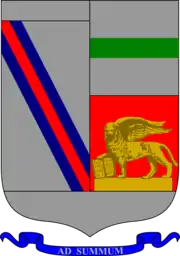
 38th Infantry Division "Puglie" insignia | |
| Active | 1939–1943 |
| Country | .svg.png.webp) Kingdom of Italy Kingdom of Italy |
| Branch | Royal Italian Army |
| Type | Infantry |
| Size | Division |
| Garrison/HQ | Conegliano |
| Engagements | World War II Invasion of Yugoslavia |
| Commanders | |
| Notable commanders | General Alberto D’Aponte |
| Insignia | |
| Identification symbol |       Puglie Division gorget patches |
The division was mobilized 15 May 1939 and named for the Southern Italian region of Apulia (Italian: Puglia). The division filled its ranks with men drafted in eastern Veneto and the Friuli region, with a majority of soldiers hailing from the towns of Sacile and Vittorio Veneto. The Puglie disintegrated soon after the Armistice of Cassibile between Italy and the Allies was announced on 8 September 1943.[1][2]
History
The division's lineage begins with the Brigade "Puglie" established in Milan on 1 August 1862 with the 71st and 72nd infantry regiments.[3]
World War II
10 June 1940, the Puglie division was concentrated in Belluno-Feltre area. The division have received orders to transfer to Albania 3–9 February 1941.
Greco-Italian War
Arriving in Albania, the Puglie division, acting as part of XIV Army Corps, have started to fight somewhere around Lezhë 5 March 1941. The division had only one infantry regiment attached as the 72 Puglie Infantry Regiment was assigned to the XVII Army Corps.[4] 9 March 1941, the main body of Puglie division has assaulted the Monastery Hill (Height 731) near the hamlet of Komarak, as part of failed Italian Spring Offensive.[5] By 11 March 1941, the losses in repeated attacks were such what the division was removed from the front line and ordered to Dubrovnik for reinforcement.
Invasion of Yugoslavia
1 April 1941, the division was called to cover a Kukës – Fushë-Muhurr – Qafë-Murrë border section with between Albania and Yugoslavia. It started to advance at Blatë 7 April 1941, at Maqellarë – 9 April 1941. After breaking an initial Yugoslavian resistance, it reached Debar 11 April 1941, meeting with German forces attacking from the north. 27–28 April 1941, the units of the Puglie division have occupied Prizren, Peć and Gjakova. 1 May 1941, the additional garrisons were established at Orahovac, Štimlje and Skenderaj, all in modern Kosovo. The mopping-up and counter-insurgency operations have continued in Kosovo and to the east of it until Armistice of Cassibile 8 September 1943. Afterward, the Puglie division has moved to Albania where it soon ceased to exist under murky circumstances.
Organization
- 9th Infantry Division "Puglie", in Conegliano[1][2]
- 71st Infantry Regiment "Puglie", in Sacile
- Command Company
- 3x Fusilier battalions
- Support Weapons Company (65/17 infantry support guns)
- Mortar Company (81mm Mod. 35 mortars)
- 72nd Infantry Regiment "Puglie", in Vittorio Veneto
- Command Company
- 3x Fusilier battalions
- Support Weapons Company (65/17 infantry support guns)
- Mortar Company (81mm Mod. 35 mortars)
- 15th Artillery Regiment "Puglie", in Conegliano
- Command Unit
- I Group (100/17 howitzers)
- II Group (75/27 field guns)
- III Group (75/27 field guns)
- 1x Anti-aircraft battery (20/65 Mod. 35 anti-aircraft guns)
- Ammunition and Supply Unit
- XXXVIII Mortar Battalion (81mm Mod. 35 mortars)
- 38th Anti-tank Company (47/32 anti-tank guns)
- 38th Telegraph and Radio Operators Company
- 43rd Engineer Company
- 56th Medical Section
- 56th Supply Section
- 38th Transport Section
- 38th Bakers Section
- 71st Carabinieri Section
- 72nd Carabinieri Section
- 12th Field Post Office
- 71st Infantry Regiment "Puglie", in Sacile
Attached to the division from the end of 1940 to early 1942:[2]
- 115th CC.NN. Legion "Del Cimino"
- CXV CC.NN. Battalion (remained attached to the division until September 1943)
- CXXI CC.NN. Battalion
- 115th CC.NN. Machine Gun Company
Attached to the division in 1943:[2]
- 1st Regiment "Cacciatori d'Albania"
- Battalion "Gramos"
- Battalion "Korata"
- Machine Gun Company
- Support Weapons Company (47/32 anti-tank guns)
Commanding officers
The division's commanding officers were:[1][2]
- Generale di Divisione Mario Marghinotti
- Generale di Divisione Alberto d'Aponte
- Generale di Divisione Federico d'Arle
- Colonel Gino Reghini (acting)
- Generale di Brigata Luigi Clerico
References
- "38ª Divisione di fanteria "Puglie"". Regio Esercito. Retrieved 30 October 2021.
- Bollettino dell'Archivio dell'Ufficio Storico N.II-3 e 4 2002. Rome: Ministero della Difesa - Stato Maggiore dell’Esercito - Ufficio Storico. 2002. p. 279. Retrieved 30 October 2021.
- Voghera, Enrico (1909). Annuario militare del regno d'Italia - Volume I. Rome. p. 442.
- "Invasion of Yugoslavia 6 April, 1941". Commando Supremo. Archived from the original on 21 May 2009. Retrieved 23 April 2009.
- John Carr, The Defence and Fall of Greece 1940–1941, page 153
- Paoletti, Ciro (2008). A Military History of Italy. Greenwood Publishing Group. ISBN 978-0-275-98505-9.