51st Infantry Division "Siena"
The 51st Infantry Division "Siena" (Italian: 51ª Divisione di fanteria "Siena") was an infantry division of the Royal Italian Army during World War II. The Siena was formed on 15 September 1939 and named for the city of Siena. After the Armistice of Cassibile the division disbanded on 8 September 1943. The division was a Campanian unit and it's men were almost entirely Neapolitans.[2][3]
| 51st Infantry Division "Siena" | |
|---|---|
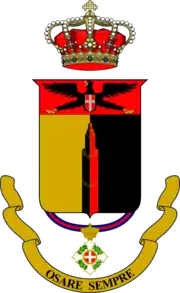
 51st Infantry Division "Siena" insignia | |
| Active | 1939–1943 |
| Country | .svg.png.webp) Kingdom of Italy Kingdom of Italy |
| Branch | Royal Italian Army |
| Type | Infantry |
| Size | Division |
| Garrison/HQ | Naples |
| Engagements | World War II |
| Commanders | |
| Notable commanders | General Ercole Caligian, General Gualtiero Gabutti,[1] General Giulio Perugi, Lieutenant General Angelico Carta |
| Insignia | |
| Identification symbol |       Siena Division gorget patches |
History
The division's lineage begins with the Brigade "Siena" established by order of the Provisional Government of the Grand Duchy of Tuscany of 2 July 1859 with the 3rd and 4th infantry regiments. On 25 March 1860 the Brigade "Siena" entered the Royal Sardinian Army three days after the Kingdom of Sardinia had annexed the United Provinces of Central Italy, which included the Grand Duchy of Tuscany. Already before entering the Royal Sardinian Army the brigade's two infantry regiments had been renumbered on 30 December 1859 as 31st Infantry Regiment and 32nd Infantry Regiment.[4]
World War I
The brigade fought on the Italian front in World War I.
World War II
By 10 June 1940, Siena was transferred to Piedmont as part of the army reserve, and did not participate in Italian invasion of France. Fully mobilized in August 1940, the Siena division received orders to move to Albania in September 1940. By the start of Greco-Italian War On 28 October 1940, the division was deployed in the Delvinë-Konispol region as part of VIII Army Corps, covering the border from Mal Stugarë where it was adjacent to the 23rd Infantry Division "Ferrara" to the coast. Ordered to participate in the attack on the Greek city of Ioannina, the division failed to cross the Thyamis river until 6 November 1940 due to heavy Greek resistance. On 6 November 1940, the beachhead across the Thyamis was established, but the division immediately turned to a defensive stance because of the rapid pace of Greek forces build-up. On 14 December 1940, it repelled Greek probing attacks, but by 19 December was retreating with the main forces from the line from Himarë to Kallarat. It was able to stop the Greek advance just short of the valley of Shushicë, on the mountaintops of Mali i Çorajt to Horë-Vranisht. The fighting was bloody, with the infantry regiments of Siena down to the battalion strength.[5] The 33rd Mountain Infantry Division Acqui came to the rescue on 24 December 1940, and by 26 December 1940 the Siena division was relieved from front line duties and sent to Berat to regroup.
To plug the Greek breakthrough after the Capture of Klisura Pass, on 25 January 1941 the Siena division was assigned to the line from Qafa e Kiçokut – Monastery Hill (Height 731) north of Këlcyrë. It managed to stop the breakthrough, despite incessant Greek attacks. On 8 February 1941, the division was sent to reserve again. It participated in the Italian Spring Offensive on 19 March 1941 (with disastrous results) and in the Battle of Greece, capturing Këlcyrë on 14 April 1941. An order was given to Siena on 16 April 1941 to stop and to give way to the 47th Infantry Division Bari.
After the fighting ended, Siena was first re-organized in the Osum valley and then sent to Peloponnese at the beginning of May 1941, forming garrisons in Corinth, Nemea, Argos and Nafplion. In late September 1941, the division was transferred to the eastern part of the island of Crete, joining the Italian XXVI Corps. On 18 April 1943, parts of Siena repelled an Allied landing attempt on the island of Koufonisia. The division, together with the LI Special Brigade "Lecce" remained in Crete until September 1943, when Italy surrendered to the Allies according to the Armistice of Cassibile and the division was disarmed by the Germans. In October 1943, about 2,000 men were killed when they were transported to the mainland as PoWs on the MS Sinfra, which was sunk by US and British planes. Another 2,670 men drowned in February 1944 on the SS Petrella, which was torpedoed by the British submarine HMS Sportsman.
Organization
Order of battle (1940)
- 51st Infantry Division "Siena"
- 31st Infantry Regiment "Siena"
- 3x Fusilier battalions
- Support Weapons Company (65/17 infantry support guns)
- Mortar Company (81mm Mod. 35 mortars)
- 32nd Infantry Regiment "Siena"
- 3x Fusilier battalions
- Support Weapons Company (65/17 infantry support guns)
- Mortar Company (81mm Mod. 35 mortars)
- 51st Artillery Regiment "Siena"
- Command Unit
- I Group (100/17 howitzers)
- II Group (75/27 field guns)
- III Group (75/27 field guns)
- 1x Anti-aircraft Battery (20/65 Mod. 35 anti-aircraft guns)
- Ammunition and Supply Unit
- LI Machine Gun Battalion (added in 1942)
- LI Mortar Battalion (81mm Mod. 35 mortars)
- 51st Anti-tank Company (47/32 anti-tank guns)
- 51st Telegraph and Radio Operators Company Company (entered the LI Mixed Engineer Battalion in 1943)
- 83rd Engineer Company (entered the LI Mixed Engineer Battalion in 1943)
- 160 Signal Engineers Company (entered the LI Mixed Engineer Battalion in 1943)
- 53rd Transport Company
- Medical Section
- Supply Section
- Bakers Section
- 63rd Carabinieri Section
- 120th Carabinieri Section
- Field Post Office
- 31st Infantry Regiment "Siena"
Attached:[3]
- 141st CC.NN. Legion "Capuana"
- CXLI CC.NN. Battalion
- 251st CC.NN. Machine Gun Company
Commanding officers
The division's commanding officers were:[2][3]
- Generale di Divisione Ercole Caligian
- Generale di Divisione Gualtiero Gabutti
- Generale di Divisione Giulio Perugi
- Generale di Divisione Angelo Carta
References
- Enrico Tagliazucchi and Franco Agostini. "Royal Italian Army". World War II Armed Forces – Orders of Battle and Organizations. Archived from the original on 4 April 2009. Retrieved 4 May 2009.
- "51ª Divisione di fanteria "Siena"". Regio Esercito. Retrieved 30 October 2021.
- Bollettino dell'Archivio dell'Ufficio Storico N.II-3 e 4 2002. Rome: Ministero della Difesa - Stato Maggiore dell’Esercito - Ufficio Storico. 2002. p. 293. Retrieved 30 October 2021.
- Voghera, Enrico (1909). Annuario militare del regno d'Italia - Volume I. Rome. p. 402.
- "Regio Esercito - 31° RGT. Siena".
- Paoletti, Ciro (2008). A Military History of Italy. Greenwood Publishing Group. ISBN 978-0-275-98505-9.