58th Infantry Division "Legnano"
The 58th Infantry Division "Legnano" (Italian: 58ª Divisione di fanteria "Legnano") was an infantry division of the Royal Italian Army during World War II. The Legnano was formed on 8 February 1934 in Milan and named for the medieval Battle of Legnano. On 24 May 1939 the division split to form the 6th Infantry Division "Cuneo". The division was disbanded on 17 February 1944 in Apulia.[1][2]
| 58th Infantry Division "Legnano" | |
|---|---|
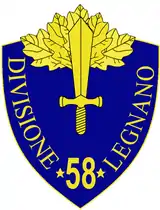 58th Infantry Division "Legnano" insignia | |
| Active | 1939–1945 |
| Country | .svg.png.webp) Kingdom of Italy Kingdom of Italy |
| Branch | Royal Italian Army |
| Type | Infantry |
| Size | Division |
| Engagements | World War II |
| Insignia | |
| Identification symbol | 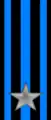      Legnano Division gorget patches |
History
The division's lineage begins with the Brigade "Palermo" established in Turin on 1 August 1862 with the 67th and 68th infantry regiments.[3]
World War II
In 1940 the division remained in Fenestrelle-Col de Fenestre as a reserve force of the 4th Army during the Italian invasion of France. The division was transferred to Albania in January 1941 to stop a Greek breakthrough during the Capture of Klisura Pass during the Grecco-Italian War. The division reached the coastal front line on 7 January 1941, and on 26 January 1941 it engaged Greek forces at Këlcyrë, which were trying to advance to Arrëza e Madhe on the Northern flank of the Battle of Trebeshina. The Legnano advance ultimately failed, forcing the division to halt by 8 March 1941. As a result, the Legnano did not take part in the Italian Spring Offensive. After Greek units withdrew during the start of the Battle of Greece, the Legnano division entered Këlcyrë on 16 April 1941. The division reached Kuman before being reassigned to the reserve of the 9th Army. On 21 June Legnano began boarding ships in Vlorë to return to Lombardy. The division was soon posted to Liguria.
In November 1942 the division was sent to France for the coastal defence of the Cannes-Saint-Tropez sector, effectively taking part in the occupation of Vichy France, and afterwards stayed in France on occupation duty. In August 1943 the division began a gradual return to Apulia in the south east of mainland Italy. It returned first to Bologna, and then headed for Brindisi in Apulia. After allied forces had landed on the Italian peninsula and an armistice between Italy and the Allies had been signed on 8 September 1943, some small detachments were already at Brindisi and Francavilla Fontana, while many others were stranded at Bologna and other locations on their way to their destination. The division remained loyal to the Italian King Victor Emmanuel III, who fled with the royal court and government from Rome to Brindisi. Therefore, the Legnano began to work with the Allies, who soon arrived in Brindisi as a result of Operation Slapstick.
On 26 September 1943 the division re-formed as the Italian 1st Motorized Group, which was to aid the Allied war effort. In the following months, the division lost all its units, which were needed for the Italian campaign. On 17 February 1944 the division was broken up, with its last units joining other divisions. On 24 September 1944 the 1st Brigade of the Italian Liberation Corps was renamed as Combat Group "Legnano". The Combat Group consisted of the 68th Infantry Regiment "Palermo", the 11th Motorized Artillery Regiment, the elite IX Assault Battalion and the Special Infantry Regiment, which contained the remnants of the 3rd Alpini Regiment and the 4th Bersaglieri Regiment. The Combat Group was equipped with British weapons and materiel. The new Legnano went to the front as part of the Polish II Corps, on the extreme left of the British 8th Army near the river Idice, and was tasked with liberating Bologna.
Organization
Order of battle (1934)
- 7th Infantry Regiment "Cuneo"
- 8th Infantry Regiment "Cuneo"
- 67th Infantry Regiment "Palermo"
- 27th Artillery Regiment
Order of battle (1940)
- 58th Infantry Division "Legnano"
- 67th Infantry Regiment "Legnano"[lower-alpha 1]
- Command Company
- 3x Fusilier battalions
- Support Weapons Company (65/17 infantry support guns)
- Mortar Company (81mm Mod. 35 mortars)
- 68th Infantry Regiment "Legnano"[lower-alpha 2]
- Command Company
- 3x Fusilier battalions
- Support Weapons Company (65/17 infantry support guns)
- Mortar Company (81mm Mod. 35 mortars)
- 58th Artillery Regiment "Legnano"
- Command Unit
- I Group (100/17 howitzers)
- II Group (75/27 field guns)
- III Group (75/27 field guns)
- IV Group (75/18 howitzers)
- 4th Anti-aircraft Battery (20/65 Mod. 35 anti-aircraft guns)
- 358th Anti-aircraft Battery (20/65 Mod. 35 anti-aircraft guns)
- Ammunition and Supply Unit
- LVIII Mortar Battalion
- LVIII Mixed Engineer Battalion
- 58th Telegraph and Radio Operators Company
- 58th Machine Gun Company
- 58th Anti-tank Company (47/32 anti-tank guns)
- 163rd Transport Company
- 58th Light Transport Section
- 138th Heavy Transport Section
- 61st Medical Section
- 89th Field Hospital
- 90th Field Hospital
- 117th Field Hospital
- 578th Field Hospital
- 31st Surgical Unit
- 1st Supply Section
- Bakers Section
- 18th Carabinieri Section
- 19th Carabinieri Section
- 240th Carabinieri Section
- 16th Field Post Office
- 67th Infantry Regiment "Legnano"[lower-alpha 1]
In France the division was reinforced by the following units:
- 99th Guardia alla Frontiera Regiment
- 162nd Coastal Infantry Regiment
- 4th Artillery Grouping
- CCCL Coastal Battalion
- 104th Bersaglieri Company
These units had reached Apulia by 8 September 1943:
- LVIII Mortar Battalion
- 58th Machine Gun Company
- Support Weapons Company of the 68th Infantry Regiment
- 12th Battery/IV Artillery Group of the 58th Artillery Regiment
- 358th Anti-aircraft Battery
These units managed to reach Apulia by 13 September 1943:
- 99th Guardia alla Frontiera Regiment
- 162nd Coastal Infantry Regiment
- 4th Artillery Grouping
- CCCL Coastal Battalion
- 323rd Anti-paratrooper Detachment
- 407th Anti-paratrooper Detachment
Order of battle (26 September 1943)
- 1st Motorized Group (58th Infantry Division "Legnano" Staff)
- Command Company
- 67th Motorized Infantry Regiment "Legnano"
- Command Company
- I Battalion/67th Infantry Regiment
- I Battalion/93rd Infantry Regiment (troops from the 18th Infantry Division "Messina")
- LI Bersaglieri Battalion
- 281st Anti-tank Rifles Company (S-18/1000 anti-tank rifles)
- V Anti-tank Battalion (newly formed)
- 16th Anti-tank Company (47/32 anti-tank guns)
- 56th Anti-tank Company (47/32 anti-tank guns)
- Tank Company (L6/40 tanks)
- 11th Motorized Artillery Regiment (from the 104th Infantry Division "Mantova")
- Mixed Engineer Company
- Carabinieri Section
- Medical Unit
- Supply Unit
- Field Post Office
Military honors
For its conduct during the Allied campaign to liberate Italy the President of Italy awarded on 12 December 1948 to the 67th Infantry Regiment "Legnano" Italy's highest military honor, the Gold Medal of Military Valour.
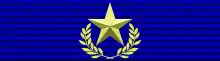 67th Infantry Regiment "Legnano" on 12 December 1948[4]
Commanding officers
The division's commanding officers were:[1][2]
- Generale di Divisione Edoardo Scala (1940)
- Generale di Brigata Vittorio Ruggero (1941)
- Generale di Divisione Amedeo De Cia (1941)
- Generale di Brigata Giovanni Marciani (1942?)
- Generale di Divisione Roberto Olmi (1943)
- Generale di Brigata Vincenzo Dapino (1943)
- Generale di Brigata Silvio Brisotto (1944)
- Generale di Brigata Livio Negro
- Colonel Ettore Fucci (acting)
Notes
- Named 67th Infantry Regiment "Palermo" until 1939 when the army reorganized its divisions as binary divisions and divisional infantry regiments took the name of the division.
- Named 68th Infantry Regiment "Palermo" until 1939 when the army reorganized its divisions as binary divisions and divisional infantry regiments took the name of the division.
References
- "58ª Divisione di fanteria "Legnano"". Regio Esercito. Retrieved 30 October 2021.
- Bollettino dell'Archivio dell'Ufficio Storico N.II-3 e 4 2002. Rome: Ministero della Difesa - Stato Maggiore dell’Esercito - Ufficio Storico. 2002. p. 308. Retrieved 30 October 2021.
- Voghera, Enrico (1909). Annuario militare del regno d'Italia - Volume I. Rome. p. 438.
- "67° Reggimento Fanteria "Legnano"". President of Italy. Retrieved 26 October 2021.
Bibliography
- Paoletti, Ciro (2008). A Military History of Italy. Greenwood Publishing Group. ISBN 978-0-275-98505-9.
- Jowett, Phillip (25 May 2001). The Italian Army 1940–45 (3): Italy 1943–45. Osprey Publishing, Westminster. ISBN 978-1-85532-866-2.
- Mollo, Andrew (1981). The Armed Forces of World War II. Crown Publishing, New York. ISBN 0-517-54478-4.