6PPD
6PPD is an organic chemical that is widely used as an antiozonant and antioxidant in rubber tires.[1] It is one of several p-phenylenediamine (PPD) additives used to protect various rubber materials.[2]
 | |
| Names | |
|---|---|
| IUPAC name
N-(1,3-dimethylbutyl)-N'-phenyl-1,4-benzenediamine | |
Other names
| |
| Identifiers | |
3D model (JSmol) |
|
| ChEMBL | |
| ChemSpider | |
| ECHA InfoCard | 100.011.222  |
| EC Number |
|
PubChem CID |
|
| UN number | 3077 |
CompTox Dashboard (EPA) |
|
| |
| |
| Properties | |
| C18H24N2 | |
| Molar mass | 268.404 g·mol−1 |
| Appearance | brown or violet solid powder |
| Density | 1.07 |
| Melting point | 45 °C (113 °F; 318 K) |
| Boiling point | 260 °C (500 °F; 533 K) |
| log P | 3.972 |
| Hazards | |
| GHS labelling: | |
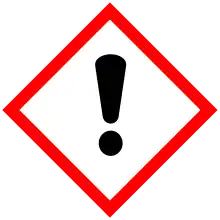 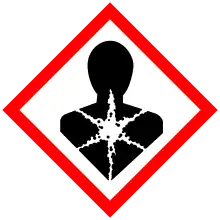 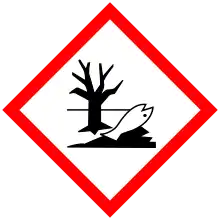 | |
| Danger | |
| H302, H317, H360, H410 | |
| P201, P202, P261, P264, P270, P272, P273, P280, P281, P301+P312, P302+P352, P308+P313, P321, P330, P333+P313, P363, P391, P405, P501 | |
| Flash point | 204 °C (399 °F; 477 K) |
Except where otherwise noted, data are given for materials in their standard state (at 25 °C [77 °F], 100 kPa). | |
| Infobox references | |
Manufacturing
6PPD is prepared by reductive amination of methyl isobutyl ketone with 4-aminodiphenylamine.[3]
Environmental Impact
A 2020 study found that 6PPD released from vehicle tires gets converted by ozone to a previously unknown quinone analog 6PPD-quinone:

and that 6PPD-quinone is the toxic chemical in storm water runoff responsible for killing coho salmon before they spawn in freshwater streams.[4][5][6]
A synthetic route to the 6PPD-quinone has been posted on ChemRxiv.[7]
See also
- N-Isopropyl-N'-phenyl-1,4-phenylenediamine a related antiozonant
- N,N'-Di-2-butyl-1,4-phenylenediamine - a phenylenediamine based antioxidant used as a fuel additive
References
- U.S. Tire Manufacturers Association (July 15, 2021). "Statement of Sarah E. Amick Vice President EHS&S and Senior Counsel U.S. Tire Manufacturers Association". Committee on Natural Resources Subcommittee on Oversight and Investigations United States House of Representatives.
- Krüger, R H; Boissiére, C; Klein-Hartwig, K; Kretzschmar, H-J (2005). "New phenylenediamine antiozonants for commodities based on natural and synthetic rubber". Food Addit Contam. 22 (10): 968–974. doi:10.1080/02652030500098177. PMID 16227180. S2CID 10548886.
- Hans-Wilhelm Engels et al., "Rubber, 4. Chemicals and Additives" in Ullmann's Encyclopedia of Industrial Chemistry, 2007, Wiley-VCH, Weinheim. doi:10.1002/14356007.a23_365.pub2
-
Tian, Zhenyu; Zhao, Haoqi; Peter, Katherine T.; Gonzalez, Melissa; Wetzel, Jill; Wu, Christopher; Hu, Ximin; Prat, Jasmine; Mudrock, Emma; Hettinger, Rachel; Cortina, Allan E.; Biswas, Rajshree Ghosh; Kock, Flávio Vinicius Crizóstomo; Soong, Ronald; Jenne, Amy; Du, Bowen; Hou, Fan; He, Huan; Lundeen, Rachel; Gilbreath, Alicia; Sutton, Rebecca; Scholz, Nathaniel L.; Davis, Jay W.; Dodd, Michael C.; Simpson, Andre; McIntyre, Jenifer K. (3 December 2020), "A ubiquitous tire rubber–derived chemical induces acute mortality in coho salmon", Science, 371 (6525): 185–189, doi:10.1126/science.abd6951, PMID 33273063, S2CID 227281491,
... existing TWP [tire wear particle] loading, leaching, and toxicity assessments are clearly incomplete. ... Accordingly, the human health effects of such exposures merit evaluation. ... It is unlikely that coho salmon are uniquely sensitive ...
- "Pollution from car tires is killing off salmon on US west coast, study finds". The Guardian. 3 December 2020.
- "Scientists solve mystery of mass coho salmon deaths. The killer? A chemical from car tires". Los Angeles Times. 3 December 2020.
- Agua, Alon; Stanton, Ryan; Pirrung, Michael (2021-02-04). "Preparation of 2-((4-Methylpentan-2-Yl)amino)-5-(Phenylamino)cyclohexa-2,5-Diene-1,4-Dione (6PPD-Quinone), an Environmental Hazard for Salmon". ChemRxiv. doi:10.26434/chemrxiv.13698985.v1.
This article is issued from Wikipedia. The text is licensed under Creative Commons - Attribution - Sharealike. Additional terms may apply for the media files.