800 metres
The 800 metres, or meters (US spelling), is a common track running event. It is the shortest commonly run middle-distance running event. The 800 metres is run over two laps of an outdoor (400-metre) track and has been an Olympic event since the first modern games in 1896. During the winter track season the event is usually run by completing four laps of an indoor 200-metre track.
| Athletics 800 metres | |
|---|---|
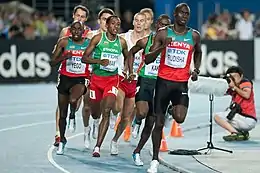 Men's 800 metres final in Daegu 2011. | |
| World records | |
| Men |  David Rudisha 1:40.91 (2012) David Rudisha 1:40.91 (2012) |
| Women |  Jarmila Kratochvílová 1:53.28 (1983) Jarmila Kratochvílová 1:53.28 (1983) |
| Olympic records | |
| Men | David Rudisha 1:40.91 (2012) |
| Women |  Nadezhda Olizarenko 1:53.43 (1980) Nadezhda Olizarenko 1:53.43 (1980) |
| World Championship records | |
| Men |  Donavan Brazier 1:42.34 (2019) Donavan Brazier 1:42.34 (2019) |
| Women | Jarmila Kratochvílová 1:53.28 (1983) |
The event was derived from the imperial measurement of a half mile (880 yards), a traditional English racing distance. 800m is 4.67m less than a half mile.
The event combines aerobic endurance with anaerobic conditioning and sprint speed, so the 800m athlete has to combine training for both.
Runners in this event are occasionally fast enough to also compete in the 400 metres but more commonly have enough endurance to 'double up' in the 1500m. Only Alberto Juantorena and Jarmila Kratochvílová have won major international titles at 400m and 800m.
Race tactics
The 800m is also known for its tactical racing. Because it is the shortest middle-distance event that has all the runners converge into one lane (after 100m), positioning on the cut-in and the position of the pack is critical to the outcome of the race. Gaining a front position early in the race is often advantageous as there are occasionally trips when running in a pack. Olympic champions Dave Wottle, Kelly Holmes and others have defied that logic by running a more evenly paced race, lagging behind the pack and accelerating past the slowing early leaders. Often the winner of elite 800m races is not the fastest runner, but the athlete best positioned near the end of the race: an athlete directly behind another runner, has to switch to an outer lane to overtake, so has to run further—and might be blocked by a third runner alongside.[1]
800 metre participants usually run a positive split, where the first lap is faster, but a negative split is occasionally run as a tactic. The current world record (by David Rudisha) was run with a positive split in the 2012 Olympic. Rudisha ran the first lap in 49.28 seconds and the second in 51.63 seconds. Theoretically, an even split is the most efficient running mode, but it is difficult to pace correctly.
Continental records
| Area | Men | Women | ||||
|---|---|---|---|---|---|---|
| Time | Athlete | Nation | Time | Athlete | Nation | |
| Africa (records) | 1:40.91 WR | David Rudisha | Kenya | 1:54.01 | Pamela Jelimo | Kenya |
| Asia (records) | 1:42.79 | Yusuf Saad Kamel |  Bahrain Bahrain | 1:55.54 | Dong Liu |  China China |
| Europe (records) | 1:41.11 | Wilson Kipketer |  Denmark Denmark | 1:53.28 WR | Jarmila Kratochvílová | Czechoslovakia |
| North, Central America and Caribbean (records) | 1:42.34 | Donavan Brazier | United States | 1:54.44 | Ana Fidelia Quirot |  Cuba Cuba |
| Oceania (records) | 1:44.11 | Peter Bol | .svg.png.webp) Australia Australia | 1:58.09 | Catriona Bisset | Australia |
| South America (records) | 1:41.77 | Joaquim Cruz |  Brazil Brazil | 1:56.58 | Letitia Vriesde |  Suriname Suriname |
All-time top 25
Men
- Correct as of August 2021.[4]









Notes
Below is a list of other times equal or superior to 1:42.66:
- David Rudisha also ran 1:41.01 (2010), 1:41.09 (2010), 1:41.33 (2011), 1:41.51 (2010), 1:41.54 (2012), 1:41.74 (2012), 1:42.01 (2009), 1:42.04 (2010), 1:42.12A (2012) and 1:42.15 (2016).
- Wilson Kipketer also ran 1:41.24 (1997), 1:41.73 (1997), 1:41.83 (1996), 1:42.17 (1996), 1:42.20 (1997), 1:42.27 (1999) and 1:42.32 (2002).
- Nijel Amos also ran 1:41.89 (2019) 1:42.14 (2018), 1:42.45 (2014) and 1:42.66 (2015).
- Sebastian Coe also ran 1:42.33 (1979)
Women
- Correct as of August 2021.[13]
.svg.png.webp)






Notes
Below is a list of other times equal or superior to 1:55.28:
- Caster Semenya also ran 1:54.60 (2018), 1:54.77 (2018), 1:54.98 (2019), 1:55.16 (2017), 1:55.27 (2017 & 2018) and 1:55.28 (2016).
- Jarmila Kratochvílová also ran 1:54.68 (1983) and 1:55.04 (1983).
- Ana Fidelia Quirot also ran 1:54.82 (1997).
- Nadezhda Olizarenko also ran 1:54.85 (1980).
- Pamela Jelimo also ran 1:54.87 (2008), 1:54.97 (2008), 1:54.99 (2008) and 1:55.16 (2008).
- Olga Mineyeva also ran hand-timed 1:55.1 (1980).
- Athing Mu also ran 1:55.21 (2021)
Non-legal marks
- Yelena Soboleva of Russia's time of 1:54.85 set in Kazan on 18 July 2007 was annulled due to doping offense.
- Mariya Savinova of Russia's time of 1:55.87 set in Tula on 5 July 2008 was annulled due to doping offence.
Juniors
World junior records (19 and under) are held by Nijel Amos (1:41.73, London, 9 August 2012) and Pamela Jelimo (1:54.01, Zürich, 29 August 2008). Both marks coincidentally rank them as the third fastest ever.
Olympic medalists
Men
.svg.png.webp)
.svg.png.webp)
.svg.png.webp)
.svg.png.webp)
.svg.png.webp)
.svg.png.webp)
.svg.png.webp)

.svg.png.webp)
.svg.png.webp)
.svg.png.webp)
.svg.png.webp)


.svg.png.webp)
.svg.png.webp)
.svg.png.webp)

.svg.png.webp)


Women
.svg.png.webp)
.svg.png.webp)
.svg.png.webp)

World Championships medalists
Men

.svg.png.webp)

Women



World Indoor Championships medalists
Men

Women
.svg.png.webp)
- A Known as the World Indoor Games
Season's bests
.svg.png.webp)
References
- Versaw, Rob. "A Fan's Guide to the 800m". Arizona Milesplit. Retrieved 25 June 2018.
- "Men's outdoor 800 Metres | Records". worldathletics.org. World Athletics. Retrieved 28 May 2021.
- "Women's outdoor 800 Metres | Records". worldathletcs.org. World Athletics. Retrieved 28 May 2021.
- "All-time men's best 800m". alltime-athletics.com. 19 August 2018. Retrieved 22 August 2018.
- "800 Metres Results". IAAF. 9 August 2012. Retrieved 14 November 2012.
- "800m Results" (PDF). sportresult.com. 22 July 2018. Retrieved 2 August 2018.
- "800m Results". diamondleague-oslo.com. 4 June 2010. Archived from the original on 7 June 2010. Retrieved 7 June 2010.
- "800m Results" (PDF). IAAF. 1 October 2019. Retrieved 3 October 2019.
- "800m Result" (PDF). Diamond League. Omega Timing. 6 September 2013. Retrieved 6 September 2013.
- "800m Results" (PDF). sportresult.com. 17 July 2015. Retrieved 18 July 2015.
- Mike Rowbottom (12 July 2019). "Hassan breaks world mile record in Monaco with 4:12.33 - IAAF Diamond League". IAAF. Retrieved 28 July 2019.
- "Men's 800m Results" (PDF). Rio 2016 official website. 15 August 2016. Archived from the original (PDF) on 20 September 2016. Retrieved 16 August 2016.
- "All-time women's best 800m". alltime-athletics.com. 16 July 2017. Retrieved 21 July 2017.
- "800m Results" (PDF). sportresult.com. 30 June 2018. Retrieved 3 July 2018.
- "Prefontaine Classic 2021 Complete Results" (PDF). sportresult.com. 21 August 2021. Retrieved 27 August 2021.
- "800m Results" (PDF). sportresult.com. 21 July 2017. Retrieved 21 July 2017.
- On 10 February 2017, the Court of Arbitration for Sport upheld a four-year ban that effectively stripped of the gold medal of Mariya Savinova of Russia, based upon her biological passport. Caster Semenya of South Africa was advanced to gold, Ekaterina Poistogova of Russia to silver, and Pamela Jelimo of Kenya to bronze. Poistogova herself was later found guilty of doping, but her Olympic results were unaffected, and the IOC decided to upgrade her medal. 1