A. R. Rahman: The Spirit of Music
A. R. Rahman: The Spirit of Music is a biography by the author and television documentary producer Nasreen Munni Kabir, containing her extensive conversations with the composer A. R. Rahman on the latter's life and career. It describes his birth in Madras (present-day Chennai) in 1967, his 29-year-long musical career, and his marriage in 1995 to Saira Banu, with whom he has three children. The book was published by Om Books International on 29 March 2011 and declared as a commercial success.
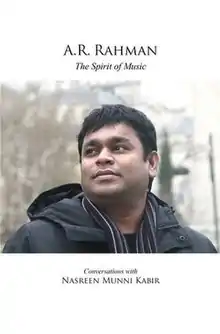 | |
| Author | Nasreen Munni Kabir |
|---|---|
| Country | India |
| Language | English |
| Subject | A. R. Rahman |
| Genre | Biography |
| Published | 29 March 2011 |
| Publisher | Om Books International |
| Media type | |
| Pages | 215 |
| ISBN | 978-93-80070-14-8 |
| OCLC | 722845483 |
A. R. Rahman: The Spirit of Music was the second work on Rahman, following the unathorised biography A. R. Rahman: The Musical Storm (2009) from Kamini Mathai. Kabir's first discussion with him about the book happened in 2003, while their conversations started in 2007 and ended four years later. Critical reviews to the book were mixed, some of which panned the author for providing less detail information about his Tamil songs. However, its question-and-answer format was generally praised.
Summary
The book contains A. R. Rahman's extensive conversations with the author Nasreen Munni Kabir. It opens with the sentence "எல்லாப் புகழும் இறைவனுக்கே" ("Ellap pukalum iraivanukke", Tamil for "All praise to God"), and is followed by they talk on his influences to Indian music industry and modern-day Indian people's interest in songs. The book later focuses on his birth to the Malayalam composer R. K. Shekhar and his wife Kasturi in Madras (present-day Chennai) on 6 January 1967. The book also chronicles on his cinematic debut, composing songs for Roja (1992), which became the first of his many collaborations with the filmmaker Mani Ratnam, and his conversion from Hinduism to Islam. Rahman's 1995 marriage to Saira Banu, with whom he has three children, continues it. The book ends with his discography, his list of accolades, and notes for the 1995 film Bombay's theme song and Roja's "Cry of the Rose".
Writing and release

Nasreen Munni Kabir, who had written several books on Indian cinema throughout her career, often used the question-and-answer style for her works and A. R. Rahman: The Spirit of Music is one of which. In an interview for The Hindu, she said she actually could write the book narratively but she would feel uncomfortable doing it and choosing this style since it is the best way to keep the book's readers "connected to the subject".[1] She said, "I like primary research and people speaking in their own words, from their own experience. That does not mean narrative biographies aren't needed, yes they are. But considering how busy [Rahman] is, this was a good format."[2] According to Kabir, she first met Rahman while she was interviewing him at his studio in Chennai for Channel 4 in 1999.[1] However, their earliest discussion on the idea of the book was in 2003, which later met with approval from Rahman.[2]
They started the conversations in 2007,[3]:6 but Kabir stated the "actual work" began in the next year. Asked by a Reuters interviewer, Rahman believed most facts in it have been said by himself in other interviews with the media. "But what she ... wanted to do was to have a completeness in the whole thing, and that's what is special about Munni and what makes it work", he revealed.[4] She recounted the process was slow, attributing it on his busy schedule.[2] When Rahman was not on his mood to talking, they would take a walk while Kabir thinking of questions she would ask to him. Describing him as "very spiritual", Kabir likened working with him with doing an adventure and took note of how free-spirited he was.[2] She also found the musician to be more confident when she interviewed him for the book, believing that his older age and the success of his works have influenced him behaviorally.[1] The conversations ended in 2011.[3]:6
A. R. Rahman: The Spirit of Music was published on hardcover by Om Books International on 29 March 2011;[3] a CD containing Rahman's eight unreleased songs is also included in the edition.[5] A launch event was held in Juhu, Mumbai on 6 April,[6] with several of his contemporaries, including Mani Ratnam and Ram Gopal Varma, attending it.[7] The book was the second work on Rahman, after Kamini Mathai's A. R. Rahman: The Musical Storm (2009), but was the first one authorised by Rahman himself; he explained that Mathai's book is unathorised because he has not read it.[8] Ajay Mago from the publishing company told Bollywood Hungama it was an honour for him to publish the book as "A. R. Rahman's journey, like that of most great artists, is one that moves and inspires."[6] Emerging as a commercial success, A. R. Rahman: The Spirit of Music debuted at and peaked the fifth position in The Hindu's non-fiction bestsellers on 19 April.[9] Its Amazon Kindle version was released on 7 July 2017,[10] followed by the paperback edition twelve days later.[11]
Critical reception
Critics were polarised in their reviews, receiving positively its question-and-answer format while panning Kabir's effort in collecting information of Rahman's Tamil songs. Charmy Harikrishnan of The Indian Express summarised, "... while Rahman holds your attention for the most parts, the way in which the Q and A has been arranged does little to give the book a structure or the narrative any kind of coherence. Kabir's exploration of Rahman's Tamil film music is meagre and unsatisfactory."[12] A writer of Bollywood Hungama suggested Kabir to divide the book in several chapters and felt "there is a distinct sense of incompleteness that one gets mid-way into reading it",[13] while the magazine India Today's Kaveree Bamzai called it "a remarkable insight into a magical mind". Bamzai added that "Rahman is an anomaly. Sometimes the more he's written about, the less he seems revealed. Kabir's patient listening pays off. Rahman seems at ease here, talking as openly about his faith as he does about his wife."[14]
Writing for the Emirati newspaper Gulf News, Mythily Ramachandran found the book "easy-to-read" and concise. She said it "does whet your appetite interspersed with pictures from Rahman's albums, hitherto unseen", concluding her review with praising Kabir for doing a well job.[15] The editor Jitesh Pillai, publishing a column in Filmfare, observed of the book, "Trying to capture his thoughts and songscapes cannot be an easy task and Nasreen Munni Kabir ... does manage an enthusiastic job. It's in interview format and we get to know the maestro up close and personal and there are anecdotes there, priceless ones that intrigue, overwhelm and stay with you."[16] Kala Krishnan Ramesh from Indiaplaza recommended it for those who are fans of Rahman, complimenting Kabir's thorough and perceptive questioning style.[17] The Hindustan Times' critic described it as "a close, fascinating insight" on him, adding, "What makes Kabir's book such a delight is that it is replete with fascinating insights about Rahman's music."[18]
Publication history
| Region | Release date | Format |
|---|---|---|
| India | 29 March 2011 | Hardcover[3] |
| 7 July 2017 | Amazon Kindle[10] | |
| 19 July 2017 | Paperback[11] |
References
- Kumar 2011, Noteworthy encounters.
- N. 2011, 'Working with Rahman.
- Kabir 2011, A. R. Rahman.
- Jamkhandikar 2011, A minute with.
- Jhunjhunwala 2011, Sheet music, soul.
- Bollywood Hungama 2011, A. R. Rahman's.
- N. 2011, Rahman's biography launched.
- Raghavan 2011, A lot's in.
- The Hindu 2011, Bestsellers.
- Kabir 2017a, A. R. Rahman.
- Kabir 2017b, A. R. Rahman.
- Harikrishnan 2011, Rahman recorded.
- Bollywood Hungama 2011, Book review.
- Bamzai 2011, Item nation.
- Ramachandran 2011, The world dances.
- Pillai 2016, Revealing Rahman.
- Ramesh 2011, Print pick.
- Ghosh 2011, Jai ho!.
Sources
- "A. R. Rahman's first authorized biography to release on April 6". Bollywood Hungama. 22 March 2011. Archived from the original on 12 August 2021. Retrieved 18 August 2021.
- Bamzai, Kaveree (2 May 2011). "Item nation". India Today. Archived from the original on 12 August 2021. Retrieved 18 August 2021.
- "Bestsellers". The Hindu. Hyderabad, India. 19 April 2011. Archived from the original on 12 August 2021. Retrieved 18 August 2021.
- "Book review: A. R. Rahman – The Spirit of Music". Bollywood Hungama. 11 April 2011. Archived from the original on 23 September 2020. Retrieved 18 August 2021.
- Ghosh, Shohini (6 May 2011). "Jai ho!". Hindustan Times. Archived from the original on 18 August 2021. Retrieved 18 August 2021.
- Harikrishnan, Charmy (16 April 2011). "Rahman recorded". The Indian Express. Archived from the original on 12 August 2021. Retrieved 18 August 2021.
- Jamkhandikar, Shilpa (9 April 2011). "A minute with: A.R. Rahman on 'The Spirit of Music'". Reuters. Archived from the original on 12 August 2021. Retrieved 18 August 2021.
- Jhunjhunwala, Udita (1 April 2011). "Sheet music, soul notes". Mint. Archived from the original on 12 August 2021. Retrieved 18 August 2021.
- Kabir, Nasreen Munni (29 March 2011). A. R. Rahman: The Spirit of Music. Noida, India: Om Books International. ISBN 978-93-80070-14-8.
- Kabir, Nasreen Munni (7 July 2017). A. R. Rahman: The Spirit of Music. Noida, India: Om Books International. ASIN B074L8PQPK.
- Kabir, Nasreen Munni (19 July 2017). A. R. Rahman: The Spirit of Music. Noida, India: Om Books International. ISBN 978-93-52761-16-6.
- Kumar, Anuj (29 April 2011). "Noteworthy encounters". The Hindu. Archived from the original on 12 August 2021. Retrieved 14 August 2021.
- N., Patcy (7 April 2011). "Rahman's biography launched". Rediff.com. Archived from the original on 10 April 2011. Retrieved 18 August 2021.
- N., Patcy (19 April 2011). "'Working with Rahman is an adventure'". Rediff.com. Archived from the original on 23 April 2011. Retrieved 14 August 2021.
- Pillai, Jitesh (6 January 2016). "Revealing Rahman". Filmfare. Archived from the original on 18 August 2021. Retrieved 18 August 2021.
- Raghavan, Nikhil (3 April 2011). "A lot's in a book". The Hindu. Archived from the original on 12 August 2021. Retrieved 18 August 2021.
- Ramachandran, Mythily (6 May 2011). "The world dances to his tunes". Gulf News. Archived from the original on 18 August 2021. Retrieved 18 August 2021.
- Ramesh, Kala Krishnan (25 July 2011). "Print pick". The Hindu. Archived from the original on 18 August 2021. Retrieved 18 August 2021.