Conversations on the Plurality of Worlds
Conversations on the Plurality of Worlds (French: Entretiens sur la pluralité des mondes) is a popular science book by French author Bernard le Bovier de Fontenelle, published in 1686.
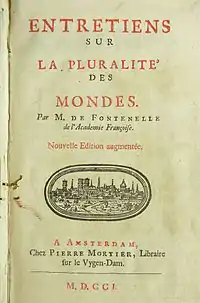 Front page of 1701 edition | |
| Author | Bernard le Bovier de Fontenelle |
|---|---|
| Original title | Entretiens sur la pluralité des mondes |
| Country | France |
| Language | French |
| Published | 1686 |
It is an early exposition of cosmic pluralism, the idea that the stars are distant suns which might have their own planetary systems, including the possibility of extraterrestrial life. The book is Fontenelle's most famous work and is considered to be one of the first major works of the Age of Enlightenment.
Background
Unlike many scientific works of its time, Conversations on the Plurality of Worlds was written not in Latin, but in French and is notable as one of the first books to attempt an explanation of scientific theories in popular language. A precursor of the book Giordano Bruno's De l'infinito, universo e mondi of 1584.
Content
In the preface, Fontenelle suggests that the offered explanation should be easily understood even by those without scientific knowledge, and he specifically addresses female readers. The book itself is presented as a series of conversations between a gallant philosopher and a marquise, who walk in the latter's garden at night and gaze at stars. The philosopher explains the heliocentric model and also muses on the possibility of extraterrestrial life.
Reception
The book was very well received both in France and elsewhere, and was regularly published. In 1691, Fontenelle was elected to the Académie française.[1] Fontenelle's work was not cast polemically against the world view of the Catholic Church or the Protestant churches, nor did it attract the attention, positive or negative, of theologians or prelates.
Translations
The first English translation was compounded by John Glanvill in 1687, followed by another translation by Aphra Behn in 1688, under the title A Discovery of New Worlds. Antiokh Kantemir translated it into Russian in 1730, although the translation was only published in a censored edition in 1740, due to objections from the Russian Orthodox Church.
References
External links
- Full text of 1800 edition at Google Books (in French)
- Full text of 1803 edition at Google Books (in English)
- Full text of 1803 edition Digitized by Google, Free Download at OpenLibrary (in English)
Authority control  | |
|---|---|
| General | |
| National libraries | |