Abbott and Costello Meet Frankenstein
Abbott and Costello Meet Frankenstein[lower-alpha 1] is a 1948 American horror comedy film directed by Charles Barton. The film features Count Dracula (Bela Lugosi) who has become partners with Dr. Sandra Mornay (Lenore Aubert), as Dracula requires "simple, pliable" brain to reactivate Frankenstein's monster (Glenn Strange). Dracula discovers that the "ideal" brain belongs to Wilbur Grey (Lou Costello) who is wooed by Mornay to the operating table, despite the warnings of Lawrence Talbot (Lon Chaney Jr.).
| Abbott and Costello Meet Frankenstein | |
|---|---|
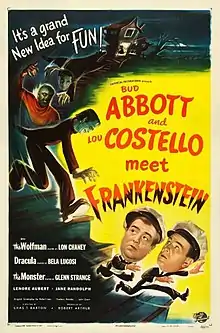 Theatrical release poster | |
| Directed by | Charles Barton |
| Screenplay by |
|
| Produced by | Robert Arthur[1] |
| Starring | |
| Cinematography | Charles Van Enger[1] |
| Edited by | Frank Gross[1] |
| Music by | Frank Skinner |
Production companies | Universal-International Pictures Co., Inc.[1] |
| Distributed by | Universal Pictures Company, Inc. |
Release date |
|
Running time | 82 minutes[2] |
| Country | United States[1] |
| Language | English[1] |
| Budget | $792,270[3] |
| Box office | $3.2 million[4] |
The film was developed and began being made against the wishes of Abbot and Costello, with Costello specifically not liking the script. The film was made under difficulty according to director Barton who found Abbott and Costello often absent or not working on the set. On the films release, it was one of Universal-Internationals's biggest films of the year and led to several follow-up films involving Abbot and Costello meeting other horror film actors and creatures. The film was well received by trade papers and West Coast american critics on its release but received poor reviews in New York. In 2001, the United States Library of Congress deemed this film "culturally, historically, or aesthetically significant" and selected it for preservation in the National Film Registry and later placed in at number 56 on the list of the American Film Institute's "100 Funniest American Movies".
Plot
Larry Talbot makes an urgent phone call to a railway station in Florida, where Chick Young and Wilbur Grey work as baggage clerks. Talbot tries to warn Wilbur of a shipment due to arrive for "McDougal's House of Horrors". However, before he finishes, the moon rises and Talbot transforms into a werewolf, causing Wilbur to think the call is a prank. Meanwhile, McDougal demands the crates be personally delivered to his wax museum.
Chick and Wilbur deliver the crates after hours. They open the first one and find Dracula's coffin. When Chick leaves the room to retrieve the second crate, Wilbur reads the Dracula legend, and the coffin suddenly opens and Dracula sneaks out. Wilbur is so frightened he can barely articulate his call for help. When Chick returns, he refuses to believe the story. The boys open the second crate, and Chick goes to greet McDougal. Dracula hypnotizes Wilbur, finds Frankenstein's Monster in the second crate, and reanimates him. Both leave, and McDougal finds the crates empty and has Wilbur and Chick arrested.
That night, Dr. Sandra Mornay welcomes Dracula and the Monster to her island castle. Sandra has seduced Wilbur as part of Dracula's plan to give the monster a more obedient brain. Meanwhile, Wilbur and Chick are bailed out of jail by Joan Raymond, an undercover insurance investigator who feigns love for Wilbur, hoping to gain information. Wilbur invites Joan to a masquerade ball that evening. Talbot takes the apartment across the hall from Wilbur and Chick, and asks them to help him find and destroy Dracula and the Monster. Wilbur agrees, but Chick remains skeptical.
Wilbur, Chick and Joan go to Sandra's castle to pick her up for the ball. Wilbur answers a telephone call from Talbot, who informs them that they are in fact in the "House of Dracula". Wilbur reluctantly agrees to search the castle and soon stumbles upon a basement staircase, where he has a few close encounters with the monsters. Meanwhile, Joan discovers Dr. Frankenstein's notebook in Sandra's desk, and Sandra finds an Insurance Investigator ID in Joan's purse.
Dracula, under the alias of Dr. Lejos, introduces himself to Joan and the boys. Also working at the castle and attending the ball is the naïve Professor Stevens, who questions some of the specialized equipment that has arrived. After Wilbur says that he was in the basement, Sandra feigns a headache and tells the others to attend the ball without her. In private, Sandra admits to Dracula that she feels they are not safe to conduct the experiment. Dracula then turns her into a vampire.
At the masquerade ball, Talbot accuses Lejos of being Dracula, but no one takes him seriously. Joan soon disappears. Sandra lures Wilbur into the woods and attempts to bite him, but fails. While looking for Joan, Talbot becomes the Wolfman and attacks McDougal. Since Chick's costume is a wolf, McDougal accuses Chick, who escapes and witnesses Dracula hypnotizing Wilbur. Chick is also hypnotized and rendered helpless, while Dracula and Sandra bring Wilbur, Stevens, and Joan back to the castle. The next morning, Chick and Talbot meet up in the bayou and set out to rescue Wilbur and Joan.
Wilbur is quickly freed, but Dracula uses hypnotism to call him back. As Sandra prepares to cut into Wilbur's brain, Talbot and Chick burst in. Chick knocks out Sandra with a chair, and Talbot tries to free Wilbur but turns into the Wolfman again. Frankenstein's Monster breaks free of his bonds—Sandra tries to control him, but he throws her out the window. After a chase through the house, Dracula transforms into a bat but is pounced on by the Wolfman, who drags the two of them to their deaths. Chick, Stevens, Joan and Wilbur escape in boats; Stevens sets the pier ablaze while the Monster is standing on it, and he dies in the flames.
Wilbur scolds Chick for his earlier skepticism, and Chick remarks they have nothing to fear now. The Invisible Man addresses them from the boat's thwart, and they flee the boat in terror.
Cast
Cast adapted from the American Film Institute.[1]
- Bud Abbott as Chick Young
- Lou Costello as Wilbur Grey
- Lon Chaney Jr. as Lawrence Talbot / The Wolf Man
- Béla Lugosi as Dracula
- Glenn Strange as Monster
- Lenore Aubert as Sandra Mornay
- Jane Randolph as Joan Raymond
- Frank Ferguson as Mr. McDougal
- Charles Bradstreet as Dr. Stevens
The following cast went uncredited in the film:[1]
- Vincent Price as the voice of the Invisible Man
Production
Background and development
On November 28, 1945, Universal Pictures joined with British entrepreneur J. Arthur Rank, who bought one-fourth interest in the studio.[5] In 1946, Universal reported a profit of only $4.6 million. They responded by dropping many actors from their contract roster, including Chaney.[6] On July 31, 1946, an official merger began. The company, now called Universal–International, had only Deanna Durbin, Maria Montez, Bud Abbott and Lou Costello and a few other actors remaining on their payroll.[5][6] Since the February 1941 release of Buck Privates starring Abbott and Costello, the duo were among the powerful stars at Universal.[7] By 1945, the duo nearly split up as they were fighting each other and suffered from their own personal issues: Abbott suffered from severe epilepsy and Costello had nearly died of rheumatic heart disease in 1943.[7]
In their first year of operation, the studio nearly went bankrupt.[8] In 1948, William Goetz, who was in charge of production since Universal merged with International Pictures [9] In the same year, Abbott and Costello's popularity was also waning with the team not having a Top Ten box office hit since 1954.[10] According to director Charles Barton, who was among the top comedy film directors at Universal between 1945 to 1952, Goetz did not want having anything to with Abbott and Costello after Metro-Goldwyn-Mayer had dropped their option for more films from the team and Camel Cigarettes dropped their radio show in 1947.[10]
Pre-production
Robert Arthur, a former writer and associate producer of MGM musicals along with veteran Abbott and Costello writers Frederic Rinaldo and Robert Lees developed a script that involved Frankenstein's monster, Count Dracula and the Wolf Man. Their original script also included Kharis the Mummy, Dracula's son Alucard, and The Invisible Man.[10] Their script involved the Monster becoming Dracula's slave and began seeking a brain of a simpleton to be placed in the Monster's, eventually settling on Lou Costello's.[10] Kharis, and Alucard were dropped from the script and the Invisible Man was only included as a small gag at the end of the film.[10] On reading their script initially titled The Brain of Frankenstein, Lou Costello responded negatively stating "You don't think I'll do that crap do you? My 5-year old daughter can write something better than that."[10]
Arthur felt strongly about the project and offered Costello a $50,000 advance on his percentage if he agreed do the film.[10] Among the cast was Glenn Strange, who had previously played the Monster in House of Dracula (1945).[11] Strange had only been in a handful of roles since that film, including Monogram's Beauty and the Bandit (1946), Eagle-Lion's Frontier Fighters (1947) and two for Universal: Brute Force (1947) and another Abbott and Costello film, The Wistful Widow of Wagon Gap (1947).[11] Other actors were called back to reprise roles from previous Universal horror films, including Lon Chaney, Jr. as The Wolf Man.[11] Chaney had been doing stage work on Of Mice and Men and Born Yesterday.[11] Bela Lugosi returned to as Count Dracula, who had not worked in a Hollywood studio since 1946 with Scared to Death.[11]
Production
"All three of the "monsters" were the nicest. The real monsters were Abbott and Costello."
- Charles Barton, director of Abbott and Costello Meet Frankenstein[12]
According to Barton, Abbott and Costello were not happy with working on the project, noting that the two would "fight me like hell. But I stood my ground with them, and so did Bob Arthur."[12] Barton continued that both the comedians would would leave hom several times during shooting the film, not show up, or spend about three days playing cards on set.[12]
The film had a new make-up department opposed to the old one headed by Jack Pierce.[12] Emile LaVigne tended to Chaney's make-up while Jack Kevan worked on Glenn Strange.[12] Both Chaney and Strange required one hour each in the make-up chair in the morning before each set with much of Strange's make-up now being a rubber mask.[12] Strange later recalled that the set was "one of the most enjoyable pictures I ever worked on"[13]
An accident on set caused production that nearly led to the production to be briefly halted. In one scene, Strange was supposed to throw Lenore Aubert through a window. An invisible wire would be attached to her to help Strange lift her. When she was thrown, she swung back into camera range leading Strange attempting to catch her, falling and breaking his foot in the process. As Strange's injury was being treated, Chaney took to applying the make-up and portrayed the monster throwing Aubert through the window.[14] Filming completed production on March 20, 1948.[14]
Post-production started immediately on the film.[14] Frank Skinner who had previously scored Son of Frankenstein (1939) and worked on the score of The Wolf Man (1941) composed the original score for the film.[15] Special effects for the film were developed by David Horsley and Jerome Ash. [16] Special effects in the film included the bats that could be seen in the eyes of Lugosi and Miss Aubert and the animation that transformed Lugosi into a bat.[16]
Release
Abbott and Costello Meet Frankenstein was released on June 15, 1948. [1] It would be shown on July 24, 1948 at in Los Angeles's United Artists, Guild, Ritz, Iris and Studio City theatres. [16] The film went on to become the most successful film int the Frankenstein series since the original release of Frankenstein (1931). [16] Along with Naked City and Tap Roots, it became one of Universal-International's highest grossing features of the year. [16] To promote the film, Univeral payed Boris Karloff's New York hotel bill to pose outside of Loew's Criterion Theatre in New York to promote the film.[17] Karloff agreed, stating "as long as I don't have to see the movie!"[17] According to Variety the film earned $2.2 million in the US in 1948.[18]
Originally released as a single DVD on August 29, 2000,[19] it was re-released several times as part of different Abbott and Costello collections, The Best of Abbott and Costello Volume Three, on August 3, 2004,[20] on October 28, 2008 as part of Abbott and Costello: The Complete Universal Pictures Collection,[21] and in 2015 in the Abbott and Costello Meet the Monsters Collection. The film's Blu-ray debut and DVD re-release was on September 4, 2012 as part of Universal's 100th Anniversary series.[22] It was also included in Frankenstein: Complete Legacy Collection (2014) along with seven other Universal Frankenstein films. Because this film includes characters and people featured in their own collections, it is part of the legacy collections of "Frankenstein", "Dracula", "The Wolf Man", and "The Best of Abbott and Costello".[23]
Reception
From contemporary reviews, trade papers praised the film. a review in The Hollywood Reporter proclaimed it as a "crazy giddy show" noting that "Robert Arthur's production spells out showmanship right down the line, and Charles T. Barton's direction keeps things moving at a lively, vigourous pace."[16] Variety echoed this praise, stating that Arthur and Barton "can chalk it up as one of the best for [Abbot and Costello]."[16] The Los Angeles Times critic Philip K. Scheuer praised the film as "put together with enormous ingenuity. Its comic inventiveness seldom falters, yet it never seriously violates the tradition of the three celebrated creatures who are its antagonists."[16]
On the films release in New York City's Lowe's Criterion Theatre, the film predominantly received negative films from the Manhattan critics. [16] On Rotten Tomatoes, the film holds an approval rating of 89% based on 27 reviews and a weighted average rating of 7.08/10. The site's critical consensus reads, "A zany horror spoof that plays up and then plays into the best of Universal horror cliches."[24]
Legacy
Following the success of the film, Universal-International paired Abbott and Costello in similar situations to this film. The first was Abbott and Costello Meet the Killer, Boris Karloff (1949).[17] This was followed by other films and pairings, including Abbott and Costello Meet the Invisible Man (1951), Abbott and Costello Meet Dr. Jekyll and Mr. Hyde (1953), and their last film for Universal: Abbott and Costello Meet the Mummy (1955).[17] The duo only made one more film following their 1953 feature, Dance With Me, Henry which was directed by Barton and made for United Artists.[17]
Lon Chaney, Jr. did not have positive things to say about the feature, later proclaiming that he "used to enjoy horror films when there was thought and sympathy involved. Then they became comedies. Abbott and Costello ruined the horror films: they made buffoons out of the monsters..."[25]
In 2001, the United States Library of Congress deemed this film "culturally, historically, or aesthetically significant" and selected it for preservation in the National Film Registry,[26][27] The film is number 56 on the list of the American Film Institute's "100 Funniest American Movies".[28]
See also
References
- "Bud Abbott and Lou Costello Meet Frankenstein (1948)". American Film Institute. Archived from the original on December 11, 2021. Retrieved December 11, 2021.
- Mank 1981, p. 151.
- Furmanek & Palumbo 1991, p. 168.
- Furmanek & Palumbo 1991, p. 175.
- Weaver, Brunas & Brunas 2007, p. 14.
- Mank 2020, p. 72.
- Mank 1981, p. 156.
- Mank 1981, p. 155.
- Mank 1981, p. 155-156.
- Mank 1981, p. 157.
- Mank 1981, p. 158.
- Mank 1981, p. 159.
- Mank 1981, p. 160.
- Mank 1981, p. 161.
- Mank 1981, p. 161-162.
- Mank 1981, p. 162.
- Mank 1981, p. 163.
- "Top Grossers of 1948". Variety. Vol. 173 no. 4. January 5, 1949. p. 46. Retrieved December 11, 2021 – via Archive.org.
- Beierle, Aaron (2000-08-17). "Abbott And Costello Meet Frankenstein". DVD Talk. Retrieved 2020-04-21.
- Galbraith, Stuart (2004-09-01). "The Best of Abbott & Costello - Volume 3 (8 Film Collection)". DVD Talk. Retrieved 2020-04-21.
- Galbraith, Stuart (2008-12-03). "Abbott and Costello: The Complete Universal Pictures Collection". DVD Talk. Retrieved 2020-04-21.
- Galbraith, Stuart (2012-08-27). "Bud Abbott Lou Costello Meet Frankenstein (Abbott and Costello Meet Frankenstein) (Blu-ray)". DVD Talk. Retrieved 2020-04-21.
- Erickson, Glenn (2014-09-28). "Universal Classic Monsters: Complete 30-Film Collection 1931-1956 Savant DVD Review". DVD Talk. Retrieved 2020-04-21.
- "Abbott and Costello Meet Frankenstein (1948)". Rotten Tomatoes. Fandango. Retrieved 3 March 2020.
- Mank 1981, p. 164.
- "Librarian of Congress Names 25 More Films to National Film Registry". Library of Congress, Washington, D.C. 20540 USA. Retrieved 2020-05-18.
- "Complete National Film Registry Listing | Film Registry | National Film Preservation Board | Programs at the Library of Congress | Library of Congress". Library of Congress, Washington, D.C. 20540 USA. Retrieved 2020-05-18.
- "Archived copy". Archived from the original on 2017-06-23. Retrieved 2016-08-12.CS1 maint: archived copy as title (link)
Notes
- The film's poster title reads Bud Abbott and Lou Costello Meet Frankenstein, and the onscreen title is Bud Abbott Lou Costello Meet Frankenstein.
Sources
- Furmanek, Bob; Palumbo, Ron (1991). Abbott and Costello in Hollywood. Perigee Books. ISBN 0-399-51605-0.
- Mank, Gregory William (1981). It's Alive! The Classic Cinema Saga of Frankenstein. A.S. Barnes & Company, Inc. ISBN 0-498-02473-3.
- Mank, Gregory Wm. (2020) [1993]. "Production Background". In Riley, Philip J. (ed.). House of Dracula. BearManor Media. ISBN 978-1629336169.
- Weaver, Tom; Brunas, Michael; Brunas, John (2007) [1990]. Universal Horrors (2 ed.). McFarland & Company. ISBN 978-0-7864-2974-5.
External links
 |
Wikiquote has quotations related to: Abbott and Costello Meet Frankenstein |
 |
Wikimedia Commons has media related to Abbott and Costello Meet Frankenstein. |
- Abbott and Costello Meet Frankenstein essay by Ron Palumbo at National Film Registry
- Abbott and Costello Meet Frankenstein essay by Daniel Eagan in America's Film Legacy: The Authoritative Guide to the Landmark Movies in the National Film Registry, A&C Black, 2010 ISBN 0826429777, pages 417-417

Authority control  | |
|---|---|
| General | |
| National libraries | |