Argentine seabass
The Argentine seabass (Acanthistius brasilianus), is a species of seabass in the family Serranidae.[1] They can be found on the South American continental shelf of the western Atlantic Ocean, where it is caught commercially for human consumption.[2]
| Argentine seabass | |
|---|---|
.jpg.webp) | |
Scientific classification  | |
| Kingdom: | Animalia |
| Phylum: | Chordata |
| Class: | Actinopterygii |
| Order: | Perciformes |
| Family: | Serranidae |
| Genus: | Acanthistius |
| Species: | A. brasilianus |
| Binomial name | |
| Acanthistius brasilianus (Cuvier, 1828) | |
| Synonyms | |
Taxonomy and naming
The Argentine seabass, was first described by Georges Cuvier as part of his 22 volume work Histoire naturelle des poissons, which he wrote with Achille Valenciennes from 1828 to 1849.[3][4] He originally named it Plectropoma brasilianum, though it is now considered a synonym of Acanthistius brasilianus.[3][5] As a result of his participation in first voyage of the HMS Beagle, Leonard Jenyns described a fish in 1840 that he named Plectropoma patachonica, and while many of the fishes he observed may have also been Argentine seabass, it is not totally clear whether P. patachonica is a true synonym of A. brasilianus.[3][6]
Etymology
The Argentine seabass' genus name, Acanthistius, comes from the Greek akantha (ακανθα), meaning thorn and Greek, istio (ιστίο) meaning sail, which is in reference to the spines along the front of its dorsal fin[2][7] The species name, brasilianus, means "from Brazil". This is a reference to where the first specimens to be reported were caught.[3][4]
Description
The Argentine seabass has a deep, compressed body and is covered in ctenoid scales, which are typical in teleost fishes. The dorsal profile is evenly arched and this arch is traced by the shape of the lateral line, which is covered by between 84 and 98 scales and runs from the upper margin of the operculum to the base of the caudal fin. The Argentine seabass' dorsal fin has 13 spines and 15 soft rays, while it's anal fin has only 3 spines and 8 rays.[2] They generally reach maturity when around 29 cm in length though they have been recorded to lengths of 60 cm.[8]
Distribution and habitat
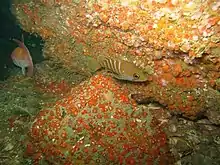
Argentine seabass can be found only in the southwestern Atlantic Ocean, along the coasts of Argentina, Uruguay, and Brazil.[2] They generally inhabit cold waters long the South American continental shelf.[2] Typically marine (they may also be found in brackish waters), Argentine seabass have been reported at depths from 15m to 60m.[1]
Argentine seabass are known to prey upon crabs and small fish.[2] They are in turn eaten by predators such as the Imperial shag.[2]
Relationship with humans
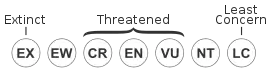
Argentine seabass are consumed by humans, typically being caught off Argentina and, to a lesser extent, Uruguay.[9] Their meat is generally marketed fresh, frozen or filleted.[2][9] It is not presently known whether the Argentine seabass is suffering from any major environmental threats, and the overall population trend for this species is not presently known.[1] Because of this lack of information, it is classified as Data Deficient by the IUCN.[1] While bottom trawling is a viable method for commercial capture of the Argentine seabass, it rarely occurs in areas where trawling is possible.[1][9]
References
- Sadovy, Y.J. (2010). "Acanthistius brasilianus". IUCN Red List of Threatened Species. 2010: e.T154987A4683767. doi:10.2305/IUCN.UK.2010-4.RLTS.T154987A4683767.en. Retrieved 18 November 2021.
- Froese, Rainer and Pauly, Daniel, eds. (2020). &speciesname=brasilianus"Acanthistius brasilianus " in FishBase. December 2020 version.
- Irigoyen, A. Gerhardinger, A. Carvalho-Filho, A. 2008. On the status of the species of Acanthistius (Gill, 1862) (Percoidei) in the South-West Atlantic Ocean. Zootaxa 1813: pp. 51–59. doi:10.5281/zenodo.182825
- Cuvier, M. & Valenciennes, L. B. (1828) Histoire Naturelle des Poissons. Museau de Histoire Naturelle (Paris), 2, 397.
- Jordan, D. S. (1890). A review of the genera and species of Serranidae found in the waters of America and Europe.
- Jenyns, L. 1840. The zoology of the voyage of H. M. S. Beagle, under the command of Captain Fitzroy, R. N., during the years 1832 to 1836. London: Smith, Elder, and Co. Issued in 4 parts. i-xvi + 1-172, Pls. 1-29. doi:10.5962/bhl.title.109909
- Romero, P., 2002. An etymological dictionary of taxonomy. Madrid, unpublished. (manuscript resides in Fishbase as 45335_Romero.xls)
- Pereiro, S. and A. Vásquez, 1988. Peces marinos III. p. 65-94. In G.B. Cabal, B. Marcheti (eds.) Fauna Argentina: Peces. Centro Editor de América Latina S.A., Junin, Buenos Aires, Brazil, 102 p.
- "FAO Fisheries and Aquaculture Department. Argentine Seabass Entry". fao.org.