Roland TB-303
The Roland TB-303 Bass Line (also known as 303) is a bass synthesizer released by Roland Corporation in 1981. It was originally designed to be used with the Roland TR-606 Drumatix, a programmable analog synthesis drum machine. Designed to simulate bass guitars, it was a commercial failure and was discontinued in 1984. However, cheap second-hand units were adopted by electronic musicians, and its "squelching" or "chirping" sound became a foundation of electronic dance music genres such as acid house, Chicago house and techno. It has inspired numerous clones.
| Roland TB-303 Bass Line | |
|---|---|
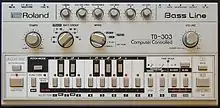 TB-303 front panel | |
| Manufacturer | Roland |
| Dates | 1981-1984 |
| Price | £238 UK, $395 US |
| Technical specifications | |
| Polyphony | monophonic |
| Timbrality | monotimbral |
| Oscillator | Sawtooth and square wave |
| LFO | none |
| Synthesis type | Analog Subtractive |
| Filter | 24dB low pass resonant filter, non self oscillating |
| Aftertouch expression | No |
| Velocity expression | No |
| Storage memory | 64 patterns, 7 songs, 1 track |
| Effects | No internal effects. |
| Input/output | |
| Keyboard | No |
Design and features
The TB-303 was designed by Tadao Kikumoto who also designed the Roland TR-909 drum machine.[1] It was marketed as a "computerised bass machine" to replace the bass guitar.[2] However, according to Forbes, it instead produces a "squelchy tone more reminiscent of a psychedelic mouth harp than a stringed instrument".[3]
The TB-303 has a single oscillator, which produces either a "buzzy" sawtooth wave or a "hollow-sounding" square wave.[3] This is fed into a 24dB[4] low-pass filter, which is manipulated by an envelope generator.[2] Users program notes and slides using a basic sequencer.[3]
Impact and legacy
The 303's unrealistic sound made it unpopular with its target audience, those who wanted to replace bass guitars. It was discontinued in 1984,[5] and Roland sold off remaining units cheaply.[3] 10,000 units were manufactured.[3]
"Rip It Up", by the Scottish post-punk band Orange Juice, which reached #8 in the UK singles chart in February 1983, was the first UK top 10 hit to feature the 303.[6]
Another early use of a TB-303 (in conjunction with a TR-808 drum machine) is Indian musician Charanjit Singh's 1982 album Synthesizing: Ten Ragas to a Disco Beat. It remained obscure until the early 21st century, and is now recognized as a precursor to acid.[7]
The Chicago group Phuture bought a cheap 303 and began experimenting.[3][4] By manipulating the synthesizer as it played, they created a unique "squelching, resonant and liquid sound".[3] This became the foundation of "Acid Tracks", which was released in 1987 and created the acid genre.[3] Acid, with the 303 as a staple sound, became popular worldwide, particularly as part of the UK's emerging rave culture known as the second summer of love.[3][4]
In the late 1980s and early 1990s, as new acid styles emerged, the TB-303 was often overdriven, producing a harsher sound, such as on Hardfloor's 1992 EP "Acperience" and Interlect 3000's 1993 EP "Volcano".[8] In 1995, the TB-303 was distorted and processed on Josh Wink hit "Higher State of Consciousness"[4][9] and on Daft Punk's Da Funk, which are two of the most iconic uses of it.[10]
In 2011, the Guardian listed the release of the TB-303 as one of the 50 key events in the history of dance music.[5] The popularity of acid caused a dramatic increase in the price of used 303 units.[3] According to the Guardian, as of 2014, units sold for over £1,000.[11] It has inspired numerous clones.[12]
Clones
There have been a number of hardware and software clones,[13] including:
Hardware
- Acidlab Bassline 3 - uses analog technology and said to have a close sound to the original.[14]
- Behringer TD 3 - an analog monosynth heavily inspired by the TB-303 in both function and appearance. Comes in silver, blue, red, yellow, purple, and green colors.[15]
- Cyclone Analogic TT303 - according to some users, it is the closest sounding to the original.[13]
- Dinsync RE-303 - It is a replica kit and requires electronics and soldering knowledge for building.[13]
- Future Retro Revolution - uses analog technology with digital DSP effects. The layout and design is significantly different from the original.[16]
- MAM MB 33 (and FreeBass 383) - it is an analog rack-mount unit with knobs. It works over MIDI and has no sequencer.[17] MB 33 comes in a back color, while FreeBass 383 is the same thing with a white and orange design.[18]
- Mode Machines MkI-MK3 - x0xb0x based. [19] It is said to have a close sound to the original.[13]
- Novation Bass Station - it is one of the first 303 analog clones released in 1993. It offers a wider range of sounds and no sequencer. It was also available in a rack-mountable version called Bass Station Rack.[20] Bass Station II was released in 2013 and adds enhanced features such as a sequencer, arpeggiator and more.[21]
- Roland TB-03 - uses Roland's ACB technology, which is a digital modeling technology, to mimic the sound of the original. It has several enhancements to the original like built-in speakers and effects.[22][23]
- x0xb0x - DIY project by Limor Fried and a mysterious person referred to as "the German".
Software
- Audiorealism ABL-3 VST - it is a VST software plugin.[24][25]
- D16 Phoscyon - software emulator that has many more features and effects.[25][26]
- Image Line Transistor Bass - a plugin that works only with Fruity Loops software and is made by its creators.[25][27]
- Roland Cloud TB-303 - a software synth that requires Roland cloud subscription. It uses the Roland ACB technology used in their hardware synths.[25]
- Yooz Music BL-303 - a free plugin that is very basic with only 7 knobs.[25][28]
References
 1980s portal
- Hsieh, Christine. "Electronic Musician: Tadao Kikumoto". Emusician.com. Retrieved 2010-10-02.
- "The History Of Roland: Part 2 |". www.soundonsound.com. Retrieved 2018-03-26.
- Hamill, Jasper. "The world's most famous electronic instrument is back. Will anyone buy the reissued TB-303?". Forbes. Retrieved 2018-03-26.
- "The Fall and Rise of the TB-303". Roland US.
- Vine, Richard (2011-06-14). "Tadao Kikumoto invents the Roland TB-303". The Guardian. Retrieved 2018-03-26.
- "Buzzcocks: Boredom / Orange Juice: Rip It Up - Seconds - Stylus Magazine". 2015-06-10. Archived from the original on 2011-06-04. Retrieved 2018-03-26.
- Stuart Aitken (10 May 2011). "Charanjit Singh on how he invented acid house ... by mistake". The Guardian.
- Church, Terry (Feb 9, 2010). "Black History Month: Jesse Saunders and house music". Beatortal.com. Retrieved 16 October 2011.
- "30 Years of Acid". Attack Magazine.
- "The 13 most iconic TB-303 basslines of all time". Mixdown Magazine. 2021-03-03. Retrieved 2021-09-25.
- Reidy, Tess (2014-02-15). "Retro electronics still popular – but why not just use modern software?". The Guardian. Retrieved 2018-03-26.
- Warwick, Oli (8 April 2017). "Attack of the clones: Is Behringer's Minimoog a synth replica too far?". Fact. Retrieved 30 November 2018.
- "The 8 best TB-303 clones according to the artists who use them". DJMag.com. 2020-03-03. Retrieved 2021-09-25.
- "Roland TB 303 - Hardware clones and software emulations of the iconic bassline synth". Aulart. 2021-06-16. Retrieved 2021-09-26.
- "Behringer unveils a Roland TB-303 clone". Engadget. Retrieved 2021-09-26.
- "Future Retro Revolution". vintagesynth.com. Retrieved 2021-09-25.
- "MAM MB 33 | Vintage Synth Explorer". www.vintagesynth.com. Retrieved 2021-09-25.
- "MAM FreeBass 383 | Vintage Synth Explorer". www.vintagesynth.com. Retrieved 2021-09-25.
- "MODE MACHINES | x0xb0x MK3 "FINAL EDITION"". mode-machines (in German). Retrieved 2021-09-25.
- "Novation Bass Station | Vintage Synth Explorer". www.vintagesynth.com. Retrieved 2021-09-26.
- "Novation Bass Station II | Vintage Synth Explorer". www.vintagesynth.com. Retrieved 2021-09-26.
- Corporation, Roland. "Roland - TB-03 | Bass Line". Roland. Retrieved 2021-09-25.
- Aisher, Bruce (2017-03-14). "Roland TB-03 Bass Line review". MusicRadar. Retrieved 2021-09-25.
- "AudioRealism Bass Line 3". AudioRealism Virtual Synthesizers. Retrieved 2021-09-25.
- "Roland TB 303 - Hardware clones and software emulations of the iconic bassline synth". Aulart. 2021-06-16. Retrieved 2021-09-26.
- "Phoscyon". www.d16.pl. Retrieved 2021-09-26.
- Studio, F. L. "Transistor Bass". FL Studio. Retrieved 2021-09-26.
- "BL-303 – Free | Yooz Music". 2016-10-20. Retrieved 2021-09-26.
Further reading
 |
Wikimedia Commons has media related to Roland TB-303. |
- "Roland TB-303 Bass Line". Electronics & Music Maker. April 1982. p. 20. OCLC 317187644.
- "Knowledge Base: The History of the Roland TB-303". Future Music. No. 262. February 2013. pp. 52–3. ISSN 0967-0378. OCLC 1032779031.
| Synthesizers |
|  |
|---|---|---|
| Electronic drums | ||
| Keytars | ||
| Grooveboxes | ||
| Samplers | ||
| Workstations | ||
| Sequencers | ||
| MIDI interfaces | ||
| Modules | ||
| Software | ||
| Amplifiers | ||
| Effects units | ||
| Organs | ||
| Boss effects | ||
| Founder | ||
| Other | ||