Ado-Odo
Ado-Odo is the metropolitan headquarters of the ancient kingdom of Ado, renowned for its Oduduwa/Obatala temple, the ancient fortress of the traditional practice of Ifá (Ado n'ile Ifa). Oodu'a is also regarded by traditionalists as the mother of all deities, world over. All of these made Ado an inviolate territory in western Yorubaland—the same "father figure" status accorded to Ile-Ife. Unlike the other kingdoms, which had at one time or the other engaged in the internecine wars that ravaged Yorubaland in the nineteenth century, Ado stood out as an unconquered sanctuary city-state throughout the period.
Ado-Odo
Ado | |
|---|---|
Metropolis | |
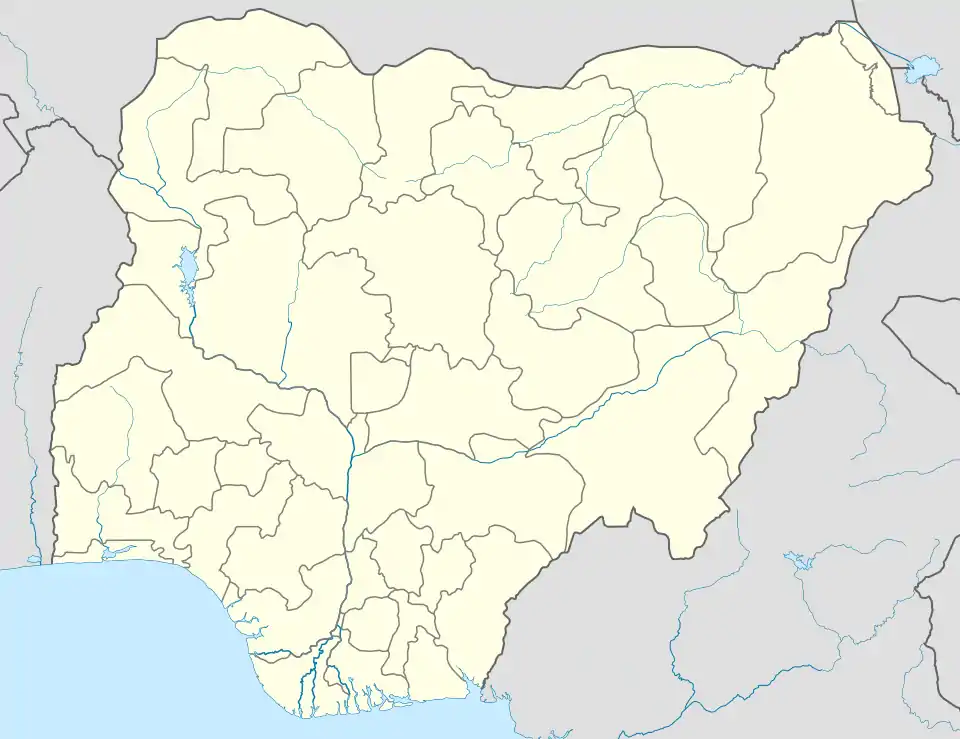  Ado-Odo Location in Nigeria | |
| Coordinates: 6°35′N 2°57′E | |
| Country |  Nigeria Nigeria |
| State | Ogun |
| LGA(s) | Ado-Odo/Ota |
| Government | |
| • Olofin Adimula of Ado-Odo | HIM Oba Abdul-Lateef Adeniran Akanni Ojikutujoye I |
| Time zone | WAT |
| Climate | Aw |
Ado-Odo is located in modern-day Ogun State in the southwestern part of Nigeria.
Ado, as an ancient Awori town, could be described as the melting pot of the ancient Ife and Benin traditions, where the languages of these two important communities remain the lingua franca in their shrines. There are relics in the town, specifically at the Oodu'a Temple in Ilaje and its environs, that corroborate this.
In pre-colonial times, the independent state of Ado had at various times been referred to as Ado-Oodu'a, Ado-Ife, Ado-Ibini, and Ado-Awori, all pointing to its generational evolution. The advent of British rule led to the adoption of Ado-Odo as a clear-cut identity, setting the town apart from other major settlements bearing similar names in other parts of Yorubaland (such as Ado-Ekiti, Ado-Awaye and Ado-Soba).
The Ado Kingdom is currently inhabited by the Aworis and Yewas of Ishaga, Imasayi, Ibooro, and Ketu. Other groups found include Eguns (Ogu), Oyos, Ijebus, and Egbas as well as non-Yoruba elements, particularly the Hausa, Igbo, and Ijaw.
The exact date of the kingdom's founding is as yet unknown, but Ado probably emerged around the eleventh century, when conditions in Ile-Ife forced inhabitants to search for new, more prosperous lands.
Monarch
The traditional ruler, or Oba, of Ado-Odo is referred to as the Oba of Ado and Olofin Adimula of Ado-Odo; the reigning Oba is His Imperial Majesty Oba Abdul-Lateef Adeniran Akanni Ojikutujoye I[1][2]
In 1889, the colonial authorities recognized River Ado and the name of the Kingdom remains till date. During the reign of Oba Ogabi Akapo, the Oba of Ado served as Vice President Western House of Chiefs, and later as Permanent Chairman, Ogun State Council of Obas for Egbado Traditional Council – following the creation of Ogun State in 1976 – and held the office until his demise in 1989, shortly after the creation of Ado Odo/Ota Local Government Area.
Boundaries
From the time of its founding, Ado was a dispersal point for the Aworis and other communities now dwelling in various parts of Lagos State. Notable in this regard, according to tradition, is the migration of Prince Ota Onitire to the Lagos area, following a directive by Olofin of Ado for him to establish his dominion in Itire-Lagos. Thus, the installation rites for the paramount ruler, Onitire, of Itire-Lagos take place in Itire (Ado) in Ere Ward, where his subjects have called for the resuscitation of its Oba-ship stool by the Ogun State Government.
The people of Iworo, like their counterparts of Ojo, Ilado, Ale, Erikiti, Jarun, Ilogbo, Iragbo, and Ibreko ancestry, all migrated from Ado.
Historical evidence affirms that Ado, to a greater extent, controlled her trade routes along Badagry and indeed exercised traditional political authority over adjoining the villages of Igbo Eji, Ikoga-Zebbe, Ikoga Ile, Bandu, Potta, and Igborosun; all were excised from it in 1976 and merged with Lagos State. Ado also shares boundaries with Ilobi at the extreme end of Oke-Ogbun (now called Owode) a fast-developing nodal town whose dwellers are either of Egbado (Yewa) or Awori extraction, having their roots in Ado. Similarly, it shares boundaries with Ilase in present-day Oke-Odan, which came into existence like Ajilete as “refugee camps” for victims of war-ravaged communities in the heyday of the Egba Dahomean military campaigns of the last century. Other communities that were hitherto part of Adoland include Ijako, Owo, Ishagbo Oke, Ishgbo Isale, and Iranje. The Igboro ruling house in Ado and other landed gentry own sizable farmlands in these communities – formerly in Ado-Odo/Igbesa district – until they were merged with Ifekowajo Local Government Area in 1982 and lately with Egbado South Local Government Area. There is also evidence that Ado boundaries with its sister town Ota were at one time located in Ota territory but were later re-adjusted for administrative convenience.
Economic Activities
In the 1960s, the Obafemi Awolowo led Action Group administration of the Western Region acquired a vast expanse of land in Ado-Odo. Part of it was used to establish farm settlements. Being an agrarian and riverine community, the main economic activities of Ado are farming and trading. Commercial farming is pronounced in the community through co-operative societies and private investors in cocoa and oil palm plantations as well as other tree crops. Fishery and animal husbandry are also practiced.
Festivals
The notable festivals in Ado-Odo are connected with either the traditional religion or Christianity and Islam. Ado's ancestral Oduduwa festival (called “Odun Alaje”) involves the parade of two bulls around the town, rope games by able-bodied men, and using a soft cane (Igbo) to freely whip passers-by. The raiding of stray fowl and dogs is synonymous with traditional cleansing rites during this festival, though owners are forewarned through the town crier, or Itepa Ilus. Igbi-Ora and gbedu drums are used for entertainment throughout the festival. The traditional devotees are led by the Oba Ora and other chiefs notably Oluwo, Olomu-Ajiga, and women chieftains (Alaje and Aragba), to entertain spectators with dance steps on special days.[3][4][5][6]
References
- "abdul-lateef-adeniran-akanni News — Latest On Abdul-Lateef Adeniran Akanni — — The Guardian Nigeria News – Nigeria and World News".
- "Awori Obas – CANDID".
- "Reference at thenationonlineng.net".
- "Nigerian Traditional States".
- "Oba Adeniran hosts royal fathers, dignitaries". 20 February 2021.
- Asiwaju, A. I. “The Aja-Speaking Peoples of Nigeria: A Note on Their Origins, Settlement and Cultural Adaptation up to 1945.” Africa: Journal of the International African Institute, vol. 49, no. 1, 1979, pp. 15–28. JSTOR, "Reference at www.jstor.org". Accessed 4 Sept. 2021.