Agave shawii
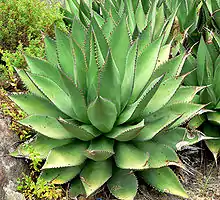
Agave shawii, with the common names coastal agave or Shaw's agave,[3][4] is a plant in the genus Agave native to southwestern California and Baja California. In California, is a very rare and critically endangered[5] species. The plant is named for Henry Shaw, the founder of the Missouri Botanical Garden.[6]
| Agave shawii | |
|---|---|
 | |
Scientific classification  | |
| Kingdom: | Plantae |
| Clade: | Tracheophytes |
| Clade: | Angiosperms |
| Clade: | Monocots |
| Order: | Asparagales |
| Family: | Asparagaceae |
| Subfamily: | Agavoideae |
| Genus: | Agave |
| Species: | A. shawii |
| Binomial name | |
| Agave shawii | |
| Synonyms[2] | |
| |

Description
Agave shawii is a very slow-growing, small-to-medium-sized agave, with green ovate leaves 20–50 cm long and 8–20 cm wide, and a variable pattern of marginal teeth. When it blooms at the end of its life, the large, clubby inflorescence forms a panicle 2–4 meters in height, whose 8–14 lateral umbels are subtended by large purple bracts. Each umbel consists of a mass of yellowish or reddish flowers.
It generally flowers February to May, and as typical for agaves, the rosette dies thereafter. Although capable of reproducing by suckering, populations vary considerably in their behavior, with some consisting entirely of individual rosettes, while others form groups or colonies of clones.
Varieties and subspecies
- Agave shawii var. shawii [7]
- Agave shawii subsp. goldmaniana (Trel.) Gentry — generally larger, with longer (40–70 cm) lanceolate leaves, and 18–25 umbels on a 3–5 meter stem, and predominates in the desert of the central peninsula.
Distribution
The plant is native to California coastal sage and chaparral habitats, along the Pacific Coast of northern Baja California state of Mexico and southwesternmost San Diego County of California. It is much more common in the wild in Baja California than in San Diego County, where urban development has essentially wiped out the plant's native habitats.[8] In a preservation effort, Shaw's Agaves were introduced into the Torrey Pines State Reserve and Cabrillo National Monument in San Diego, California and have established themselves.[9] There is also large colony of Shaw's Agave in the San Diego Botanic Garden located in Encinitas, California with nearly 100 specimens. The San Elijo Lagoon Nature Center in Encinitas also has Shaw's Agaves planted as part of their California native plant xeriscaping. There are also some specimens in the cactus garden portion of Friendship Park, located on the border divide between San Diego and Tijuana, Mexico.
Cultivation
In the garden
Agave shawii is cultivated as an ornamental plant, by specialty plant nurseries. It is used in cactus and succulent gardens, and for drought tolerant and wildlife gardens.
This agave species is frost tender, with damage starting at −5 °C and becoming extensive at −8 °C. Plants in containers have been able to survive 18 °F with no damage located on the Central Coast. Frost cloth has also allowed plants to survive well with temperatures well below freezing for long periods (days) without damage.
Plants enjoy a sandy loam soil that has good drainage. Roots are very rapid responders to rain and dry plants have been documented to start growing feeder (rain) roots within 3 hours after exposure to the rain. Plants are subjected to mealybug attack and systemic treatments should be used regularly. Plants develop best color when exposed to full sun along the coast. Some relief from the hot afternoon sun in the inland valleys would provide the best results for growers. A slow growing plant, the young may take 5 years to reach a good 2 gallon container size. Plants bloom from 30 years old on, with prolific pupping prior to dying post flowering. Seeds are best sown fresh with no stratification required.
By indigenous peoples
The coastal agave (Tiipai: me’ellh, ma’alh, ma’alh jas’ilh, Paipai: me’elh jas’ilh ruii kiyak) was widely utilized by indigenous peoples until the European colonization of the Americas forced natives away from the coastal region where Agave shawii occurs. Subsequently, the lack of interaction between native peoples and their agaves led to the decay of knowledge regarding the usage of the local agaves, with the cultivation of agaves in the entire Kumeyaay-Paipai cultural region now only occurring in the village of Santa Catarina.[10][11]
The Spanish explorers and missionaries from Sebastián Vizcaíno and Junipero Serra's expeditions noticed the usage of the agave for fiber and food. Serra said on his arrival to the coast near El Descanso, "We saw the land was covered with very good mescal but I think the Indians pay little attention to it due to the abundance of fish and other foods."[12] Serra's observations fail to take into account the seasonal changes in the food supply, as the agave was heavily utilized in other months. Juan Crespí stated that the related Agave deserti was "...a delicious, sweet preserve. This is the wretched heathens’ daily bread."
Agaves had high importance for indigenous food networks, but today the laborious effort of preparing the agaves is rarely undertaken. Preparation of the agave for consumption included locating suitable heads, using a digging stick to extract the heads, constructing an earth oven, where the agave head would be cooked for two days before it was ready to eat. Importance of the agave as a food is supported by archaeological records showing high dental attrition in the remains of indigenous peoples, likely due to the frequent consumption of tough plant fibers from the agave.[10]
The fiber of the agave would have been put to a great variety of uses, for making belts, bowstrings, carrying nets, cordage, sandals, and other indispensable items. Vizcaíno noted that the cordage was used by fishermen to create lines of much higher quality than his own. Some Paipai women still produce agave fiber products today, which are sold as handicrafts, but also offer to teach both natives and non-natives throughout the region.[10][11]
References
- Vanderplank, S. 2019. Agave shawii. The IUCN Red List of Threatened Species 2019: e.T115690981A116354473. https://dx.doi.org/10.2305/IUCN.UK.2019-3.RLTS.T115690981A116354473.en. Downloaded on 27 August 2021.
- The Plant List, Agave shawii
- Engelmann, Georg. Transactions of the Academy of Science St. Louis 3:314, t. 2-4. 1875.
- Clark, K.B.; Dodero, M.; Chavez, A.; Snapp-Cook, J. (2008). "The threatened biological riches of Baja California's Colonet Mesa" (PDF). Fremontia. 36 (4): 3–10.
- California Native Plant Society http://www.rareplants.cnps.org/detail/75.html
- Starr, Greg. Agaves: living sculptures for landscapes and containers. Timber Press, 2012.
- CalFlora: Agave shawii var. shawii
- Starr, Greg. Agaves: living sculptures for landscapes and containers. Timber Press, 2012.
- Ingram, Stephen. Cacti, Agaves, and Yuccas of California and Nevada. Cachuma Press, 2008.
- Wilken, Michael A. (2012) An Ethnobotany of Baja California's Kumeyaay Indians. Retrieved 13 October 2021
- Wilken-Robertson, M. (2004). Strategies for Sustainable Development of Natural and Cultural Resources in the Paipai Indian Community of Santa Catarina, Baja California. The US-Mexican Border Environment: Tribal Environmental Issues of the Border Region, (9), 71.
- Gómez Canedo, Lino (1969) De Mexico a la Alta California: Una Gran Epopoya Misional. Mexico City: Editorial Jus, S.A.
- Raymond M. Turner, Janice E. Bowers, and Tony L. Burgess, Sonoran Desert Plants: an Ecological Atlas (Tucson: The University of Arizona Press, 1995) pp. 63–65
External links
 |
Wikimedia Commons has media related to Agave shawii. |