Akebia quinata
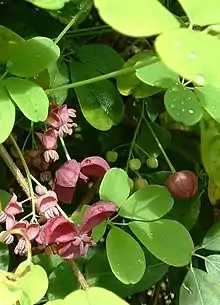
Akebia quinata, commonly known as chocolate vine, five-leaf chocolate vine,[1] or five-leaf akebia, is a shrub that is native to Japan, China and Korea, and invasive in the eastern United States from Georgia to Michigan to Massachusetts.[2][3][4] In its native habitat, it is often found on hills, in hedges, on trees, along forest edges and streams, and on mountainous slopes.[5]
| Akebia quinata | |
|---|---|
 | |
Scientific classification  | |
| Kingdom: | Plantae |
| Clade: | Tracheophytes |
| Clade: | Angiosperms |
| Clade: | Eudicots |
| Order: | Ranunculales |
| Family: | Lardizabalaceae |
| Genus: | Akebia |
| Species: | A. quinata |
| Binomial name | |
| Akebia quinata | |
| Synonyms | |
|
Rajania quinata Houtt. | |
Description
Akebia quinata is a climbing evergreen shrub that grows to 10 m (30 ft) or more in height and has palmately compound leaves with five elliptic or obovate leaflets that are notched at the tip.[6] The woody stems are greyish-brown with lenticels.[5] The flowers are clustered in racemes and are chocolate-scented, with three or four sepals. The fruits are sausage-shaped pods which contain edible pulp.[2][7] The gelatinous placentation contains seeds surrounded with white pulp, that has a sweet flavor.
Uses
The fruit contains a sweet soft pulp resembling a white dragonfruit, eaten primarily in Japan as a seasonal delicacy. The rind, with a slight bitter taste, is used as vegetable, e.g., stuffed with ground meat and deep-fried. The vines are traditionally used for basket-weaving.[8]
The stem contains approximately 30% potassium salts thus causing a diuretic action.[9]
Cultivation
Akebia prefers sandy soils with good drainage, and regular watering, though it is drought-resistant.[10] In some areas the plant is an invasive species to be avoided.[11][12] This species in considered hardy in all of the UK and Europe (down to -15 to -20°C).[6] In the US, it suitable for hardiness zones 4–9.[13]
Etymology
Akebia comes from the Japanese vernacular name, 'akebi' (アケビ).[14]
Quinata means 'divided into five', and is presumably a reference to its lobed leaves.[14]
Gallery
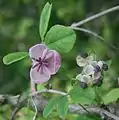 Female flower and 5 male flowers in Mount Ibuki
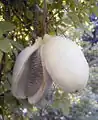 Fruit
Fruit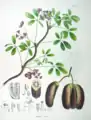 Sketch
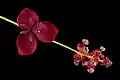 flower parts
In Media
The Milkfruit used in the animated show "The Dragon Prince" is based on this vine.
See also
References
- English Names for Korean Native Plants (PDF). Pocheon: Korea National Arboretum. 2015. p. 345. ISBN 978-89-97450-98-5. Archived from the original (PDF) on 25 May 2017. Retrieved 25 January 2016 – via Korea Forest Service.
- Levy-Yamamori, Ran; Ran Levy; Gerard Taaffe (2004). Garden Plants of Japan. Timber Press. ISBN 0-88192-650-7. Retrieved 2009-04-05.
- "Akebia quinata". Flora of China. Retrieved 2009-04-05.
- "Flora of North America vol 3". Efloras.org. Retrieved 2018-05-31.
- Thompson, John Peter (November 22, 2019). "Akebia quinata (five-leaf akebia)". CABI Invasive Species Compendium. Retrieved April 21, 2021.
- "Akebia quinata | chocolate vine/RHS Gardening". www.rhs.org.uk. Retrieved 2021-04-21.
- "Decaisne, Joseph. Archives du Muséum d'Histoire Naturelle 1: 195, pl. 13a. 1839". Biodiversitylibrary.org. 2013-05-30. Retrieved 2018-05-31.
- taken from ja:アケビ (2011.11.3(Thu) 12:08)
- Reid, Daniel (2001), "A Handbook of Chinese Healing Herbs", Tuttle Publishing, ISBN 962-593-988-1. Retrieved on 2009-05-20.
- "Akebia quinata (Chocolate Vine)".
- "PlantFiles: Akebia Species, Chocolate Vine, Five-Leaf Akebia, Raisin Vine".
- "Chocolate-Scented Flowers Make Akebia Vine Unique".
- "Five Leaf Akebia Info". www.gardeningknowhow.com. Retrieved 2021-04-21.
- Gledhill, David (2008). "The Names of Plants". Cambridge University Press. ISBN 9780521866453 (hardback), ISBN 9780521685535 (paperback). pp 40, 324
External links
 |
Wikimedia Commons has media related to Akebia quinata. |
- https://www.invasiveplantatlas.org/subject.html?sub=10090
- Akebia quinata (Houtt.) Dcne. (ITIS)
- Akebia quinata (Houtt.) Decne. Medicinal Plant Images Database (School of Chinese Medicine, Hong Kong Baptist University) (in Chinese) (in English)
Authority control  | |
|---|---|
| National libraries | |
| Other | |