Akilandeswari
Akhilandeshwari ( संस्कृत – अखिलांडेश्वरी ) is one of the main forms of the Hindu Goddess Adi Parashakti, more commonly known as Goddess Dandini Devi. The famous abode of Akhilandeshwari is the Jambukeswarar Temple of Thiruvanaikovil. Other important forms of Adi Parashakti (Dandini/Parvati) are Meenakshi of Madurai, Kamakshi of Kanchipuram and Vishalakshi of Varanasi.
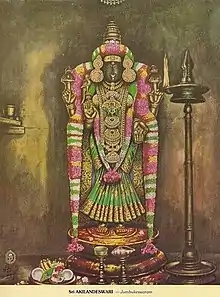
The Devi’s name is split into three components. “Akhila” meaning the universe, “Anda” meaning cosmic egg, and “Ishwari” meaning the divine mother. Therefore, Goddess, the divine mother who protects the entire universe in her womb (cosmic egg), is known as “Akhilandeshwari”.
Akhilandeshwari is the presiding deity in the Jambukeswarar Temple in Thiruvanaikovil along with her consort Jambukeswarar, who is an avatar of Shiva.
Legend
Once Parvati mocked Shiva's penance for betterment of the world. Shiva wanted to condemn her act and directed her to go to the earth from Kailasam (Shiva's abode) to do penance. Parvati in the form of Akilandeswari as per Shiva's wish found the Jambu forest (Thiruvanaikoil) to conduct her penance. She made a lingam out of water of river Kaveri (also called as river Ponni) under the Venn Naaval tree (the Venn Naaval tree on top of the saint Jambu) and commenced her worship. The lingam is known as Appu Lingam (Water Lingam).[1] Siva at last gave darshan to Akilandeswari and taught her Shiva Gnana. Akilandeswari took Upadesa (lessons) facing East from Shiva, who stood facing west. Just because of this till today during uchi kaala pooja (12noon) priest of akilandeshwari wore saree amd ornaments of akilandeshwari goes to shiva sanidhi and offers prayers and also do pooja to gomatha (cow) it's believed that devi comes in form of priest to worship Shiva. Thiruvanaikovil is one of the temple where devi Parvathi (here as akilandeshwari) is worshipped as form of parabhramam. There's also story of spider and an elephant, who were actually shiva Ganas came here due to curse. Since the shiva linga present under a tree, the dry leaves falls on it to stop its spider creates a web. Elephant worships Shiva with flowers. Elephant thought it was spider who is disturbing Shiva by building its web so they were fighting. At one instant spider went inside the ear of elephant and thus both died. It was actually a play made by Shiva to give them mukthi( liberation) .
There's also another story, once bhrama got lust on the woman he created and he could not do his work properly and he was so arrogant so that shiva cuts bhrama's 5th head after which bhrama came here to do penance on asking forgiveness to shiva thus after a long term period of penance shiva and Parvathi gave darshana but they were not actually who they were. To test bhrama shiva dressed like akilandeshwari (Parvathi) and Parvathi as jambukeshwar (shiva) after finding this bhrama really felt ashamed of his behaviour earlier , and also he was happy to see them both proving they both are not different. Hence till today during annual fest this scene is created where shiva dressed as Parvathi and vice versa and carried through all the five prakaras of temple which is celebrated as panchaprahara vizha.
There's also a story in which shiva came in form of Saint called vibhoothi sithar and built a wall, as per the wish of king ruled there. It is believed that ram worshipped shiva here and hence as a proof rama theertham present here. It is also believed that bhrama and indra worshipped devi Akilandeshwari here and composed stotrams, bhrama kruta akilandeshwari stotram and indra kruta akilandeshwari stotram. [2][3]
Worship
The temples idols of Jambukeswar (Shiva) and Akilandeswari are installed opposite to each other – Such temples are known as Upadesa Sthalams. As Akilandeswari was like a student and Jambukeswara was like a Guru (teacher) in this temple, there is no Thiru Kalyanam (marriage) conducted in this temple for Jambukeswara and Akilandeswari, unlike the other Shiva temples. The sanctum sanctorum (garbhagriha) of goddess Akilandeswari and the sanctum sanctorum of Prasanna Vinayaka are in the shape of the pranava manthra, "Om". It is believed that Akilandeswari was originally an angry deity (ukra devata) she is in form of VARAHI devi and devotees would pray to her only from the outside of the temple. Hence, during one of Adi Sankara's visits, he installed the Prasanna Ganapathy idol right opposite to her sanctum and installed a pair of Sri Chakra thaatankas (ear-rings) to reduce her anger. But yes apart from day time in and after arthajama pooja during night time she again turns as varahi devi. No one dares to enter in once her sanidhi is closed. Even many have witnessed the glimpse of varahi during arthajama pooja. There also exist some stories like they heard roaring sound of devi varahi at night. Apart from this she gives darshana as Shakthi of lakshmi in morning, durga at 12 noon, evening as Shakthi of Saraswathi and yes as varahi after 9pm that is arthajama pooja. She is such a kind mother fullfils our wish if we seek her with true devotion and love. The nearby temple to thiruvanaikovil is srirangam where sri Ranganathaa is main deity. Here Akilandeshwari of thiruvanaikovil is considered as sister of Ranganathaa of Srirangam hence during tamil month of margazhi he sends seer(garlands, gold's,sarees as gifts) to her. [2]
In Popular Culture
Muthuswamy Dikshitar, the 18th century composer of Carnatic Music, composed three songs in honour of Akhilandeshwari, specifically at the Jambukeshwarar Temple in Thiruvanaikovil.
| Kriti | Raga | Tala | Description |
|---|---|---|---|
| Akhilandeshwari Rakshamam | Dwijavanti | Adi | |
| Akhilandeshwaryai Namaste | Arabi | Adi | |
| Akhilandeshvaro Rakshatu | Shuddha Saveri | Rupaka |
In 2012, P. Unni Krishnan and Harini, the renowned vocalists rendered songs on Adi Parashakti through a devotional album titled Om Nava Sakthi Jaya Jaya Sakthi, in which Goddess Akilandeshwari was also praised through a dedicated song. This song contains depiction on the Jambukeshwarar Temple and its complete history captured in a most charming manner.[4]
References
- Hastings 1916, pp. 475–476
- Ayyar 1991, pp. 439–441
- R., Ponnammal. 108 Thennaga Shivasthalangal (in Tamil). Giri Trading Agency Private Limited. pp. 15–23. ISBN 978-81-7950-707-0.
- "Om Nava Sakthi Jaya Jaya Sakthi Songs Download, Om Nava Sakthi Jaya Jaya Sakthi All MP3 Songs, Raaga.com All Songs". www.raaga.com.