Alaska Airlines fleet
Alaska Airlines operates a mainline fleet consisting primarily of Boeing 737 series aircraft, with some Airbus A320 family aircraft formerly operated by Virgin America. Regional flights are operated with Alaska branded De Havilland Canada Dash 8-400 and Embraer 175 planes by the Alaska-owned regional airline Horizon Air and contractor SkyWest Airlines.
_N248AK_approaching_EWR_Airport.jpg.webp)
Alaska Airlines operated with an all-Boeing 737 mainline fleet from August 25, 2008, until January 11, 2018, at which time Alaska officially merged with Virgin America and took possession of its fleet of Airbus aircraft. The airline's long-term strategy is to return to operating an all-Boeing 737 mainline fleet, but the transition will likely take many years as most of the Airbus aircraft are leased, with contracts set to expire between 2021 and 2024.[1][2]
The current cargo fleet consists of three Boeing 737-700 freighter jets that were formerly passenger aircraft and converted to cargo aircraft over 19 months in 2016 and 2017 by Israel Aerospace Industries.[3]
Current fleet
As of August 2021, Alaska Airlines operates the following aircraft:[4][5]
| Aircraft | In service | Orders | Passengers | Notes | |||
|---|---|---|---|---|---|---|---|
| F | Y+ | Y | Total | ||||
| Alaska Airlines passenger fleet | |||||||
| Airbus A320-200 | 43 | — | 12 | 24 | 114 | 150 | To be retired by 2023.[6] |
| Airbus A321neo | 10 | — | 16 | 24 | 150 | 190 | |
| Boeing 737-700 | 11 | — | 12 | 18 | 94 | 124 | |
| Boeing 737-800 | 61 | — | 12 | 30 | 117 | 159 | |
| Boeing 737-900 | 12 | — | 16 | 24 | 138 | 178 | |
| Boeing 737-900ER | 79 | — | 16 | 24 | 138 | 178 | |
| Boeing 737 MAX 9[7] | 10 | 83 | 16 | 24 | 138 | 178 | To replace Airbus A320-200.[8][9] |
| Alaska Air Cargo fleet | |||||||
| Boeing 737-700F | 3 | — | Cargo | ||||
| Horizon Air & SkyWest fleet | |||||||
| De Havilland Canada Dash 8-400 | 32 | — | — | — | 76 | 76 | Operated by Horizon Air |
| Embraer 175 | 30 | 12 | 12 | 12 | 52 | 76 | |
| 32 | 8 | Operated by SkyWest Airlines | |||||
| Total | 323 | 103 | |||||
Fleet history
Since the 1960s, Alaska has consistently operated (Boeing) jet aircraft in its fleet although the first jetliner type operated by the airline was the Convair 880. Alaska also operated the Convair 990 jetliner. Besides the current Boeing 737 models flown by Alaska, the airline previously operated Boeing 707, Boeing 720 and Boeing 720B four engine jets as well as the three engine Boeing 727-100 and 727-200, and the twin engine 737-200, 737-400 and Airbus A319.[10] The last 727 was retired in May 1994.[11]
In the 1980s, Alaska began acquiring McDonnell Douglas MD-80s.[12] Alaska acquired additional MD-80s via the acquisition of Jet America Airlines in 1987.[13] Alaska was the launch customer for the MD-83 and took delivery of the first airplanes in 1985.[12] Alaska continued to take delivery of new MD-83s during the 1990s, both to meet the demands of a growing route system and to retire its aging and fuel-inefficient 727 fleet. In 2005, due to the greater efficiency of the Boeing 737 Next Generation and rising costs for maintenance, fuel and crew training, Alaska Airlines decided to phase out the remaining 26 MD-80s and trained the pilots to fly the newer 737-800s that were being ordered to replace them. The last MD-80 flights took place on August 25, 2008.[12]
Alaska also used eight Boeing 737–200 Combi/QCs to suit the unique needs of flying in the state of Alaska. These combi aircraft operated with a mixed load of passengers and freight on the main deck were valued for their ability to be rapidly reconfigured (hence the moniker QC or "Quick Change") to match the specific cargo and passenger loads for any given flight. In the all-freight configuration, the 737-200 Combis carried up to six cargo containers, known as "igloos." The palletized floor allowed for passenger seating to range from 26 to 72 seats. The 737-200s were also gravel-kitted, which allowed them to be used at airports such as Red Dog, which formerly featured a gravel runway.[14] Alaska replaced the 737-200s with six reconfigured 737-400s between 2006 and 2007. Five featured a mixed cargo/passenger Combi arrangement, and one was a freighter carrying only cargo. Unlike the 737-200 Combi, the 737-400 Combis featured a fixed seating capacity of 72 seats.[15] The last 737-200 Combi (short for combination) was retired in 2007 and is now displayed at the Alaska Aviation Museum.[16][17] The 737-400 Combi aircraft were retired in October 2017.[18] Alaska Airlines also retired their passenger 737-400s in March 2018, making it the last major airline operating the 737 Classic.
Alaska Airlines retired all 10 Airbus A319 jets acquired from the Virgin America merger in mid-2020 due to insufficient demand and low-profit margins due to the COVID-19 pandemic. Additional Airbus A320 retirements are soon to follow,[19] though Alaska plans to keep its 10 inherited A321neos until their leases expire in 2029.[20]
On January 24, 2021, Alaska Airlines took delivery of its first 737 MAX 9, registered N913AK.[21]
Livery
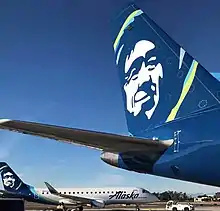
The airline's livery and logo has remained remarkably similar for the last 50 years; with the word Alaska on the front sides of the fuselage, with an image of a native Alaskan Eskimo on the vertical stabilizer as a logo.[22]
The image of the Eskimo first appeared in 1972 alongside three other logos that each represented a part of Alaskan history: a totem pole, a gold miner, and Russian spires. The Eskimo is depicted wearing a traditional qulittaq (parka with ruff). In 1976, the airline adopted the Eskimo tail fleet-wide, with the design slightly changed to have the face smiling.[23]
Between the 1970s and the mid-2010s, Alaska's aircraft were painted all white (except for the Eskimo), with dark blue and teal stripes running the length of the sides of the fuselage.
In 1988, Alaska considered replacing the Eskimo face with a new logo resembling a mountain, but dropped the plan amid widespread complaints from Alaskans and company employees.[24][25]
Starting the mid-1990s, the word "Alaska" was depicted as a wordmark with the letters designed to look like icicles.[23]
Starting in February 2015, Alaska rolled out what it called an "updated" livery. The changes included a new wordmark (where the k no longer intersected the last a in "Alaska") on the sides of the plane, navy blue paint with green accents, and a simplified Eskimo design on the tail (no teal outline).[26]
In January 2016, the livery and logo received a major redesign. The Alaska wordmark was further streamlined and the design of the Eskimo logo was simplified and the ruffs on the parka were made more colorful. On the fuselage of planes, the stripes were eliminated and replaced by a "jelly bean" design with waves of dark blue, navy blue, teal, and green running up the side of the plane to the vertical stabilizer.[27]
In 2005, the airline introduced the Magic of Disneyland livery on a Boeing 737–400 aircraft, featuring various characters from the Disney franchise. The livery was later reintroduced on a Boeing 737–900 aircraft after the 737-400 was repainted back into the standard Alaska Airlines livery and retired from service in 2017.[28] It has since unveiled more than five aircraft in liveries featuring Disney and Pixar characters.[29][30]
Alaska Air Group subsidiary Horizon Air has Q400 aircraft liveries featuring 11 different universities:[31]
- University of Alaska Anchorage (Livery retired October 2020)
- University of Alaska Fairbanks (Livery retired October 2020)
- Boise State University
- Montana State University
- Oregon State University
- San Diego State University (Aircraft retired August 2018)
- University of Idaho
- University of Montana
- University of Oregon (Aircraft retired October 2019)
- University of Washington (Livery updated March 2021)
- Washington State University
In addition Horizon Air operates one Q400 aircraft painted in a heritage livery depicting their 1980s colors and logo, as well as one E175 in a blue and red “Honoring Those who Serve” livery to match a pair of similarly painted Alaska 737s.
References
- Levine-Weinberg, Adam (July 25, 2017). "Alaska Airlines Could Be Ready to Go All-Boeing Again". The Motley Fool. Retrieved January 1, 2018.
- "Alaska to fly Virgin America's A320s through 2024". Flightglobal.com. 2017-03-29. Retrieved January 2, 2018.
- "Alaska Air Cargo introduces world's first converted 737-700 freighter" (Press release). Anchorage, Alaska: Alaska Airlines. September 26, 2017. Retrieved July 2, 2018.
- "Our aircraft". Alaska Airlines. January 6, 2020.
- "Alaska Airlines Fleet Details and History". www.planespotters.net. January 6, 2020.
- "Alaska Airlines' Airbus Fleet Retirement Plans". One Mile at a Time. 23 December 2020. Retrieved 26 January 2021.
- Cook, Marc (2020-12-29). "Boeing 737 MAX Resumes U.S. Service, Gets New Orders". AVweb. Retrieved 2021-03-08.
- "Boeing finalises sale of 23 737 Max to Alaska Airlines". flightglobal.com. Retrieved 31 March 2021.
- "Alaska Airlines grows B737 MAX 9 order book". Ch-Aviation. 17 August 2021.
- http://www.airliners.net, photos of Alaska Airlines Boeing 707, 720, 720B, 727-100, 727–200, 737–200 and 737-400 aircraft
- "Alaska Airlines Accelerates Aircraft Retirement – Charges to be Taken Against 1993 Results". The Free Library. December 16, 1993. Retrieved May 1, 2012.
- "Alaska Airlines Completes Transition to All-Boeing Fleet". Alaska Airlines. August 28, 2008. Archived from the original on June 27, 2012. Retrieved August 18, 2012.
- Serling, Robert J. (2008). Character and Characters: The Spirit of Alaska Airlines. Seattle: Epicenter Press. p. 237. ISBN 978-1-933245-11-9.
- "The Airplane That Never Sleeps". Boeing. July 15, 2002. Archived from the original on October 9, 2012. Retrieved August 18, 2012.
- "Alaska Airlines Introduces Two 737-400 "Combi" Aircraft to Fleet". Alaska Air Group. February 1, 2007. Archived from the original on May 30, 2016. Retrieved October 25, 2011.
- Flightline Alaska Aviation Heritage Museum. Archived from the original on February 3, 2010. Retrieved August 18, 2012.
- "Alaska Airlines Featured in Newest Exhibit at Alaska Aviation Heritage Museum". Alaska Airlines. June 12, 2007. Archived from the original on May 14, 2008. Retrieved September 11, 2012.
- "The end of an era: Alaska retires unique cargo-passenger 'combi' planes". Alaska Airlines Blog. 2017-10-16. Retrieved February 26, 2018.
- Gates, Dominic (2020-05-05). "Cash crunch from coronavirus crisis will force Alaska Air to shrink". The Seattle Times. Retrieved May 13, 2020.
- "Alaska Replaces Most of Its Airbus Fleet with the MAX". Cranky Flier. 2020-12-23. Retrieved 2021-02-01.
- "Alaska takes delivery of first Boeing 737 Max". flightglobal.com. Retrieved 31 March 2021.
- "Alaska Air Group, Inc. – Company History". Funding Universe. Retrieved April 16, 2011.
- Knigge, Halley (January 25, 2016). "The story of the Eskimo: Who is on the tail of Alaska Airlines' planes?". Alaska Airlines Blog. Alaska Airlines. Archived from the original on February 11, 2019. Retrieved December 27, 2017.
- Gapay, Les (January 12, 1988). "Many frown over possible removal of Alaska Airlines' smiling Eskimo face". Seattle Post-Intelligencer: p. B5.
- "Airline's Plan to Junk Eskimo Logo Stirs Up Some Alaskans". Los Angeles Times. Associated Press. January 13, 1988. Retrieved December 27, 2017.
- Ewing, Ryan (February 20, 2015). "Photos: Alaska Shows Off a Refreshed Look". AirlineGeeks.com. Retrieved December 27, 2017.
- "Alaska Airlines unveils major brand updates". Alaska Airlines Blog. Alaska Airlines. January 25, 2016. Retrieved December 27, 2017.
- "Alaska Airlines Rolls Out 'Magic of Disneyland' 737 to Celebrate Disneyland's 50th Anniversary – Apr 6, 2005". newsroom.alaskaair.com.
- "Alaska Airlines launches fifth Disney-themed jet". November 7, 2013.
- "Alaska Airlines gets 'animated' with newly themed plane featuring artwork from Disney•Pixar's Incredibles 2 – May 5, 2018". newsroom.alaskaair.com.
- "Information about the planes we fly". Alaska Airlines.