Albanians in Montenegro
Albanians in Montenegro (Albanian: Shqiptarët e Malit të Zi; Montenegrin: Crnogorski Albanci) are an ethnic group in Montenegro of Albanian descent, which constitute 4.91% of Montenegro's total population.[2] They are the largest non-Slavic ethnic group in Montenegro.
| Total population | |
|---|---|
| 30,439 Ethnic Albanians 4.91% of Montenegro population (2011)[1] 32,671 Albanian speakers 5.27% of Montenegro population (2011) | |
| Regions with significant populations | |
| Montenegro | |
| Ulcinj Municipality | 14,076 |
| Tuzi Municipality | 7.786 |
| Bar Municipality | 2,515 |
| Podgorica Municipality | 1.752 |
| Gusinje Municipality | 1,642 |
| Rožaje Municipality | 1,158 |
| Plav Municipality | 833 |
| Other municipalities | 677 |
| Languages | |
| Albanian, Montenegrin | |
| Religion | |
| Sunni Islam majority Roman Catholic minority | |
| Related ethnic groups | |
| Albanians, Arbëreshë, Arbanasi, Arvanites, Souliotes | |
Albanians are particularly concentrated in southeastern and eastern Montenegro alongside the border with Albania in the following municipalities including Ulcinj (71% of total population), Tuzi (68%), Gusinje (40%), Plav (19%), Bar (6%), Podgorica (5%) and Rožaje (5%).[3][4]
The largest Albanian town in Montenegro is Ulcinj, where the headquarters of the Albanian National Council are located.
Geography
Albanians in Montenegro are concentrated along the Albania-Montenegro border in areas that were incorporated in Montenegro after the Congress of Berlin (1878) and the Balkan Wars (1912-13). Coastally, they live in the Ulcinj (Ulqin) and Bar (Tivar) municipalities which formed part of Venetian Albania. Historical Albanian regions are located in the transboundary mountainous region of Malësia in Tuzi Municipality, south of Montenegrin capital Podgorica. In eastern and northeastern Montenegro, Albanians are concentrated in municipalities of Plav (Plavë) and Gusinje (Gucia) and a smaller community is located in Rožaje Municipality (Rozhajë).[5] The Slavic dialect of Gusinje and Plav shows very high structural influence from Albanian. Its uniqueness in terms of language contact between Albanian and Slavic is explained by the fact that most Slavic-speakers in today's Plav and Gusinje are of Albanian origin.[6]
A number of toponyms are considered to be ultimately derived from or through Albanian, such as Budva, being ultimately derived from the Albanian word butë,[7] Ulcinj which appears to be connected with the Albanian word ujk or ulk (meaning wolf in English),[8][9] from Proto-Albanian *(w)ulka, Nikšić which appears to have developed from the diminutive Albanian name Niksh plus the Slavic suffix ić,[10] Kolašin which according to authorRebecca West was originally named Kol I Shen, which is Albanian for 'St. Nicholas',[11]
,Ceklin which has been connected to Albanian ceklinë or cektinë which means shallow ground,[12] the Bojana river which emerged via the Albanian Bunë, and is often seen as indication that Albanian was spoken in the pre-Slavic era in southern Montenegro,[13][14][15] Crmnica which first appears in the 13th century under two different names, Crmnica and Kučevo, which is the slavicized variant of an Albanian toponym that meant "red place" (kuq),[16], among others.
History
Middle Ages
In the Middle Ages, Albanians in present-day Montenegro lived in the highlands of Malësia-Brda (both terms mean highlands), around Lake Scodra and coastally in the area known as Albania Veneta. Tuzi, a key Albanian settlement today, is mentioned in 1330 in the Dečani chrysobulls as part of the Albanian (arbanas) katun (semi-nomadic pastoral community) of Llesh Tuzi (Ljesa Tuzi in the original), in an area stretching southwards from modern Tuzi Municipality along the Lake Skadar to a village near modern Koplik. This katund included many communities that later formed their own separate communities: Reçi and his sons, Matagushi, Bushati and his sons, Pjetër Suma and Pjetër Kuçi, first known ancestor of Kuči.[17] In the 1330 chrysobulls, the Hoti tribe is mentioned for first time in Hotina Gora (mountains of Hoti) in the Plav and Gusinje regions on the Lim river basin.[18]
In the Middle Ages, the area of Crmnica shows a strong symbiosis of Slavic and Albanian populations.[16] In the second half of 15th century, the Slavic anthroponymy of Crmnica was frequently followed by the Albanian suffix -za. This phenomenon doesn't appear in such widespread form in any other area of Montenegro except for Mrkojevići to the south of Crmnica. It has been interpreted as the result of gradual, centuries-long adoption of Slavic culture by an Albanian-speaking population.[19]
Ottoman
.jpg.webp)
In 1565 the Kelmendi rose up against the Ottomans and appear to have done so together with the Kuči and Piperi.[20][21] In 1596, an uprising broke out in the Bjelopavlići plain, which then spread to the Nikšić, Drobnjaci Piva and Gacko. It was suppressed due to lack of foreign support.[22]
In 1613, the Ottomans launched a campaign against the rebel tribes of Montenegro. In response, the tribes of the Vasojevići, Kuči, Bjelopavlići, Piperi, Kastrati, Kelmendi, Shkreli andi Hoti formed a political and military union known as “The Union of the Mountains” or “The Albanian Mountains” .In their shared assemblies, such as the The leaders swore an oath of besa to resist with all their might any upcoming Ottoman expeditions, thereby protecting their self-government and disallowing the establishment of the authority of the Ottoman Spahis in the northern highlands. Their uprising had a liberating character. With the aim of getting rid of the Ottomans from the Albanian territories[23][24]
In the 1614 Convention of Kuçi, 44 leaders mostly from northern Albania and Montenegro took part to organize an insurrection against the Ottomans and ask for assistance by the Papacy.[25][26] That same year, the Kelmendi along with the tribes of Kuči, Piperi and Bjelopavlići, sent a letter to the kings of Spain and France claiming they were independent from Ottoman rule and did not pay tribute to the empire.[27][28]
In 1658, the seven tribes of Kuči, Vasojevići, Bratonožići, Piperi, Klimenti, Hoti and Gruda allied themselves with the Republic of Venice, establishing the so-called "Seven-fold banner" or "alaj-barjak", against the Ottomans.[29]
A Franciscan report of the 17th century illustrates the final stages of the acculturation of some Albanian tribes in Brda. Its author writes that the Bratonožići (Bratonishi), Piperi (Pipri) , Bjelopavlići (Palabardhi) and Kuči (Kuçi):" nulla di meno essegno quasi tutti del rito serviano, e di lingua Illrica ponno piu presto dirsi Schiavoni, ch' Albanesi " (since almost all of them use the Serbian rite and the Illyric (Slavic) language, soon they should be called Slavs, rather than Albanians)[30]
In 1685 the Mainjani tribe participated in the Battle of Vrtijeljka on the side of the Venetians. The battle resulted in defeat.[31]
In 1688 the tribes of Kuçi, Kelmendi and Pipri rose up and captured the town of Medun, defeating 2 Ottoman counter-assaults and capturing many supplies in the process before retreating.[32]
British author Rebecca West visited the town of Kolašin in the 1930s where she learned that in the 18th century, Catholic Albanians and Orthodox Montenegrins lived in peace. In 1858, however, several Montenegrin tribes attacked the town and killed all inhabitants who kept their Albanian identity or who were Muslim.[33]
On October 26, 1851, the Arnaut chieftain Gjonlek from Nikšić was traveling with 200 Arnauts, given the task of defending Ottoman Albanian interests. They were attacked by Montenegrin forces from Gacko. On November 11, 1851, Montenegrin forces numbering 30 crossed the Moraca river and attacked the Albanian Ottoman citadel, under Selim Aga, with 27 men. Five were killed and four wounded while Selim Aga pulled back, wounded, into his house. The next morning, he returned to counter the Montenegrins. The Pasha of Scutari immediately began gathering troops.[34]
In 1877, Nikšić was annexed by the Montenegrins in accordance with the Treaty of Berlin.[35][36] American author William James Stillman (1828-1901) who traveled in the region at the time writes in his biography of the Montenegrin forces who, on the orders of the Prince, began to bomb the Studenica fortress in Nikšić with artillery. Around 20 Albanian nizams were inside the fortress who resisted and when the walls breached, they surrendered and asked Stillman if they were going to be decapitated. An Albanian accompanying Stillman translated his words saying they were not going to be killed in which the Albanians celebrated.[37] Shortly after the treaty, the Montenegrin prince began expelling the Albanians from Nikšić, Žabljak and Kolašin who then fled to Turkey, Kosovo (Pristina)[38] and Macedonia.[39] The Montenegrin forces also robbed the Albanians before the expulsion.[40] After the fall of Nikšić, Prince Nicholas I wrote a poem of the victory.[41] After the territorial expansion of Montenegro towards the Ottoman territories in 1878, Albanians for the first time became citizens of that country. Albanians that obtained Montenegrin citizenship were Muslims and Catholics, and lived in the cities of Bar and Ulcinj, including their surroundings, in the bank of river Bojana and shore of Lake Skadar, as well as in Zatrijebač.[42]
On the eve of conflict between Montenegro and the Ottomans (1876–1878), a substantial Albanian population resided in the Sanjak of İşkodra.[43] In the Montenegrin-Ottoman war that ensued, strong resistance in the towns of Podgorica (majority Muslim at the time, with a substantial portion being Albanian) and Spuž toward Montenegrin forces was followed by the expulsion of their Albanian and Slavic Muslim populations who resettled in Shkodër.[44] [44] These populations resettled in Shkodër city and its environs.[45][46] A smaller Albanian population formed of the wealthy elite voluntarily left and resettled in Shkodër after Ulcinj's incorporation into Montenegro in 1880.[46][45]
On January 31, 1879, Montenegrin teacher Shcepan Martinovied informed the government of Cetinje that the Muslims of Nikšić desired a school.[47] The Ottomans had opened schools in Nikšić , among other neighboring regions, in the 17th and 18th century.[48]
In 1879, Zenel Ahmet Demushi of the Geghyseni tribe, fought with 40 members of the family against Montenegrin forces led by Marko Miljanov in Nikšić .[49] The conflict intensified in 1880 when the Albanian irregulars fought under Ali Pash Gucia against the Montenegrin forces led by the brother of Marko Milajnov, Teodor Miljanov, the battle lasting five hours, according to letters written by two local Albanians from Shkodër who participated in the battle.[50]
The Battles for Plav and Gusinje were armed conflicts between the Principality of Montenegro and Ottoman irregular armies (pro-Ottoman Albanian League of Prizren) that broke out following the decision of the Congress of Berlin (1878) that the territories of Plav and Gusinje (part of former Scutari Vilayet) be ceded to Montenegro. The conflicts took place in this territory between 9 October 1879 and 8 January 1880. The following battles were fought: the Velika attacks (9 October–22 November 1879), the Battle of Novšiće (4 December 1879) and the Battle of Murino (8 January 1880).
In 1880 a battle was fought between the Ottoman forces of Dervish Pasha and Albanian irregulars at the region of Kodra e Kuqe, close to Ulcinj. The area of Ulcinj had been handed over to Montenegro by the Ottomans after the Albanians previously fought against the annexions of Hoti and Grude.[51] The Great powers instead pressured the Ottomans to hand over the area of Ulcinj, but also here the Albanians refused. Eventually the Great powers forced the Ottomans to take actions against the League of Prizren, ending the resistance and successfully handing over the town of Ulcinj to Montenegro.[52][53]
In 1899, the government in Montenegro arrested Albanians in Nikšić and Danilovgrad out of fear that the Malesori would attack the Young Turks in the region, and the captives were held for more than six months in prison.[54]
20th century
The Bulgarian foreign ministry compiled a report about the five kazas (districs) of the sanjak of the Novi Pazar in 1901-02. According to the Bulgarian report, the kazas of Akova and Kolašin were almost entirely populated by Albanians. In the kaza of Akovo there were 47 Albanian villages which had 1,266 households, whereas Serbs lived in 11 villages which had 216 households.[55] The town of Akova (Bijelo Polje) had 100 Albanian and Serb households. The kaza of Kolašin had 27 Albanian villages with 732 households and 5 Serb villages with 75 households. The administrative centre of the kaza, Šahovići, had 25 Albanian households. [56]
The Plav–Gusinje massacres (1912–1913) occurred between late 1912 and March 1913 in the areas of the modern Plav and Gusinje municipalities and adjacent areas. More than 1,800 locals, mostly Muslim Albanians from these two regions were killed and 12,000 were forced to convert to Orthodoxy by the military administration put in charge of these regions by the Kingdom of Montenegro which had annexed them during the First Balkan War.[57][58]
After the Balkan Wars, new territories inhabited by Albanians became part of Montenegro. Montenegro then gained a part of Malesija, respectively Hoti and Gruda, with Tuzi as center, Plav, Gusinje, Rugovo, Peja and Gjakova.[42] During World War I, Albanian immigrants from Nikšić who had been expelled to Cetinje sent a letter to Isa Boletini saying that they risked starving if he did not send them money for food.[59]
During the Serbian army's second occupation of Rožaje, which took place in 1918-1918, seven hundred Albanian citizens were slaughtered in Rožaje (Sandžak). This was also done in order to quell uprisings in the Plav and Gusinje districts, which resulted in a large influx of Albanians migrating to Albania.[60][61]
With the creation of the Kingdom of Serbs, Croats and Slovenes after World War I, Albanians in Montenegro became discriminated. The position would improve somewhat in Tito's Yugoslavia. In the mid-twentieth century, 20,000 Albanians lived in Montenegro and their number would grow by the end of the century. By the end of the 20th century the number of Albanians began to fall as a result of immigration.[42]
During the Second World War, Chetnik forces based in Montenegro conducted a series of ethnic cleansing operations against Muslims in the Bihor region. In May of 1943, an estimated 5400 Albanian men, women and children in Bihor were massacred by Chetnik forces under Pavle Đurišić.[62] The notables of the region then published a memorandum and declared themselves to be Albanians. The memorandum was sent to Prime Minister Ekrem Libohova whom they asked to intervene so the region could be united to the Albanian kingdom.[63]
The Bar massacre was the killings of an unknown number of mostly ethnic Albanians from Kosovo Yugoslav Partisans in late March or early April 1945 in Bar, a municipality in Montenegro, at the end of World War II. Yugoslav sources put the number of victims at 400[64] while Albanian sources put the figure at 2,000 killed in Bar alone.[65] According to Croatian historian Ljubica Štefan, the Partisans killed 1,600 Albanians in Bar on 1 April after an incident at a fountain.[66] There are also accounts claiming that the victims included young boys.[67] Other sources cited that the killing started en route for no apparent reason and this was supported by the testimony of Zoi Themeli in his 1949 trial.[68] Themeli was a collaborator who worked as an important official of the Sigurimi, the Albanian secret police.[69] After the massacre, the site was immediately covered in concrete by the Yugoslav communist regime and built an airport on top of the mass grave.[67]
Modern period
On 26 November 2019, an earthquake struck Albania. In Montenegro, Albanians from Ulcinj were involved in a major relief effort sending items such as food, blankets, diapers and baby milk through a local humanitarian organisation Amaneti and in Tuzi through fundraising efforts.[70]
Demographics
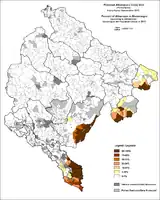
Albanians in Montenegro are settled in the southeastern and eastern parts of the country. Ulcinj Municipality, consisting Ulcinj (Albanian: Ulqin) with the surroundings and Ana e Malit region, along with the newly-formed Tuzi Municipality, are the only municipalities where Albanians are the majority (71% and 68% of the populations respectively). A large number of Albanians also live in the following regions: Bar (Tivar) and Skadarska Krajina (Krajë) in Bar Municipality (2,515 Albanians or 6% of the population), Plav (Plavë) and Gusinje (Guci) in Plav Municipality (2,475 or 19%) and Rožaje (Rozhajë) in Rožaje Municipality (1,158 or 5%).[4]
The largest Albanian settlement is Ulcinj, followed by Tuzi.
Municipalities with an Albanian majority
Of the 24 municipalities in the country, 2 have an ethnic Albanian majority.
| Emblem | Municipality | Area km² (sq mi) |
Settlements | Population (2011) | Mayor | |
|---|---|---|---|---|---|---|
| Total | % | |||||
 |
Ulcinj Ulqin |
255 km2 (98 sq mi) | 41 | 19,921 | 70.66% | Ljoro Nrekić (DPS) |
 |
Tuzi Tuz |
236 km2 (91 sq mi) | 37 | 12,096 | 68.45% | Nik Gjeloshaj (AA) |
| — | 2 | — | 78 | 32,017 | — | — |
Anthropology
The Albanians in Montenegro are Ghegs.

Tribes
The historical Albanian tribes which exist in Montenegro up to the modern era are: Hoti, Gruda, Trieshi, Koja.[71]
Other Albanian tribes also existed in the past, but either formed other tribes or assimilated into the neighbouring Slavic population. Examples include Mataruge and Španje in Old Herzegovina, Kryethi and Pamalioti around the city of Ulcinj, Mahine above Budva, Goljemadi in Old Montenegro, as well as tribes who inhabited the Brda area, including Bytadosi, Bukumiri, Malonšići, Macure, Mataguzi, Drekalovići, Kakarriqi, Rogami, Kuçi, Piperi, Bratonožići, Vasojevići and Bjelopavlići, the latter five now identifying as Slavic.
Culture
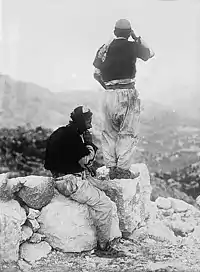
Montenegrin Albanian culture in this region is closely related to the culture of Albanians in Albania, and the city of Shkodër in particular. Their Albanian language dialect is Gheg as of Albanians in Northern Albania.
Religion
According to the 2003 census, 73.37% of Albanians living in Montenegro were Muslim and 26.08% were Roman Catholic.[72] The religious life of Muslim Albanians is organized by the Islamic Community of Montenegro, comprising not only Albanians, but also other Muslim minorities in Montenegro.[73] Catholic Albanians, generally living in Malesija, Šestani and some in the Bar and Ulcinj municipalities, are members of Roman Catholic Archdiocese of Bar, whose members are mainly Albanians, but which also includes a small number of Slavs. The current archbishop, Zef Gashi, is an ethnic Albanian.[73]
Language
Albanians in Montenegro speak the Gheg Albanian dialect, namely the northwestern variant, while according to the 2011 Census, there are 32,671 native speakers of the Albanian language (or 5.27% of the population).[4]
According to Article 13 of the Constitution of Montenegro, Albanian language (alongside Serbian, Bosnian and Croatian) is a language in official use, officially recognized as minority language.[74]
Education
The government of Montenegro provides Albanian-language education in the local primary and secondary schools. There is one department in the University of Montenegro, located in Podgorica, offered in Albanian, namely teacher education[42]
Politics
The first political party created by Albanians in this country is the Democratic League in Montenegro, founded by Mehmet Bardhi in 1990. Most Albanians support the country's integration into the EU: during the 2006 Montenegrin independence referendum, in Ulcinj Municipality, where Albanians at that time accounted over 72% of the population, 88.50% of voters voted for an independent Montenegro. Overall, the vote of the Albanian minority secured the country's secession from Serbia and Montenegro.[75]
In 2008, the Albanian National Council (Albanian: Këshilli Kombëtar i Shqiptarëve, abb. KKSH) was established to represent the political interests of the Albanian community. The current chairman of the KKSH is Genci Nimanbegu.
Prominent Individuals
See also
| Part of a series on |
| Albanians |
|---|
 |
| By country |
|
Native Albania · Kosovo Croatia · Greece · Italy · Montenegro · North Macedonia · Serbia Diaspora Australia · Bulgaria · Denmark · Egypt · Finland · Germany · Norway · Romania · South America · Spain · Sweden · Switzerland · Turkey · Ukraine · United Kingdom · United States |
| Culture |
| Architecture · Art · Cuisine · Dance · Dress · Literature · Music · Mythology · Politics · Religion · Symbols · Traditions · Fis |
| Religion |
|
Christianity (Catholicism · Italo-Albanian Church · Albanian Greek-Catholic Church · Orthodoxy) · Islam (Sunnism · Bektashism) · Judaism |
| Languages and dialects |
|
Albanian Gheg (Arbanasi · Upper Reka · Istrian) · Tosk (Arbëresh · Arvanitika · Cham · Lab) |
|
History of Albania (Origin of the Albanians) |
Gallery
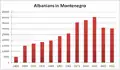 Albanians in Montenegro from 1921 to 2011.
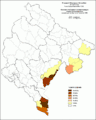 Percent of Albanians by municipalities, 1953.
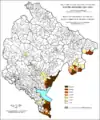 Percent of Albanians by settlements, 1961.
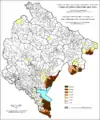 Percent of Albanians by settlements, 1971.
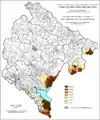 Percent of Albanians by settlements, 1981.
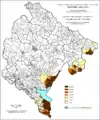 Percent of Albanians by settlements, 1991.
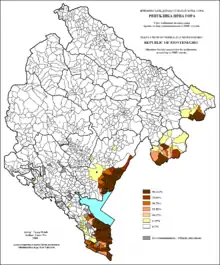 Percent of Albanians by settlements, 2003.
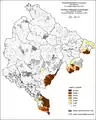 Percent of Albanians by settlements, 2011.
References
- "Popis stanovništva, domaćinstava i stanova u Crnoj Gori 2011. godine" [Census of Population, Households and Dwellings in Montenegro 2011] (PDF) (Press release) (in Serbo-Croatian). Statistical office, Montenegro. 12 July 2011. Retrieved 30 March 2011.
- "Census of Population, Households and Dwellings in Montenegro 2011" (PDF). July 12, 2011. Retrieved 13 July 2011.
- Simon Broughton; Mark Ellingham; Richard Trillo (1999). World music: the rough guide. Africa, Europe and the Middle East. Rough Guides. p. 5. ISBN 978-1-85828-635-8. Retrieved 13 July 2013.
Most of the ethnic Albanians that live outside the country are Ghegs, although there is a small Tosk population clustered around the shores of lakes Presp and Ohrid in the south of Macedonia.
- Stanovništvo Crne Gore prema polu, tipu naselja, nacionalnoj, odnosno etničkoj pripadnosti, vjeroispovijesti i maternjem jeziku po opštinama u Crnoj Gori – monstat.org
- Morrison 2018, p. 66
- Matthew C., Curtis (2012). Slavic-Albanian Language Contact, Convergence, and Coexistence. The Ohio State University. p. 140.
- Eichler, Ernst; Hilty, Gerold; Löffler, Heinrich; Steger, Hugo; Zgusta, Ladislav (2008). Namenforschung / Name Studies / Les noms propres. 1. Halbband. Walter de Gruyter. p. 718. ISBN 978-3110203424.
- Wilkes, John (1992). The Illyrians. Wiley. p. 244. ISBN 9780631146711. "Names of individuals peoples may have been formed in a similar fashion, Taulantii from ‘swallow’ (cf. the Albanian tallandushe) or Erchelei the ‘eel-men’ and Chelidoni the ‘snail-men’. The name of the Delmatae appears connected with the Albanian word for ‘sheep’ delmë) and the Dardanians with for ‘pear’ (dardhë). Some place names appear to have similar derivations, including Olcinium (Ulcinj from ‘wolf’ (ukas), although the ancients preferred a connection with Cholchis."
- Birnbaum, Henrik; Puhvel, Jaan (1963). "The Position of Albanian". Ancient Indo-European Dialects. University of California Press. p. 108.
- Gashi, Skënder (2015). ONOMASTIC-HISTORICAL RESEARCH ON EXTINCT AND ACTUAL MINORITIES OF KOSOVA. ASHAK. p. 245.
- West, Rebecca (2007). Black Lamb and Grey Falcon. Penguin. ISBN 978-1-101-04268-7. Retrieved 24 December 2019.
- Zbornik Matice srpske za filologiju i lingvistiku. Matica. 1994. p. 498. Retrieved 6 May 2013.
- Ismajli 2015, p. 474.
- Katičić 1976, p. 186
- Demiraj 2006, p. 148.
- Milan Šufflay (2000). Izabrani politički spisi. Matica hrvatska. p. 218. ISBN 9789531502573. Retrieved 20 March 2020.
- Pulaha 1975, pp. 94–95.
- Ahmetaj 2007, p. 170.
- Pulaha, Selami (1972). "Elementi shqiptar sipas onomastikës së krahinave të sanxhakut të Shkodrës [The Albanian element in view of the anthroponymy of the sanjak of Shkodra]". Studime Historike: 84–5. Retrieved 18 March 2020.
- Elsie 2015, p. 28. sfn error: multiple targets (2×): CITEREFElsie2015 (help)
- Stanojević & Vasić 1975, p. 97.
- Ćorović, Vladimir (2001) [1997]. "Преокрет у држању Срба". Историја српског народа (in Serbian). Belgrade: Јанус.
- Kola, Azeta (2017). "FROM SERENISSIMA'S CENTRALIZATION TO THE SELFREGULATING KANUN: THE STRENGTHENING OF BLOOD TIES AND THE RISE OF GREAT TRIBES IN NORTHERN ALBANIA FROM 15TH TO 17TH CENTURY". Acta Histriae: 369. Cite journal requires
|journal=(help) - Mala, Muhamet (2017). "The Balkans in the anti-Ottoman projects of the European Powers during the 17th Century". Studime Historike (1–02): 276.
- Dokumente të shekujve XVI-XVII për historinë e Shqipërisë (in Albanian). Akademia e Shkencave e RPS të Shqipërisë, Instituti i Historisë. 1989. p. 9. Retrieved 4 April 2020.
- Studime Historike (in Albanian). 1967. p. 127. Retrieved 4 April 2020.
- Kulišić, Špiro (1980). O etnogenezi Crnogoraca (in Montenegrin). Pobjeda. p. 41. Retrieved 19 November 2011.
- Lambertz, Maximilian (1959). Wissenschaftliche Tätigkeit in Albanien 1957 und 1958. Südost-Forschungen. S. Hirzel. p. 408. Retrieved 19 November 2011.
- Mitološki zbornik. Centar za mitološki studije Srbije. 2004. pp. 24, 41–45.
- Ramaj, Albert. Poeta nascitur, historicus fit -Ad honorem Zef Mirdita (PDF). p. 132.
Në mënyrë domethënëse, një tekst françeskan i shek. XVII, pasi pohon se fi set e Piperve, Bratonishëve, Bjelopavliqëve e Kuçëve ishin shqiptare, shton se: “megjithatë, duke qenë se thuajse që të gjithë ata ndjekin ritin serbian (ortodoks) dhe përdorin gjuhën ilirike (sllave), shumë shpejt do mund të quhen më shumë Sllavë, se sa Shqiptarë...Ma favellando delle quattro popolationi de Piperi, Brattonisi, Bielopaulouicchi e Cuechi, liquali et il loro gran ualore nell’armi danno segno di esser de sangue Albanese e a tale dalli Albanesi sono tenuti
- SANU (1971). "Editions speciales". 443. Naučno delo: 151. Cite journal requires
|journal=(help) - Elsie, Robert (30 May 2015). The tribes of Albania: History,Society and Culture. I.B.Tauris. ISBN 978-1-78453-401-1.
- ANDRÉ-LOUIS SANGUIN, SANGUIN (2011). MONTENEGRO IN REBECCA WEST'S BLACK LAMB AND GREY FALCON: THE LITERATURE OF TRAVELLERS AS A SOURCE FOR POLITICAL GEOGRAPHY CRNA GORA U DJELU REBECCE WEST BLACK LAMB AND GREY FALCON: PUTOPISI KAO IZVOR PODATAKA U POLITIČKOJ GEOGRAFIJI. 1Sveučilište Paris-Sorbonne / University of Paris-Sorbonne. p. 257. Retrieved 26 March 2020.
- Samtiden: skildringar från verldstheatern (in Swedish) (In Swedish "Den 26 Oktober 1851 tilldrog sig nemligen, att Arnaut-chefen Gjulek från Niksic, hvilken skulle försvara landet mot Montenegrinerna och hålla själv staden i lydnad, hade med 200 arnauter, dem han hemtat till förstärkning från Mostar, blifvit överfallen af en stark Montenegrinsk Ceta i trakten af Gatsko. " Translation: On October 26, 1851, Arnaut commander Gjulek of Niksic, who would defend the country against the Montenegrin and keep the city in obedience, had agreed, with 200 arnauts, which he had taken to reinforce Mostar, to have been attacked by a strong Montenegrin Ceta in the neighborhood of Gatsko. ed.). tryckt hos P. G. Berg. 1858. p. 478. Retrieved 21 November 2019.
- Qosja, Rexhep (1999). Kosova në vështrim enciklopedik (in Albanian). Botimet Toena. p. 81. ISBN 978-99927-1-170-5. Retrieved 21 November 2019.
- Houtsma, M. Th (1993). E.J. Brill's First Encyclopaedia of Islam, 1913-1936. BRILL. p. 559. ISBN 978-90-04-09791-9. Retrieved 21 November 2019.
- Stillman, William James (1877). The Autobiography of a Journalist, Volume II by William James Stillman - Full Text Free Book (Part 3/5). Retrieved 21 November 2019.
- Malcolm, Noel (1998). Kosovo: A Short History. Macmillan. p. 229. ISBN 978-0-333-66612-8. Retrieved 21 November 2019.
- Kultura popullore (in Albanian) (Translation: 118/5000 the process of expelling Albanians from their lands in Koloshin, Niksic Field, Zabjak and elsewhere ”. ed.). Akademia e Shkencave e RSH, Instituti i Kulturës Popullore. 1991. p. 25. Retrieved 21 November 2019.
- Maloku, Enver (1997). Dëbimet e shqiptarëve dhe kolonizimi i Kosovës (1877-1995) (in Albanian) (Montenegrin army violence and property theft forced them to flee from Kolasin, Niksic, Shpuza, ... ed.). Qendra për Informim e Kosovës. Retrieved 21 November 2019.
- ILLYRIAN LETTERS. 1878. p. 187. Retrieved 21 November 2019.
- Istorijski Leksikon Crne Gore, Grup of authors, Daily press: Podgorica, 2006 [[Speciale:BurimeteLibrave/867706169X|ISBN 86-7706-169-X]]
- Roberts 2005, p. 22. "Meanwhile Austria-Hungary's occupation of Bosnia-Hercegovina, which had been conceded at the congress, acted as a block to Montenegrins territorial ambitions in Hercegovina, whose Orthodox Slav inhabitants were culturally close to the Montenegrins. Instead Montenegro was able to expand only to the south and east into lands populated largely by Albanians – both Muslims and Catholics – and Slav Muslims. Along the coast in the vicinity of Ulcinj the almost exclusively Albanian population was largely Muslim. The areas to the south and east of Podgorica were inhabited by Albanians from the predominantly Catholic tribes, while further to the east there were also concentrations of Slav Muslims. Podgorica itself had long been an Ottoman trading centre with a partly Turkish, but largely Slav Muslim and Albanian population. To incorporate such a population was to dilute the number of Montenegrins, whose first loyalties lay with the Montenegrin state and Petrović dynasty, not that this was seen as sufficient reason for the Montenegrins to desist from seeking to obtain further territory."; p.23 "It was only in 1880 after further fighting with local Albanians that the Montenegrins gained an additional 45 km, stretch of seaboard extending from just north of Bar- down to Ulcinj. But even after the Congress of Berlin and these later adjustments, certain parts of the Montenegrin frontier continued to be disputed by Albanian tribes which were strongly opposed to rule by Montenegro. Raiding and feuding took place along the whole length of the porous Montenegrin-Albanian border."
- Blumi 2003, p. 246. "What one sees over the course of the first ten years after Berlin was a gradual process of Montenegrin (Slav) expansion into areas that were still exclusively populated by Albanian-speakers. In many ways, some of these affected communities represented extensions of those in the Malisorë as they traded with one another throughout the year and even inter-married. Cetinje, eager to sustain some sense of territorial and cultural continuity, began to monitor these territories more closely, impose customs officials in the villages, and garrison troops along the frontiers. This was possible because, by the late 1880s, Cetinje had received large numbers of migrant Slavs from Austrian-occupied Herzegovina, helping to shift the balance of local power in Cetinje's favor. As more migrants arrived, what had been a quiet boundary region for the first few years, became the center of colonization and forced expulsion." ; p.254. footnote 38. "It must be noted that, throughout the second half of 1878 and the first two months of 1879, the majority of Albanian-speaking residents of Shpuza and Podgoritza, also ceded to Montenegro by Berlin, were resisting en masse. The result of the transfer of Podgoritza (and Antivari on the coast) was a flood of refugees. See, for instance, AQSH E143.D.1054.f.1 for a letter (dated 12 May 1879) to Dervish Pasha, military commander in Işkodra, detailing the flight of Muslims and Catholics from Podgoritza."
- Gruber 2008, pp. 142. "Migration to Shkodra was mostly from the villages to the south-east of the city and from the cities of Podgorica and Ulcinj in Montenegro. This was connected to the independence of Montenegro from the Ottoman Empire in the year 1878 and the acquisition of additional territories, e.g. Ulcinj in 1881 (Ippen, 1907, p. 3)."
- Tošić 2015, pp. 394–395. "As noted above, the vernacular mobility term 'Podgoriçani' (literally meaning 'people that came from Podgoriça', the present-day capital of Montenegro) refers to the progeny of Balkan Muslims, who migrated to Shkodra in four historical periods and in highest numbers after the Congress of Berlin 1878. Like the Ulqinak, the Podgoriçani thus personify the mass forced displacement of the Muslim population from the Balkans and the 'unmixing of peoples' (see e.g. Brubaker 1996, 153) at the time of the retreat of the Ottoman Empire, which has only recently sparked renewed scholarly interest (e.g. Blumi 2013; Chatty 2013)." ; p. 406.
- Redžepagić 1970, p. 102.
- Redžepagić 1970, p. 36.
- Brahim Uk Demushi, personalitet i shquar i Tropojës. Retrieved 21 November 2019.
- Prizrenit, Lidhja Shqiptare e (1978). Me pushkë dhe penë për liri e pavarësi (in Albanian) (Translation: But the peak of this war reached the battle of Nikshiiq in early January 1880. ed.). Shtëpia Botuese "8 Nëntori". pp. 120, 115. Retrieved 21 November 2019.
- Library of Congress Subject Headings. Library of Congress. 2012.
- Office, Library of Congress Cataloging Policy and Support (2009). Library of Congress Subject Headings. Library of Congress, Cataloging Distribution Service.
- Elsie, Robert (24 April 2015). The Tribes of Albania,: History, Society and Culture. I.B.Tauris. ISBN 9780857739322.
- Shpuza, Gazmend (1999). Në prag të pavarësisë (in Albanian) (... fearing that the Highlanders would attack the Young Turk troops from the territories of Montenegro, the third, arrested and interned the Albanians in Niksic and Danilovgrad, lasting up to six months ed.). Eagle Press. p. 94. ISBN 978-1-891654-04-6. Retrieved 21 November 2019.
- Bartl, 1968 & 63:Die Kaza Bjelopolje ( Akova ) zählte 11 serbische Dörfer mit 216 Häusern , 2 gemischt serbisch - albanische Dörfer mit 25 Häusern und 47 albanische Dörfer mit 1 266 Häusern . Bjelopolje selbst hatte etwa 100 albanische und serbische.
- Bartl, 1968 & 63:Die Kaza Kolašin zählte 5 serbische Dörfer mit 75 Häusern und 27 albanische Dörfer mit 732 Häusern .
- Poláčková & Van Duin 2013, p. 72.
- Müller 2005, p. 203.
- Gjurmime albanologjike: Seria e shkencave historike (in Albanian). Instituti. 1988. p. 251. Retrieved 21 November 2019.
- Mulaj, Klejda (2008-02-22). Politics of Ethnic Cleansing: Nation-State Building and Provision of In/Security in Twentieth-Century Balkans. Lexington Books. p. 33. ISBN 978-0-7391-4667-5.
- Banac, Ivo (2015-06-09). The National Question in Yugoslavia: Origins, History, Politics. Cornell University Press. pp. 298 snippet view. ISBN 978-1-5017-0194-8.
- Kaba, Hamit (2013). "RAPORTI I STAVRO SKËNDIT DREJTUAR OSS' NË WASHINGTON D.C "SHQIPËRIA NËN PUSHTIMIN GJERMAN". STAMBOLL, 1944". Studime Historike: 275.
- Džogović, Fehim (2020). "NEKOLIKO DOKUMENATA IZ DRŽAVNOG ARHIVA ALBANIJE U TIRANI O ČETNIČKOM GENOCIDU NAD MUSLIMANIMA BIHORA JANUARA 1943". ALMANAH - Časopis za proučavanje, prezentaciju I zaštitu kulturno-istorijske baštine Bošnjaka/Muslimana (in Bosnian) (85–86): 329–341. ISSN 0354-5342.
- "Željko Milović-DRUGI SVJETSKI RAT". Montenengrina Digitalna Biblioteka.
- "Massive Grave of Albanian Victims of Tivari Massacre uncovered". Albanian Telegraphic Agency. 19 September 1996. Retrieved 31 August 2012.
- Ljubica Štefan (1999). Mitovi i zatajena povijest. K. Krešimir. ISBN 978-953-6264-85-8.
- Bytyci, Enver (2015). Coercive Diplomacy of NATO in Kosovo. Newcastle upon Tyne: Cambridge Scholars Publishing. p. 12. ISBN 9781443872720.
- Fevziu, Blendi (2016-02-01). Enver Hoxha: The Iron Fist of Albania. London: I.B.Tauris. ISBN 9780857729088.
- Pearson, Owen (2004). Albania in the Twentieth Century, A History: Volume III: Albania as Dictatorship and Democracy, 1945-99. London: I.B.Tauris. p. 343. ISBN 1845111052.
- "Mali i Zi me sy nga Shqipëria- vijojnë ndihmat nga qytete, institucione dhe individë" (in Albanian). TRT. 28 November 2019. Retrieved 29 November 2019.
- Recherches albanologiques: Folklore et ethnologie (in French). Pristina: Instituti Albanologijik i Prishtinës. 1982.
- "Montenegrin Census' from 1909 to 2003 - Aleksandar Rakovic". www.njegos.org.
- Bieber, Florian (2003). Montenegro in Transition – Problems of Identity and Statehood. Baden-Baden, Germany: Nomos Verlagsgesellschaft. ISBN 978-3-8329-0072-4.
- KUSHETUTA E MALIT TË ZI – minmanj.gov.me
- "The Minority Report: Jobless Ethnic Albanians "Let Down by the State"".
Bibliography
- Ahmetaj, Mehmet (2007). "Toponymy of Hoti". Studime Albanologjike. 37.
- Curtis, Matthew (2012). Slavic-Albanian Language Contact, Convergence, and Coexistence. Ohio State University.
- Elsie, Robert (2003). Early Albania: A reader of Historical texts, 11th–17th centuries. Wiesbaden: Otto Harrassowitz Verlag. ISBN 9783447047838.
- Gawrych, George (2006). The Crescent and the Eagle: Ottoman rule, Islam and the Albanians, 1874–1913. London: IB Tauris. ISBN 9781845112875.
- Morrison, Kenneth (2018). Nationalism, Identity and Statehood in Post-Yugoslav Montenegro. Bloomsbury Publishing. ISBN 978-1474235198.
- Morozova, Maria (2019). "Language Contact in Social Context: Kinship Terms and Kinship Relations of the Mrkovići in Southern Montenegro". Journal of Language Contact. 12 (2): 305–343. doi:10.1163/19552629-01202003.
- Morozova, Maria; Rusakov, Alexander (2018). "SLAVIC-ALBANIAN INTERACTION IN VELJA GORANA: PAST AND PRESENT OF A BALANCED LANGUAGE CONTACT SITUATION". International Scientific Conference "Multiculturalism and Language Contact".
- Pulaha, Selami (1975). "Kontribut për studimin e ngulitjes së katuneve dhe krijimin e fiseve në Shqipe ̈rine ̈ e veriut shekujt XV-XVI' [Contribution to the Study of Village Settlements and the Formation of the Tribes of Northern Albania in the 15th century]". Studime Historike. 12.
- Redžepagić, Jašar (1970). Zhvillimi i arësimit dhe i sistemit shkollor të kombësisë shqiptare në teritorin e Jugosllavisë së sotme deri në vitin 1918. Enti i teksteve dhe i mjeteve mësimore i Krahinës Socialiste Autonome të Kosovës.
|
| Europe |  Map of countries with the largest Albanian communities. | |
|---|---|---|
| Americas | ||
| Asia | ||
| Africa | ||
| Oceania | ||
| ||