Alexander (Byzantine emperor)
Alexander[lower-alpha 1] Porphyrogenitus(Greek: Αλέξανδρος, Alexandros, c. 870 – 6 June 913) was Byzantine emperor from 912 to 913.
| Alexander | |
|---|---|
| Emperor and Autocrat of the Romans | |
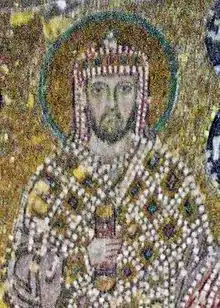 Byzantine Mosaic portrait of Emperor Alexander in Istanbul. In his left hand he holds a globus cruciger, and in his right the akakia. | |
| Byzantine emperor | |
| Reign | 11 May 912 – 6 June 913 |
| Predecessor | Leo VI |
| Successor | Constantine VII |
| Born | c. 870 |
| Died | June 6, 913 (aged 42) |
| Dynasty | Macedonian |
| Father | Basil I |
| Mother | Eudokia Ingerina |
Life
Alexander was the third son of Emperor Basil I and Eudokia Ingerina. Unlike his older brother Leo VI the Wise, his paternity was not disputed between Basil I and Michael III because he was born years after the death of Michael.[6] As a child, Alexander was crowned as co-emperor by his father around 879.[7]
Upon the death of his brother Leo on 11 May 912, Alexander succeeded as senior emperor alongside Leo's young son Constantine VII. He was the first Byzantine emperor to use the term "autocrator" (αὐτοκράτωρ πιστὸς εὑσεβὴς βασιλεὺς) on coinage to celebrate the ending of his thirty-three years as co-emperor.[8] Alexander promptly dismissed most of Leo's advisers and appointees, including the admiral Himerios, the patriarch Euthymios, and the Empress Zoe Karbonopsina, the mother of Constantine VII whom he locked up in a nunnery.[9] The patriarchate was again conferred on Nicholas Mystikos, who had been removed from this position because he had opposed Leo's fourth marriage. During his short reign, Alexander found himself attacked by the forces of Al-Muqtadir of the Abbasid Caliphate in the East, and provoked a war with Simeon I of Bulgaria by refusing to send the traditional tribute on his accession. Alexander died of exhaustion after a game of tzykanion on June 6, 913, allegedly fulfilling his brother's prophecy that he would reign for 13 months.
The sources are uniformly hostile towards Alexander, who is depicted as lazy, lecherous, drunk, and malignant, including the rumor that he planned to castrate the young Constantine VII in order to exclude him from the succession. At least that charge did not come to pass, but Alexander left his successor a hostile regent (Nicholas Mystikos) and the beginning of a long war against Bulgaria. The sources also accused the Emperor of idolatry, including making pagan sacrifices to the golden statue of a boar in the Hippodrome in hope of curing his impotence.[10]

Notes
References
- Browning 1980, p. 297.
- Haldon 2005, p. 176.
- Lawler 2015, p. 37.
- Tougher 1996, p. 209.
- Jenkins 1999, p. 101.
- Schmitz, Leonhard (1867). "Alexander". In William Smith (ed.). Dictionary of Greek and Roman Biography and Mythology. 1. Boston: Little, Brown and Company. p. 115.
- Ostrogorsky, George (1969). History of the Byzantine State. Rutgers University Press. p. 233. ISBN 0-8135-0599-2.
- Ostrogorsky (1969), pp. 261ff.
- Ostrogorsky (1969), p. 261.
- Runciman S., A history of the First Bulgarian empire, London, G.Bell & Sons, 1930, p. 155
Sources
- The Oxford Dictionary of Byzantium. Oxford University Press. 1991.
- Browning, Robert (1980). The Byzantine Empire (Revised ed.). The Catholic University of America Press. ISBN 978-0813207544.
- Haldon, John (2005). The Palgrave Atlas of Byzantine History. Palgrave Macmillan. ISBN 978-0230243644.
- Jenkins, Everett (1999). The Muslim Diaspora: A Comprehensive Chronology of the Spread of Islam in Asia, Africa, Europe and the Americas (Volume 1: 570-1500). McFarland. ISBN 978-0786447138.
- Lawler, Jennifer (2015) [2004]. Encyclopedia of the Byzantine Empire. Jefferson: McFarland. ISBN 978-0-7864-6616-0.
- John Julius Norwich (1993). Byzantium, The Apogee. Penguin Books. ISBN 0140114483.
- Tougher, Shaun F. (1996). "The bad relations between Alexander and Leo". Byzantine and Modern Greek Studies. 20: 209–212. doi:10.1179/byz.1996.20.1.209.
Authority control  | |
|---|---|
| General | |
| National libraries | |