Alexander Gorodnitsky
Alexander Moiseevich Gorodnitsky (Russian: Алекса́ндр Моисе́евич Городни́цкий, IPA: [ɐlʲɪˈksandr məɪˈsʲejɪvʲɪtɕ ɡərɐˈdʲnʲitskʲɪj] ( listen); born March 20, 1933) is a well-known Soviet and Russian Jewish bard and poet. Professionally, he is a geologist and oceanographer. He is a member of the Russian Academy of Natural Sciences.
Biography
Early life
Gorodnitsky was born on 20 March 1933 in Leningrad to a Russian Jewish family. His father was engineer and worked in the printing industry. His mother, in her youth, was a school math teacher, then she worked as corrector and editor of sailing directions.
Gorodnitsky survived the Siege of Leningrad during Second World War. In 1951, he graduated from high school and entered the Faculty of Geophysics of the Leningrad Mining Institute, which he graduated in 1957 with specialist degree.
Academic career
From 1957 until 1972 Gorodnitsky worked in the Research institute for Geology of Arctic (its current name is All-Russian Research Institute for Geology and Mineral Resources of the World Ocean named after academician I.S. Gramberg (Russian: Всероссийский научно-исследовательский институт геологии и минеральных ресурсов Мирового океана имени академика И.С. Грамберга)). He has participated in many geological expeditions. Gorodnitsky is one of the discoverers of the Igarskoye copper deposit (1962).
Since 1962, he has participated in maritime geophysical expeditions. Gorodnitsky is one of the authors of new ocean's electric field measurement method (1967). In collaboration with V.D. Fedorov and A.N. Paramonov he discovered the bioelectric effect of phytoplankton (1967).
In 1968, he became a Candidate of Sciences (thesis on "The application of magnetometry and electrometry for the ocean bottom exploration").
From 1969 until 1972 Gorodnitsky headed the Laboratory of Marine Geophysics of the Research institute for Geology of Arctic.
In 1972, Gorodnitsky moved from Leningrad to Moscow and started working for the Research Institute of Oceanology named after P.P. Shirshov as a principal researcher.
In 1982, he became a Doctor of Sciences in geological and mineralogical sciences (thesis on "The structure of oceanic lithosphere and underwater mountain building").
In 1991, Gorodnitsky was given the highest academic rank of the professor.
He authored original model of petromagnetic structure of the Mid-ocean ridge zones (1997).[1]
Gorodnitsky is an author of over 250 scientific publications on geophysics and tectonics of ocean bottom. He teaches in Moscow State University and State University of the naukograd Dubna. He was awarded the honorary title of "Merited figure of sciences of Russian Federation" (2005).[2]
Poet and singer-songwriter
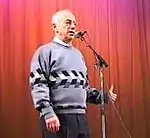
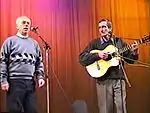
Gorodnitsky's first songs appeared during his expedition in 1953. For a long time his songs were distributed via samizdat tape recordings, and often performed by other singers. Like Alexander Galich, and unlike other bards, Gorodnitsky composed and sang his songs a cappella for several decades; later, he started playing the guitar. Most of his songs are of the Tourist Song subgenre and are based on his personal experiences. In concert, he usually performs with a professional guitarist accompanying him.
Gorodnitsky is acknowledged to be one of the founders of the bard songs genre in Soviet Union along with Vladimir Vysotsky, Bulat Okudzhava, Alexander Galich, Yuri Vizbor. His most popular songs are following: "Atlases hold up the sky", "Near the Pillars of Hercules", "To the mainland", "Blue sky above Canada", "French ambassador's wife", "Snow", "Riffles", "The song of polar pilots". He is an author of over 50 poems, songs and other literary works.[3]
Gorodnitsky is a member of the Union of Writers of Russia and PEN International. He was awarded the honorary title of "Merited figure of arts of Russian Federation" (2013).[4]
Gorodnitsky currently resides in Moscow and regularly performs at concerts and various bard festivals.
Family
Gorodnitsky has a son from first wife, a Vladimir (born 1955), who has been living in Israel since 1984.
His second wife was Anna Nal (28 September 1942 - 11 September 2017), professional interpreter/translator. The marriage was childless.
Views on climate change
Gorodnitsky doubts that human activities are responsible for climate change and sees natural causes for the global warming trend.[5]
Political views and social activity
Gorodnitsky is opposed the annexation of Crimea by the Russian Federation and had signed the open letter against war, political self-isolation of Russia, restoration of totalitarianism.[6]
References
- "Городницкий Александр Моисеевич". Shirshov Institute of Oceanology.
- "О награждении государственными наградами Российской Федерации". Decree No. 292 of 15 March 2005 (in Russian). President of Russia.
- "Биография Городницкого Александра Моисеевича". Gorodnitsky Official site.
- "О награждении государственными наградами Российской Федерации". Decree No. 639 of 25 July 2013 (in Russian). President of Russia.
- Gorodnitsky, Alexander (13 January 2020). "Девочка и миф" [Little girl and myth]. Огонёкъ [Ogoniok] (in Russian). No. 1 (5593). Moscow. p. 33. ISSN 0131-0097.
- "Обращение инициативной группы по проведению Конгресса интеллигенции "Против войны, против самоизоляции России, против реставрации тоталитаризма"". Novaya Gazeta (in Russian). 13 March 2014.
External links
 |
Wikimedia Commons has media related to Alexander Gorodnitsky. |
- (in Russian) gorodnit.spb.ru—official site
- (in English) Personalities of Saint-Petersburg—biography and photographs
- (in English) Alexander Gorodnitsky’s bio
- (in Russian) А.М. Городницкий поёт "Снег" и "Над Канадой". Видео. "Климат, лёд, вода, ландшафты"
Authority control  | |
|---|---|
| General | |
| National libraries | |
| Other | |