Alternative lifestyle
An alternative lifestyle is a lifestyle perceived to be outside the cultural norm. The phrase "alternative lifestyle" is often used pejoratively.[1] Description of a related set of activities as an alternative lifestyle is a defining aspect of certain subcultures.[2]
History
Alternative lifestyles and subcultures originated in the 1920s with the "flapper" movement. It is during these times when women cut their hair and skirts short (as a symbol of freedom from oppression and the old way of living).[3][4] Women in the flapper age were the first large group of females to practice pre-marital sex, dancing, cursing, and driving in modern America without scandal following them. The American press in the 1970s frequently used the term "alternative lifestyle" as a euphemism for homosexuality and for those perceived as hippies, both groups being seen as threatening to the social order.[1] A Stanford University cooperative house, Synergy, was founded in 1972 with the theme of "exploring alternative lifestyles."[5]
Examples
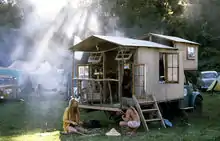
Following is a non-exhaustive list of activities that have been described as alternative lifestyles:
- Alternative child-rearing, such as homeschooling, coparenting and home births
- Restrictive dieting, such as veganism, vegetarianism, freeganism, or raw foodism
- Living in unusual communities, such as communes, intentional communities, ecovillages, off-the-grid, or the tiny house movement
- Traveling subcultures, including lifestyle travellers, housetrucking, and New Age travelling
- Simple living Bohemianism, Punk rock, Emo, antiquarian steampunk subculture and hippies.
- Body modification, including tattoos, body piercings, eye tattooing, scarification, non-surgical stretching like ears or genital stretching, and transdermal implants
- Cross dressing and transvestism
- Nudism and clothing optional lifestyles
- Non-normative sexual lifestyles, such as BDSM, polyamory, swinging, and certain types of sexual fetishism or paraphilia[6]
- Alternative medicine and natural methods of medical care or herbal remedies as medication
- Adherents to alternative spiritual and religious practices, such as Ordo Templi Orientis, Thelemites, Neo-pagans, Satanists and New Age spiritual communities
- Certain religious minorities, such as the Amish who pursue a non-technological or anti-technology lifestyle
- Secular anti-technology community called Luddites
- Special interest groups into collecting
See also
References
- Ryan, Maureen E. (2018). Lifestyle Media in American Culture: Gender, Class, and the Politics of Ordinariness. New York: Routledge. ISBN 978-1-315-46495-4.
- Ciment, James (2015). "Introduction". In Misiroglu, Gina (ed.). American Countercultures: An Encyclopedia of Nonconformists, Alternative Lifestyles, and Radical Ideas in U.S. History. Routledge. pp. xxxvi–xxxvii. ISBN 978-1-317-47729-7.
- O’Rourke, Ryan (2020-11-17). "Rights group raises fears 'alternative lifestyle' women on garda watchlist". Irish Examiner. Retrieved 2020-12-21.
- Bland, Lucy (2013). Modern women on trial: Sexual transgression in the age of the flapper. Oxford University Press. ISBN 9781847798961.
- "SYNERGY | Residential Education". resed.stanford.edu. Retrieved 2020-10-29.
- Makai, Michael (September 2013). Domination & Submission: The BDSM Relationship Handbook. Createspace. ISBN 978-1492775973.
Authority control  | |
|---|---|
| General | |
| National libraries | |
| Other | |