Alyattes of Lydia
Alyattes (Lydian language: 𐤥𐤠𐤩𐤥𐤤𐤯𐤤𐤮 Walweteś;[2] Ancient Greek: Ἀλυάττης Aluáttēs; reigned c. 635-585 BC[3]), sometimes described as Alyattes I, was the fourth king of the Mermnad dynasty in Lydia, the son of Sadyattes, grandson of Ardys, and great-grandson of Gyges. He died after a reign of 57 years and was succeeded by his son Croesus.[4][5]
| Alyattes of Lydia | |
|---|---|
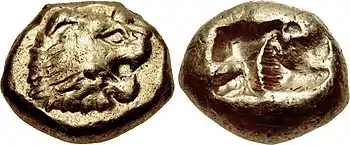 Coin of Alyattes. Circa 620/10-564/53 BC.[1] | |
| Lydian King | |
| Reign | c. 635 – c. 585 BC |
| Predecessor | Sadyattes |
| Successor | Croesus |
| Issue | Aryenis Croesus |
| Father | Sadyattes |
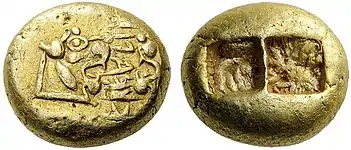
Alyattes was the first monarch who issued coins, made from electrum (and his successor Croesus was the first to issue gold coins). Alyattes is therefore sometimes mentioned as the originator of coinage, or of currency.[6]
Name
The most likely etymology for the name Aluáttēs derives it, via a form with initial digamma Ϝαλυάττης (Waluáttēs), itself originally from a Lydian Walweteś (Lydian alphabet: 𐤥𐤠𐤩𐤥𐤤𐤯𐤤𐤮).[2][7] The name Walweteś meant "lion-ness" (i.e. the state of being a lion), and was composed of the Lydian term walwe (𐤥𐤠𐤩𐤥𐤤), meaning "lion", to which was added an abstract suffix -at(t)a- (𐤠𐤯𐤠-).[3]
Chronology
Dates for the Mermnad kings are uncertain and are based on a computation by J. B. Bury and Russell Meiggs (1975) who estimated c.687–c.652 BC for the reign of Gyges.[9] Herodotus 1.16, 1.25, 1.86 gave reign lengths for Gyges' successors, but there is uncertainty about these as the total exceeds the timespan between 652 (probable death of Gyges, fighting the Cimmerians) and 547/546 (fall of Sardis to Cyrus the Great). Bury and Meiggs concluded that Ardys and Sadyattes reigned through an unspecified period in the second half of the 7th century BC,[10] but they did not propose dates for Alyattes except their assertion that his son Croesus succeeded him in 560 BC. The timespan 560–546 BC for the reign of Croesus is almost certainly accurate.[11]
However, based on an analysis of sources contemporary with Gyges, such as Neo-Assyrian records, Anthony Spalinger has convincingly deduced dated Gyges's death to 644 BCE,[12] and Alexander Dale has consequently dated Alyattes's reign as starting in c. 635 BCE and ending in 585 BCE.[3]
Life and reign
Alyattes ascended to the kingship of Lydia during period of severe crisis: during the 7th century BCE, the Cimmerians, a nomadic people from the Pontic steppe who had invaded the Levant, attacked Lydia several times but had been repelled by Alyattes's great-grandfather, Gyges. In 644 BCE, the Cimmerians, led by their king Lygdamis, attacked Lydia for the third time. The Lydians were defeated, Sardis was sacked, and Gyges was killed, following which he was succeeded by his son Ardys.[12] In 637 BCE, during the seventh regnal year of Ardys, the Thracian Treres tribe who had migrated across the Thracian Bosporus and invaded Anatolia,[13] under their king Kobos, and in alliance with the Cimmerians and the Lycians, attacked Lydia.[12] They defeated the Lydians again and for a second time sacked the Lydian capital of Sardis, except for its citadel. It is probable that Ardys was killed during this Cimmerian attack, and Ardys's son and successor Sadyattes might have also been killed during another Cimmerian attack in 653 BCE.[3]
Alyattes thus succeeded his father Sadyattes amidst extreme turmoil in 635 BCE.[3] Soon after Alyattes' ascension and early during his reign, with Assyrian approval[14] and in alliance with the Lydians,[15] the Scythians under their king Madyes entered Anatolia, expelled the Treres from Asia Minor, and defeated the Cimmerians so that they no longer constituted a threat again, following which the Scythians extended their domination to Central Anatolia[16] until they were themselves expelled by the Medes from Southwest Asia in the 590s BCE.[12] This final defeat of the Cimmerians was carried out by the joint forces of Madyes, who Strabo credits with expelling the Cimmerians from Asia Minor, and of Alyattes, whom Herodotus and Polyaenus claim finally defeated the Cimmerians.[17]
Alyattes's dealings with the Greeks were complex. He continued his predecessors' policy of making offerings to the sanctuary of Delphi in European Greece, to which he sent a silver krater, but carried out military confrontations with the Asiatic Greek cities immediately to the west of Lydia. Alyattes had inherited more than one war from his father, and he continued the hostilities with the Ionian city of Miletus started by Sadyattes. Alyattes's war with Miletus consisted largely of a series of raids to capture the Milesians' harvest of cereals, which were severely lacking in the Lydian core regions. These hostilities lasted until Alyattes's sixth year (c. 630 BCE), when he finally made peace with the city's tyrant Thrasybulus, and a treaty of friendship as well as one of military alliance was concluded between Lydia and Miletus whereby Miletus. Since Miletus lacked auriferous and other metallurgic resources while cereals were scarce in Lydia, trade of Lydian metal in exchange of Milesian cereal was initiated to seal these treaties, according to which Miletus voluntarily provided Lydia with military auxiliaries and would profit from the Lydian control of the routes in inner Anatolia, and Lydia would gain access to the markets and maritime networks of the Milesians in the Black Sea and at Naucratis.[18]
Herodotus's account of Alyattes's illness, caused by Lydian troops' destruction of the temple Athena in Assesos, and which was cured after he heeded the Pythia and rebuilt two temples of Athena in Assesos and then made peace with Miletus, is a largely legendary account of these events which appears to not be factual. This legendary account likely arose as a result of Alyattes's offerings to the sanctuary of Delphi.[18]
Alyattes further subdued the Carians, and took several Ionian cities, including Smyrna and Colophon. Smyrna was sacked and destroyed with its inhabitants forced to move into the countryside.[19]
Alyattes was obliged to turn his attention towards the newly rising Median and Neo-Babylonian Empires until, on 28 May 585 BC, during a battle on the Halys river fought against Cyaxares, king of Media, a solar eclipse occurred; after this, hostilities were suspended, a peace was concluded and Alyattes married his daughter Aryenis to Cyaxares's son Astyages and the Halys River was fixed as the boundary between the two kingdoms.[19] The alliance preserved Lydia for another generation, during which it enjoyed its most brilliant period.[20] Alyattes continued to wage a war against Miletus for many years.
He created the first coins in history made from electrum, a naturally occurring alloy of gold and silver. The weight of either precious metal could not just be weighed so they contained an imprint that identified the issuer who guaranteed the value of its contents.[21] Today we still use a token currency, where the value is guaranteed by the state and not by the value of the metal used in the coins.[22] Almost all coins used today descended from his invention after the technology passed into Greek usage through Hermodike II - a Greek princess from Cyme who was likely one of his wives (assuming he was referred to a dynastic 'Midas' because of the wealth his coinage amassed and because the electrum was sourced from Midas' famed river Pactolus; she was also likely the mother of Croesus (see croeseid symbolism. He standardised the weight of coins (1 stater = 168 grains of wheat). The coins were produced using an anvil die technique and stamped with a lion's head, the symbol of the Mermnadae.[23]
Tomb

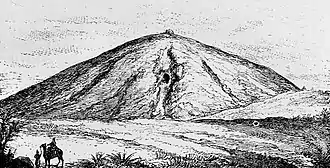
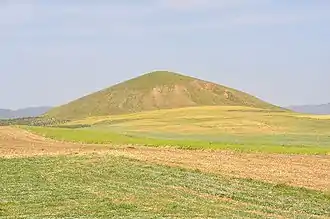
Alyattes' tomb still exists on the plateau between Lake Gygaea and the river Hermus to the north of the Lydian capital Sardis — a large mound of earth with a substructure of huge stones. (38.5723401, 28.0451151) It was excavated by Spiegelthal in 1854, who found that it covered a large vault of finely cut marble blocks approached by a flat-roofed passage of the same stone from the south. The sarcophagus and its contents had been removed by early plunderers of the tomb. All that was left were some broken alabaster vases, pottery and charcoal. On the summit of the mound were large phalli of stone.[19]
Herodotus described the tomb:
But there is one building to be seen there which is more notable than any, saving those of Egypt and Babylon. There is in Lydia the tomb of Alyattes the father of Croesus, the base whereof is made of great stones and the rest of it of mounded earth. It was built by the men of the market and the artificers and the prostitutes. There remained till my time five corner-stones set on the top of the tomb, and on these was graven the record of the work done by each kind: and measurement showed that the prostitutes' share of the work was the greatest.
— Herodotus 1-93.[27]
Some authors have suggested that Buddhist stupas were derived from a wider cultural tradition from the Mediterranean to the Indus valley, and can be related to the funeral conical mounds on circular bases that can be found in Lydia or in Phoenicia from the 8th century B.C., such as the tomb of Alyattes.[28][29][30]
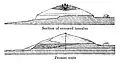 Alyattes tumulus reconstitution
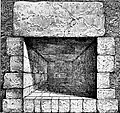 Alyattes tomb entrance
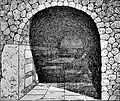 Alyattes tomb passageway
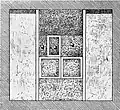 Alyattes tomb inner vault
References
- Weidauer Group XVII, 108 var. Triton XXI (2018) no. 497, auctioned for USD 2750. This particular coin does not bear an inscription, but it is from the same punch as contemporary coins which have the inscription WALWEL. (Classical Numismatics Group).
- Browne, Gerald Michael (1996). "Notes on Two Lydian Texts". Kadmos. 35 (1): 49–52. doi:10.1515/kadm.1996.35.1.49. Retrieved 9 November 2021.
- Dale, Alexander (2015). "WALWET and KUKALIM: Lydian coin legends, dynastic succession, and the chronology of Mermnad kings". Kadmos. 54: 151–166. doi:10.1515/kadmos-2015-0008. Retrieved 10 November 2021.
- Herodotus 1975, p. 46
- "Summary of Herodotus | First Floor Tarpley". Retrieved 16 November 2020.
- A. Ramage, "Golden Sardis", King Croesus' Gold: Excavations at Sardis and the History of Gold Refining, edited by A. Ramage and P. Craddock, Harvard University Press, Cambridge, 2000, p. 18.
- The name WALWET is inscribed on some of the coins of the Artemision deposit. Robert W. Wallace, "KUKALIM, WALWET, and the Artemision Deposit: Problems in Early Anatolian Electrum Coinage: Studies in Money and Exchange" in: Peter G. Van Alfen (ed.) Agoranomia: Studies in Money and Exchange Presented to John H. Kroll, American Numismatic Society (2006) 37–49.
- Interpreted as the given name Kukaś, equivalent to Gyges Wallace, “KUKALIṂ”, pl. 1, 1–4 = Weidauer Group XVIII, Triton XV no. 1241 (3 January 2012). Auctioned in 2013 for CHF 25000. (Classical Numismatics Group)
- Bury & Meiggs 1975, pp. 82–83
- Bury & Meiggs 1975, p. 501
- Bury & Meiggs 1975, p. 502
- Spalinger, Anthony J. (1978). "The Date of the Death of Gyges and Its Historical Implications". Journal of the American Oriental Society. 98 (4): 400–409. doi:10.2307/599752. Retrieved 25 October 2021.
- Diakonoff 1985, p. 94-55.
- Grousset 1970, p. 9. "A Scythian army, acting in conformity with Assyrian policy, entered Pontis to crush the last of the Cimmerians."
- Diakonoff 1985, p. 126.
- Phillips, E. D. (1972). "The Scythian Domination in Western Asia: Its Record in History, Scripture and Archaeology". World Archaeology. 4 (2): 129–138. Retrieved 5 November 2021.
- Ivantchik, Askold (1993). Les Cimmériens au Proche-Orient [The Cimmerians in the Near East] (in French). Fribourg, Switzerland; Göttingen, Germany: Editions Universitaires (Switzerland); Vandenhoeck & Ruprecht (Germany). p. 95-125. ISBN 978-3-727-80876-0.
- Leloux, Kevin (2018). La Lydie d’Alyatte et Crésus: Un royaume à la croisée des cités grecques et des monarchies orientales. Recherches sur son organisation interne et sa politique extérieure (PDF) (PhD). 1. University of Liège. Retrieved 5 December 2021.
- Chisholm 1911, p. 776
- Bury & Meiggs 1975, pp. 142–143
- Harari, Yuval Noah (2015). Sapiens: a Brief History of Humankind. First U.S. Edition: HarperCollins Publishers. p. 182. ISBN 978-0-06-231609-7.
- Amelia Dowler, Curator, British Museum; A History of the World; http://www.bbc.co.uk/ahistoryoftheworld/objects/7cEz771FSeOLptGIElaquA
- Mundall, Robert A. (2002). "The birth of coinage". Columbia Academic Commons. doi:10.7916/D8Q531TK.
- The Tomb of Atyattes (in French). 1993.
- Taylor, Richard P. (2000). Death and the Afterlife: A Cultural Encyclopedia. ABC-CLIO. p. 381. ISBN 9780874369397.
- Fergusson, James. Rude Stone Monuments. pp. 31–32.
- Herodotus 1-93
- "It is probably traceable to a common cultural inheritance, stretching from the Mediterranean to the Ganges valley, and manifested by the sepulchres, conical mounds of earth on a circular foundation, of about the eighth century B.C. found in Eritrea and Lydia." Rao, P. R. Ramachandra (2002). Amaravati. Youth Advancement, Tourism & Cultural Department Government of Andhra Pradesh. p. 33.
- On the hemispherical Phenician tombs of Amrit: Coomaraswamy, Ananda K. (1972). History of Indian and Indonesian art. p. 12.
- Commenting on Gisbert Combaz: "In his study L'évolution du stupa en Asie, he even observed that "long before India, the classical Orient was inspired by the shape of the tumulus for constructing its tombs: Phrygia, Lydia, Phenicia ." in Bénisti, Mireille; K, Thanikaimony (2003). Stylistics of Buddhist art in India. Indira Gandhi National Centre for the Arts. p. 12. ISBN 9788173052415.
Sources
- Bury, J. B.; Meiggs, Russell (1975) [first published 1900]. A History of Greece (Fourth Edition). London: MacMillan Press. ISBN 0-333-15492-4.
- Herodotus (1975) [first published 1954]. Burn, A. R.; de Sélincourt, Aubrey (eds.). The Histories. London: Penguin Books. ISBN 0-14-051260-8.
Attribution:
- This article incorporates text from a publication now in the public domain: Chisholm, Hugh, ed. (1911). "Alyattes". Encyclopædia Britannica. 1 (11th ed.). Cambridge University Press. p. 776. This cites A. von Ölfers, "Über die lydischen Königsgräber bei Sardes," Abh. Berl. Ak., 1858.
{[refend}}
External links
- Alyattes of Lydia by Jona Lendering