Amasa Eaton
Amasa Mason Eaton (May 31, 1841 – October 3, 1914) was an American lawyer and politician.
| Amasa Eaton | |
|---|---|
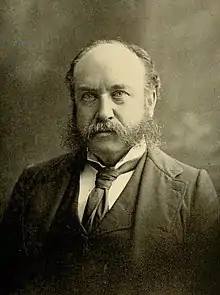 Eaton circa 1900 | |
| Born | May 31, 1841  Providence |
| Died | October 3, 1914 (aged 73) Providence |
| Position held | member of the Rhode Island House of Representatives (1865–1866) |
Life and education
Eaton was born on May 31, 1841, in Providence, Rhode Island,[1][2] to Sarah (Brown) Eaton and Levi Eaton.[3] He received an AM from Brown University in 1861 and an LLB from Harvard Law School in 1878.[2] Shortly after graduating from Brown University, he joined the 1st Rhode Island Infantry Regiment, when the American Civil War started, serving for three months.[4] He married Maude Dunnell on September 15, 1873, with whom he had six children.[5] Eaton died on October 3, 1914, in Providence.[2]
Political career
Eaton's political career began in 1863, two years after his graduation from Brown University, when he was elected a member of the North Providence Town Council.[6] He then became a member of the Rhode Island House of Representatives (1865–1866);[6][2] a member of the Providence Common Council (1872–1874); and an alderman in Providence (1874–1875).[6][1] Eaton was a member of the Democratic Party.[6]
Scholarship
Eaton was active in law reform efforts. He was a member of the Uniform Law Commission from 1897, becoming president from 1901 to 1910.[2]
Eaton's article "On Contracts in Restraint of Trade",[7] published in the Harvard Law Review, was the first to be cited in a decision of the Supreme Court of the United States.[8] Justice Edward Douglass White cited it in dissent in United States v. Trans-Missouri Freight Association, 166 US 290 (1897).[8]
Eaton supported self-government for municipalities. In Constitution-Making in Rhode Island (1899), he argued that the constitution of Rhode Island should be amended to prohibit state-level interference with local affairs.[9] In "The Right to Local Self-Government",[10] an article in five parts, he argued that municipalities held a right to govern themselves that predated the creation of states.[11]
In 1913, Eaton published Free Trade vs. Protection, a book about efforts past and present to impose tariffs. It argued for free trade as against protectionism.[12]
References
- Foote, Allen Ripley; Everett, Charles Edward (1893). Economic Legislation of All the States. 2. R. Clarke & Company. p. 2440.
- "Amasa M. Eaton Dies; Ex-President of Commission of Uniform State Legislation". The New York Times. October 4, 1914. ISSN 0362-4331. Retrieved April 29, 2021.
- Conley, Patrick T. (2019). The Leaders of Rhode Island's Golden Age. Arcadia Publishing. p. 117. ISBN 978-1-4671-4148-2.
- Munro 1916, pp. 331–332.
- Munro 1916, p. 333.
- Munro 1916, p. 332.
- Eaton, Amasa M. (October 15, 1890). "On Contracts in Restraint of Trade". Harvard Law Review. 4 (3): 128–137. doi:10.2307/1321349. JSTOR 1321349.
- Swygert, Michael L.; Bruce, Jon W. (1985). "The Historical Origins, Founding, and Early Development of Student-Edited Law Reviews". Hastings Law Journal. 36 (5): 788.
- Gilkeson, John S. (December 31, 1986). Middle-Class Providence, 1820–1940. Princeton University Press. p. 195. doi:10.1515/9781400854356. ISBN 978-1-4008-5435-6.
- Eaton, Amasa M. (February 1900). "The Right to Local Self-Government (I)". Harvard Law Review. 13 (6): 441–454. doi:10.2307/1322832. JSTOR 1322832.
- Frug, Gerald E. (1999). City Making: Building Communities without Building Walls. Princeton University Press. p. 48. ISBN 978-1-4008-2334-5. OCLC 741691293.
- "Has Vast Amount of Data; "Free Trade vs. Protection," a Timely Volume by Amasa M. Eaton". The Boston Globe. August 23, 1913. p. 3.
Sources
- Munro, Wilfred Harold (1916). Memorial Encyclopedia of the State of Rhode Island. Boston: American Historical Society. OCLC 1048812579.
Authority control | |
|---|---|
| General | |
| National libraries | |
| Other | |