Amenhotep III
Amenhotep III (Ancient Egyptian: jmn-ḥtp(.w), Amānəḥūtpū pronounced [ʔaˈmaːnəʔ ˈħutpu],[4][5] "Amun is Satisfied";[6] Hellenized as Amenophis III), also known as Amenhotep the Magnificent or Amenhotep the Great, was the ninth pharaoh of the Eighteenth Dynasty. According to different authors, he ruled Egypt from June 1386 to 1349 BC, or from June 1388 BC to December 1351 BC/1350 BC,[7] after his father Thutmose IV died. Amenhotep was Thutmose's son by a minor wife, Mutemwiya.[8]
| Amenhotep III | |||||||||||||||||||||||||||||||||||||||||||||||||||||||||||||||||||||||||||||||||||||||||||||||||||||||||||||
|---|---|---|---|---|---|---|---|---|---|---|---|---|---|---|---|---|---|---|---|---|---|---|---|---|---|---|---|---|---|---|---|---|---|---|---|---|---|---|---|---|---|---|---|---|---|---|---|---|---|---|---|---|---|---|---|---|---|---|---|---|---|---|---|---|---|---|---|---|---|---|---|---|---|---|---|---|---|---|---|---|---|---|---|---|---|---|---|---|---|---|---|---|---|---|---|---|---|---|---|---|---|---|---|---|---|---|---|---|---|
| Nibmu(`w)areya,[1] Mimureya, Amenophis III | |||||||||||||||||||||||||||||||||||||||||||||||||||||||||||||||||||||||||||||||||||||||||||||||||||||||||||||
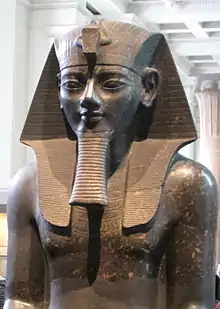 Statue of Amenhotep III, British Museum | |||||||||||||||||||||||||||||||||||||||||||||||||||||||||||||||||||||||||||||||||||||||||||||||||||||||||||||
| Pharaoh | |||||||||||||||||||||||||||||||||||||||||||||||||||||||||||||||||||||||||||||||||||||||||||||||||||||||||||||
| Reign | 1391–1353 or 1388–1351 BC (18th Dynasty) | ||||||||||||||||||||||||||||||||||||||||||||||||||||||||||||||||||||||||||||||||||||||||||||||||||||||||||||
| Predecessor | Thutmose IV | ||||||||||||||||||||||||||||||||||||||||||||||||||||||||||||||||||||||||||||||||||||||||||||||||||||||||||||
| Successor | Akhenaten | ||||||||||||||||||||||||||||||||||||||||||||||||||||||||||||||||||||||||||||||||||||||||||||||||||||||||||||
| |||||||||||||||||||||||||||||||||||||||||||||||||||||||||||||||||||||||||||||||||||||||||||||||||||||||||||||
| Consort | Tiye Gilukhepa Tadukhepa Sitamun Iset | ||||||||||||||||||||||||||||||||||||||||||||||||||||||||||||||||||||||||||||||||||||||||||||||||||||||||||||
| Children | Thutmose Amunhotep IV/Akhenaten Sitamun Iset Henuttaneb Nebetah "The Younger Lady" Beketaten(theorized) Smenkhkare(theorized) Tutankhamun(theorized) | ||||||||||||||||||||||||||||||||||||||||||||||||||||||||||||||||||||||||||||||||||||||||||||||||||||||||||||
| Father | Thutmose IV | ||||||||||||||||||||||||||||||||||||||||||||||||||||||||||||||||||||||||||||||||||||||||||||||||||||||||||||
| Mother | Mutemwiya | ||||||||||||||||||||||||||||||||||||||||||||||||||||||||||||||||||||||||||||||||||||||||||||||||||||||||||||
| Died | 1353 BC or 1351 BC | ||||||||||||||||||||||||||||||||||||||||||||||||||||||||||||||||||||||||||||||||||||||||||||||||||||||||||||
| Burial | WV22 | ||||||||||||||||||||||||||||||||||||||||||||||||||||||||||||||||||||||||||||||||||||||||||||||||||||||||||||
| Monuments | Malkata, Mortuary Temple of Amenhotep III, Colossi of Memnon | ||||||||||||||||||||||||||||||||||||||||||||||||||||||||||||||||||||||||||||||||||||||||||||||||||||||||||||


His reign was a period of unprecedented prosperity and splendour, when Egypt reached the peak of its artistic and international power. When he died in the 38th or 39th year of his reign he was succeeded by his son Amenhotep IV, who later changed his name to Akhenaten.
Family and early life
Amenhotep was the son of Thutmose IV and his minor wife Mutemwiya. He was likely born around 1401 BC.[9] Later in his life, Amenhotep would commission the depiction of his divine birth to be displayed at Luxor Temple. Amenhotep claimed that his true father was the god Amun, who had taken the form of Thutmose IV to father a child with Mutemwiya.[10][11]
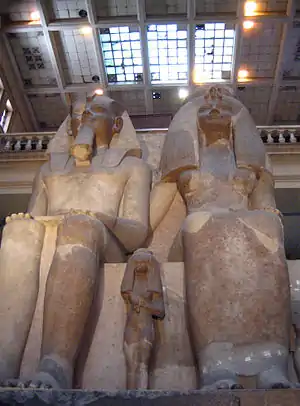
With his Great Royal Wife Tiye, Amenhotep would father at least two sons, Crown Prince Thutmose and Amenhotep IV (later called Akhenaten). In addition, several daughters are frequently credited to the couple: Sitamun, Henuttaneb, Iset, Nebetah, and Beketaten.[12] Most of the daughters appear frequently on statutes and reliefs from Amenhotep's reign.[13] However, Nebetah is attested only once, on a colossal limestone group of statues from Medinet Habu[12][14], and Beketaten only appears in Amarna.[15]
Amenhotep is also sometimes credited as the father of Smenkhkare or Tutankhamun, with varying proposals for their mothers, but these theories are not as accepted as his other children.
In addition to Tiye, Amenhotep had several other wives. In Regnal Year 10, Amenhotep married Gilukhepa, the daughter of Shuttarna II of Mitanni.[16] He would later marry Tadukhepa, daughter of Tushratta of Mitanni, in or around Regnal Year 36 of his reign.[17][18] Other wives, whose names are unknown, included: a daughter of Kurigalzu, king of Babylon; a daughter of Kadashman-Enlil, king of Babylon; a daughter of Tarhundaradu, ruler of Arzawa; and a daughter of the ruler of Ammia (modern-day Syria).[18]
Finally, he followed tradition and also married at least two of his daughters, Sitamun and Iset, in the last decade of his reign. Jar-label inscriptions from Regnal Year 30 indicate that Sitamun was elevated to the status of Great Royal Wife by that time.[12]
Life and reign
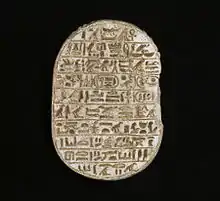
Amenhotep likely became pharaoh when he was between the ages of 6 and 12. While it is likely that a regent would have served, none is attested to in surviving records. In Regnal Year 2, Amenhotep married Tiye, who would be the Great Royal Wife throughout his reign. While he would marry many other women, she seemed to hold the highest authority at court. Many commemorative scarabs were commissioned and distributed during Amenhotep's reign. On the "marriage scarabs," Amenhotep affirmed his divine power and the legitimacy of his wife.
Further, in Regnal Year 11, Amenhotep commanded the construction of an artificial lake at Tiye's hometown of Djakaru. He then celebrated a Festival of Opening the Lake in the third month of Inundation, day sixteen, and rowed the royal barge Aten-tjehen on the lake. This event was commemorated on at least eleven commemorative scarabs.[19]
From other scarabs, Amenhotep is known to have killed either 102 or 110 lions in the first ten years of his reign.[20]
Despite the martial prowess Amenhotep displayed during the hunt, he is known to have participated in only one military incident. In Regnal Year Five, he led a victorious campaign against a rebellion in Kush. This victory was commemorated by three rock-carved stelae found near Aswan and Saï in Nubia. The official account of Amenhotep's military victory emphasizes his martial prowess with the period-typical hyperbole.[21]
International Relations
Diplomatic correspondence from Amenhotep's reign are partially preserved in the Amarna Letters, a collection of documents found near Amarna. The letters come from the rulers of Assyria, Mitanni, Babylon, Hatti, and other states, typically including requests by those rulers for gold and other gifts from Amenhotep. The letters cover the period from Year 30 of Amenhotep until at least the end of Akhenaten's reign. In one famous correspondence—Amarna letter EA 4—Amenhotep is quoted by the Babylonian king Kadashman-Enlil I in firmly rejecting the latter's entreaty to marry one of this pharaoh's daughters:
From time immemorial, no daughter of the king of Egy[pt] is given to anyone.[22]
Amenhotep's refusal to allow one of his daughters to be married to the Babylonian monarch may indeed be connected with Egyptian traditional royal practices that could provide a claim upon the throne through marriage to a royal princess, or, it could be viewed as a shrewd attempt on his part to enhance Egypt's prestige over those of her neighbours in the international world.
Sed Festivals
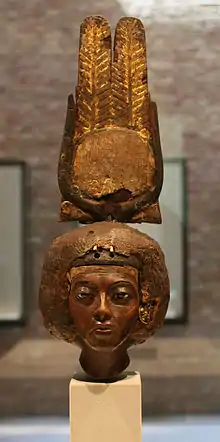
Amenhotep celebrated three Sed Festivals in Regnal Years 30, 34, and 37, each at the Palace of Malkata in Western Thebes.[23][24] A temple of Amun and festival hall were built especially for the celebrations.[23] The Sed Festival was a tradition that dated to the Old Kingdom[25], consisting of a series of tests that demonstrated the pharaoh's fitness for continuing as ruler of Egypt.
Amenhotep wanted his Sed Festivals to be far more spectacular than those of the past.[26] He appointed Amenhotep, son of Hapu to plan the ceremony, potentially because he was one of the few courtiers still alive to have served at the last Sed Festival, held for Amenhotep II.[26] In preparation for the first Sed Festival, Amenhotep, son of Hapu enlisted scribes to gather information from records and inscriptions; most of the descriptions were found in ancient funerary temples.[26] In addition to the rituals, they collected descriptions of costumes worn at previous festivals.
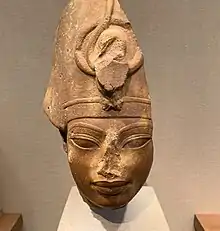
Temples were built and statues erected up and down the Nile. Craftsmen and jewelers created ornaments commentating the event including jewelry, ornaments, and stelae.[26]
The scribe Nebmerutef coordinated every step of the event.[27] He directed Amenhotep to use his mace to knock on the temple doors. Beside him, Amenhotep-Hapu mirrored his effort like a royal shadow.[27] The king was followed by Queen Tiye and the royal daughters. When moving to another venue, the banner of the jackal god Wepwawet, "Opener of Ways" preceded the King. The king changed his costume at each major activity of the celebration.[27]
One of the major highlights of the Festival was the king's dual coronation. He was enthroned separately for Upper and Lower Egypt. For Upper Egypt, Amenhotep wore the white crown but changed to the red crown for the Lower Egypt coronation.[28]
Based on indications left by Queen Tiye's steward Khenruef, the festival may have lasted two to eight months.[29] Khenruef accompanied the king as he traveled the empire, probably reenacting the ceremony for different audiences.[29]
At the time of the festival Amenhotep had three official wives: the "Great wife", Queen Tiye; their daughter, Sitamen, who was promoted to be a queen at the time of the Sed Festival; and Gilukhepa, a daughter of the king of Mitanni, a traditional Egyptian rival.[29] No mention is made of the royal harem.
Although shunned by common Egyptians, incest was not uncommon among royalty.[30] In fact, most Egyptian creation stories depend on it. By the time of the Sed Festival, Queen Tiye would be past her child-bearing years.[30] However, a sculpture restored by Amenhotep for his grandfather, Amenhotep II, shows Sitamen with a young prince beside her.[30]
Some of the known information about Amenhotep's Sed Festival comes from an unlikely source: the trash heap at Malqata Palace. Many jars bearing the names of donors to Amenhotep to celebrate his festival were found. The donors were not just the rich but also small servants. The jars bear the donor's name, title, and date. The jars were stored without respect to their origin.[31]
After the Sed Festival, Amenhotep transcended from being a near-god to one divine.[32] Few Egyptian kings lived long enough for their own celebration. Those who survived used the celebration as the affirmation of transition to divinity.
Final years

Reliefs from the wall of the temple of Soleb in Nubia and scenes from the Theban tomb of Kheruef, Steward of the King's Great Wife, Tiye, depict Amenhotep as a visibly weak and sick figure.[33] Scientists believe that in his final years he suffered from arthritis and became obese. It has generally been assumed by some scholars that Amenhotep requested and received, from his father-in-law Tushratta of Mitanni, a statue of Ishtar of Nineveh—a healing goddess—in order to cure him of his various ailments, which included painful abscesses in his teeth.[34] A forensic examination of his mummy shows that he was probably in constant pain during his final years due to his worn and cavity-pitted teeth. However, more recent analysis of Amarna letter EA 23 by William L. Moran, which recounts the dispatch of the statue of the goddess to Thebes, does not support this popular theory. The arrival of the statue is known to have coincided with Amenhotep's marriage with Tadukhepa, Tushratta's daughter, in the pharaoh's 36th year; letter EA 23's arrival in Egypt is dated to "regnal year 36, the fourth month of winter, day 1" of his reign.[35] Furthermore, Tushratta never mentions in EA 23 that the statue's dispatch was meant to heal Amenhotep of his maladies. Instead, Tushratta merely writes,
Say to Nimmureya [i.e., Amenhotep III], the king of Egypt, my brother, my son-in-law, whom I love and who loves me: Thus Tušratta, the king of Mitanni, who loves you, your father-in-law. For me all goes well. For you may all go well. For your household for Tadu-Heba [i.e., Tadukhepa], my daughter, your wife, who you love, may all go well. For your wives, for your sons, for your magnates, for your chariots, for your horses, for your troops, for your country, and for whatever else belongs to you, may all go very, very well. Thus Šauška of Nineveh, mistress of all lands: "I wish to go to Egypt, a country that I love, and then return." Now I herewith send her, and she is on her way. Now, in the time, too, of my father,...[she] went to this country, and just as earlier she dwelt there and they honored her, may my brother now honor her 10 times more than before. May my brother honor her, [then] at [his] pleasure let her go so that she may come back. May Šauška (i.e., Ishtar), the mistress of heaven, protect us, my brother and me, a 100,000 years, and may our mistress grant both of us great joy. And let us act as friends. Is Šauška for me alone my god[dess], and for my brother not his god[dess]?[36]
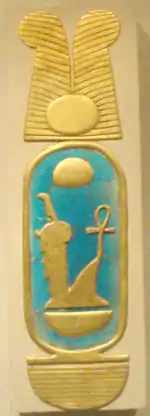
The likeliest explanation is that the statue was sent to Egypt "to shed her blessings on the wedding of Amenhotep and Tadukhepa, as she had been sent previously for Amenhotep and Gilukhepa."[37] As Moran writes:
One explanation of the goddess' visit is that she was to heal the aged and ailing Egyptian king, but this explanation rests purely on analogy and finds no support in this letter... More likely, it seems, is a connection with the solemnities associated with the marriage of Tušratta's daughter; sf. the previous visit mentioned in lines 18f., perhaps on the occasion of the marriage of Kelu-Heba [i.e., Gilukhepa]...and note, too, Šauška's role along with Aman, of making Tadu-Heba answer to the king's desires.[38]
The contents of Amarna letter EA21 from Tushratta to his "brother" Amenhotep strongly affirms this interpretation. In this correspondence, Tushratta explicitly states,
I have given...my daughter [Tadukhepa] to be the wife of my brother, whom I love. May Šimige and Šauška go before her. May they m[ake he]r the image of my brother's desire. May my brother rejoice on t[hat] day. May Šimige and Šauška grant my brother a gre[at] blessing, exquisi[te] joy. May they bless him and may you, my brother, li[ve] forever.[39]
Succession and proposed co-regency with Amenhotep IV

Amenhotep's eldest son with Tiye, Thutmose, predeceased his father and the king was ultimately succeeded by his second son, Amenhotep IV. It has been proposed by several Egyptologists and the Egyptian Ministry for Antiquities that the father and son shared a co-regency. However, the field is still divided. The Ministry for Antiquities announced in February 2014 that findings from the tomb of Vizier Amenhotep-Huy gave "definitive evidence" of a co-regency that lasted at least eight years.[40][41] In the tomb, the cartouches of the two pharaohs were carved side by side. However, this may only suggest that Amenhotep had chosen his only surviving son Akhenaten to succeed him since there are no objects or inscriptions known to name and give the same regnal dates for both kings.
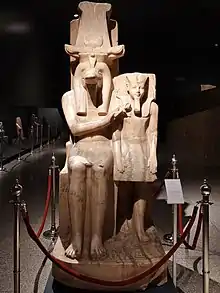
A letter from the Amarna palace archives dated to Year 2—rather than Year 12—of Akhenaten's reign from the Mitannian king, Tushratta, (Amarna letter EA 27) preserves a complaint about the fact that Akhenaten did not honor his father's promise to forward Tushratta statues made of solid gold as part of a marriage dowry for sending his daughter, Tadukhepa, into the pharaoh's household.[42] This correspondence implies that if any co-regency occurred between Amenhotep and Akhenaten, it lasted no more than a year.[43] Lawrence Berman observes in a 1998 biography of Amenhotep that,
It is significant that the proponents of the coregency theory have tended to be art historians [e.g., Raymond Johnson], whereas historians [such as Donald Redford and William Murnane] have largely remained unconvinced. Recognizing that the problem admits no easy solution, the present writer has gradually come to believe that it is unnecessary to propose a coregency to explain the production of art in the reign of Amenhotep III. Rather the perceived problems appear to derive from the interpretation of mortuary objects.[44]
The Egyptologist Peter Dorman also rejects any co-regency between these two kings, based on the archaeological evidence from the tomb of Kheruef.[45]
Death and burial
Amenhotep 's highest attested regnal date is Year 38, which appears on wine jar-label dockets from Malkata.[46] He may have lived briefly into an unrecorded Year 39, dying before the wine harvest of that year.[47] Foreign leaders communicated their grief at the pharaoh's death, with Tushratta saying:
When I heard that my brother Nimmureya had gone to his fate, on that day I sat down and wept. On that day I took no food, I took no water.[48]
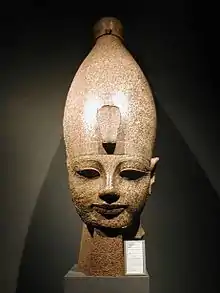
When Amenhotep died, he left behind a country that was at the very height of its power and influence, commanding immense respect in the international world; however, he also bequeathed an Egypt that was wedded to its traditional political and religious certainties under the Amun priesthood.[49]
The resulting upheavals from his son Akhenaten's reforming zeal would shake these old certainties to their very foundations and bring forth the central question of whether a pharaoh was more powerful than the existing domestic order as represented by the Amun priests and their numerous temple estates. Akhenaten even moved the capital away from the city of Thebes in an effort to break the influence of that powerful temple and assert his own preferred choice of deities, the Aten. Akhenaten moved the Egyptian capital to the site known today as Amarna (though originally known as Akhetaten, 'Horizon of Aten'), and eventually suppressed the worship of Amun.[50]
Amenhotep was buried in the Western Valley of the Valley of the Kings, in Tomb WV22. Sometime during the Third Intermediate Period his mummy was moved from this tomb and was placed in a side-chamber of KV35 along with several other pharaohs of the Eighteenth and Nineteenth Dynasties where it lay until discovered by Victor Loret in 1898.
Mummy
An examination of his mummy by the Australian anatomist Grafton Elliot Smith concluded that the pharaoh was between 40 and 50 years old at death.[51] His chief wife, Tiye, is known to have outlived him by at least twelve years, as she is mentioned in several Amarna letters dated from her son's reign as well as depicted at a dinner table with Akhenaten and his royal family in scenes from the tomb of Huya, which were made during Year 9 and Year 12 of her son's reign.[52][53] For the 18th dynasty the mummy shows an unusually heavy use of subcutaneous stuffing to make the mummy look more lifelike.[54]
His mummy has the inventory number CG 61074.[54] In April 2021 his mummy was moved from the Museum of Egyptian Antiquities to the National Museum of Egyptian Civilization along with those of 17 other kings and 4 queens in an event termed the Pharaohs' Golden Parade. [55]
The Court
There were many important individuals in the court of Amenhotep. Viziers were Ramose, Amenhotep, Aperel and Ptahmose. They are known from a remarkable series of monuments, including the well known tomb of Ramose at Thebes. Treasurers were another Ptahmose and Merire. High stewards were Amenemhat Surer and Amenhotep (Huy). Viceroy of Kush was Merimose. He was a leading figure in the military campaigns of the king in Nubia. Perhaps the most famous official of the king was Amenhotep, son of Hapu. He never had high titles but was later worshipped as god and main architect of some of the king's temples.[56] Priests of Amun under the king included the brother-in-law of the king Anen and Simut.As a reward for a lifetime of serving the Egyptian kings, Amenhotep-Hapu received his own funerary temple.[57] The location was behind that of his king, Amenhotep . Some of Amenhotep 's workshops were razed to make room for Amenhotep-Hapu's temple.[57]
Monuments and legacy
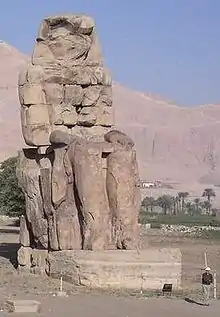
Amenhotep has the distinction of having the most surviving statues of any Egyptian pharaoh, with over 250 of his statues having been discovered and identified. Since these statues span his entire life, they provide a series of portraits covering the entire length of his reign.
Amenhotep built extensively at the temple of Karnak including the Luxor temple which consisted of two pylons, a colonnade behind the new temple entrance, and a new temple to the goddess Ma'at. Amenhotep dismantled the Fourth Pylon of the Temple of Amun at Karnak to construct a new pylon—the Third Pylon—and created a new entrance to this structure where he erected two rows of columns with open papyrus capitals down the centre of this newly formed forecourt. The forecourt between the Third and Fourth Pylons, sometimes called an obelisk court, was also decorated with scenes of the sacred barque of the deities Amun, Mut, and Khonsu being carried in funerary boats.[58] The king also started work on the Tenth Pylon at the Temple of Amun there. Amenhotep's first recorded act as king—in his Years 1 and 2—was to open new limestone quarries at Tura, just south of Cairo and at Dayr al-Barsha in Middle Egypt in order to herald his great building projects.[59] He oversaw the construction of another temple to Ma'at at Luxor and virtually covered Nubia with numerous monuments.
...including a small temple with a colonnade (dedicated to Thutmose III) at Elephantine, a rock temple dedicated to Amun "Lord of the Ways" at Wadi es-Sebuam, and the temple of Horus of Miam at Aniba...[as well as founding] additional temples at Kawa and Sesebi.[60]
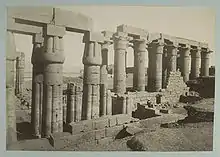
His enormous mortuary temple on the west bank of the Nile was, in its day, the largest religious complex in Thebes, but unfortunately, the king chose to build it too close to the floodplain and less than two hundred years later, it stood in ruins. Much of the masonry was purloined by Merneptah and later pharaohs for their own construction projects.[61] The Colossi of Memnon—two massive stone statues, 18 m (59 ft) high, of Amenhotep that stood at the gateway of his mortuary temple—were the only elements of the complex that remained standing. Amenhotep also built the Third Pylon at Karnak and erected 600 statues of the goddess Sekhmet in the Temple of Mut, south of Karnak.[62] Some of the most magnificent statues of New Kingdom Egypt date to his reign "such as the two outstanding couchant rose granite lions originally set before the temple at Soleb in Nubia" as well as a large series of royal sculptures.[63] Several beautiful black granite seated statues of Amenhotep wearing the nemes headress have come from excavations behind the Colossi of Memnon as well as from Tanis in the Delta.[63] In 2014, two giant statues of Amenhotep that were toppled by an earthquake in 1200 BC were reconstructed from more than 200 fragments and re-erected at the northern gate of the king's funerary temple.[64]
One of the most stunning finds of royal statues dating to his reign was made as recently as 1989 in the courtyard of Amenhotep 's colonnade of the Temple of Luxor where a cache of statues was found, including a 6 feet (1.8 m)-high pink quartzite statue of the king wearing the Double Crown found in near-perfect condition.[63] It was mounted on a sled, and may have been a cult statue.[63] The only damage it had sustained was that the name of the god Amun had been hacked out wherever it appeared in the pharaoh's cartouche, clearly done as part of the systematic effort to eliminate any mention of this god during the reign of his successor, Akhenaten.[63]
_(1904)_-_front_edited_-_TIMEA.jpg.webp)
In 2021, excavations revealed a settlement near Amenhotep 's mortuary temple, called the Dazzling Aten, which is believed to have been built by Amenhotep .[65] It is presumed to have housed craftsmen and labourers working on royal monuments and projects at Thebes, as well as in the ancillary industries needed to support such an administrative and skilled-worker population, and had its own bakery and cemetery.
One of the king's most popular epithets was Aten-tjehen which means "the Dazzling Sun Disk"; it appears in his titulary at Luxor temple and, more frequently, was used as the name for one of his palaces as well as the Year 11 royal barge, and denotes a company of men in Amenhotep's army. [66]

A Sed Festival Stela of Amenhotep III was taken from Egypt to Europe by an art dealer. It is now believed to be in the United States but not on public display.[67] In Europe, Dr. Eric Cassirer at one time owned the stela. The dimensions of the white alabaster stela are 10 x 9 cm (3.94 x 3.54 in), but only the upper half of the stela survived.[68] It was shaped in the form of a temple pylon with a gradual narrowing near the top.
Front view: The god Heh, who represents the number one million, holds notched palm leaves signifying years.[68] Above his head, Heh appears to support the cartouche of Amenhotep symbolically for a million years.
Side view: A series of festival (ḥb) emblems together with a Sed (sd) emblem identifying the stela as one made for Amenhotep 's Sed Festival royal jubilee.[68]
Top view: The top shows malicious damage to the stela where the cartouche was chipped away.
Back view: Like the top view, the cartouche has been eradicated.
Cassirer suggests Akhenaten, Amenhotep 's son and successor, was responsible for defacing the king's name on the stela.[69] Akhenaten detested his royal family name so much, he changed his own name from Amenhotep IV to Akhenaten; he vandalized any reference to the god Amun since he had chosen to worship another god, the Aten.[69] Other gods displayed on the stela, Re and Ma’at, showed no sign of vandalism.[69]
The stela is believed to have been displayed prominently in Akhenaten's new capital city of Akhetaten (current day Amarna).[69] With the royal name and Amun references removed, it likely had a prominent place in a temple or palace of Akhenaten.[69] Akhenaten could then display the stela without reminders of his old family name or the false god Amun, yet celebrate his father's achievement.
Another striking characteristic of Amenhotep's reign is the series of over 200 large commemorative stone scarabs that have been discovered over a large geographic area ranging from Syria (Ras Shamra) through to Soleb in Nubia. [70] Similarly, five other scarabs state that his wife Gilukhepa of Mitanni arrived in Egypt with a retinue of 317 women. She was the first of many such princesses who would enter the pharaoh's household. [71]
Ancestry
| Ancestors of Amenhotep III | |||||||||||||||||||||||||||||||||||||||||||||||||||||||||||||||||||||||||||||||||||||||||||||||||||||||||||||||||||||||||||||||||||||||||||||||||||||||||||||||||||||||||||||||||||||||||||||||||||||||||||||||||||||||||||||||||||||||||||||||||||||||||||||||||||||||||||||||||||||||||||||||||||||||||||||||||||||||||||||||||||||||||||||||||||||||||||||||||||||||||||||||||||||||||||||||||||||||||||||||||||||||||||||||||||||||||||||||||||||||||||||||||||||||||||||||||||
|---|---|---|---|---|---|---|---|---|---|---|---|---|---|---|---|---|---|---|---|---|---|---|---|---|---|---|---|---|---|---|---|---|---|---|---|---|---|---|---|---|---|---|---|---|---|---|---|---|---|---|---|---|---|---|---|---|---|---|---|---|---|---|---|---|---|---|---|---|---|---|---|---|---|---|---|---|---|---|---|---|---|---|---|---|---|---|---|---|---|---|---|---|---|---|---|---|---|---|---|---|---|---|---|---|---|---|---|---|---|---|---|---|---|---|---|---|---|---|---|---|---|---|---|---|---|---|---|---|---|---|---|---|---|---|---|---|---|---|---|---|---|---|---|---|---|---|---|---|---|---|---|---|---|---|---|---|---|---|---|---|---|---|---|---|---|---|---|---|---|---|---|---|---|---|---|---|---|---|---|---|---|---|---|---|---|---|---|---|---|---|---|---|---|---|---|---|---|---|---|---|---|---|---|---|---|---|---|---|---|---|---|---|---|---|---|---|---|---|---|---|---|---|---|---|---|---|---|---|---|---|---|---|---|---|---|---|---|---|---|---|---|---|---|---|---|---|---|---|---|---|---|---|---|---|---|---|---|---|---|---|---|---|---|---|---|---|---|---|---|---|---|---|---|---|---|---|---|---|---|---|---|---|---|---|---|---|---|---|---|---|---|---|---|---|---|---|---|---|---|---|---|---|---|---|---|---|---|---|---|---|---|---|---|---|---|---|---|---|---|---|---|---|---|---|---|---|---|---|---|---|---|---|---|---|---|---|---|---|---|---|---|---|---|---|---|---|---|---|---|---|---|---|---|---|---|---|---|---|---|---|---|---|---|---|---|---|---|---|---|---|---|---|---|---|---|---|---|---|---|---|---|---|---|---|---|---|---|---|---|---|---|---|---|---|---|---|---|---|---|---|---|---|---|---|---|---|---|---|---|---|---|---|---|---|---|---|---|---|---|---|---|---|---|---|---|---|---|---|---|---|---|---|---|---|---|---|---|---|---|---|---|---|---|---|---|---|---|---|---|---|---|---|---|---|---|---|---|---|---|---|---|---|---|---|---|---|---|
| |||||||||||||||||||||||||||||||||||||||||||||||||||||||||||||||||||||||||||||||||||||||||||||||||||||||||||||||||||||||||||||||||||||||||||||||||||||||||||||||||||||||||||||||||||||||||||||||||||||||||||||||||||||||||||||||||||||||||||||||||||||||||||||||||||||||||||||||||||||||||||||||||||||||||||||||||||||||||||||||||||||||||||||||||||||||||||||||||||||||||||||||||||||||||||||||||||||||||||||||||||||||||||||||||||||||||||||||||||||||||||||||||||||||||||||||||||
Gallery
 Granodiorite seated statue of Amenhotep at the British Museum, from its left side.
 Granodiorite statue of Amenhotep at the British Museum, Left of Statue above.
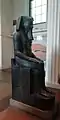 Granodiorie Amenhotep (Right Statue) Northeast side, British Museum
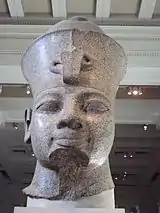
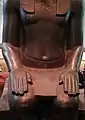 Granodiorie Amenhotep (Left Statue) Close up, British Museum
 Bulls Tail (Left Statue), British Museum
 Belt (Left Statue), British Museum
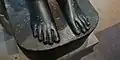 Feet (Left Statue), British Museum
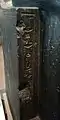 Left Inscriptions (Left Statue), British Museum
 Right Inscriptions (Left Statue), British Museum
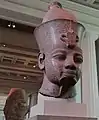 Red Granite Statue, North East side, British Museum
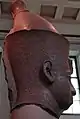 Red Granite Statue, Left side, British Museum
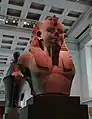 Limestone Amenhotep, British Museum
 Amenhotep wearing the red crown of Lower Egypt, c. 1400 BC. From Thebes, Egypt. British Museum. EA6
 Amenhotep wearing the red crown of Lower Egypt, c. 1400 BC. From Thebes, Egypt. British Museum. EA7
See also
 |
Wikimedia Commons has media related to Amenhotep III. |
Footnotes
- Moran 1992, p. 7.
- Leprohon 2013, pp. 102–104.
- Clayton 1994, p. 112.
- Loprieno, Antonio (1995) Ancient Egyptian: A Linguistic Introduction, Cambridge: Cambridge University Press,
- Loprieno, Antonio (2001) “From Ancient Egyptian to Coptic” in Haspelmath, Martin et al. (eds.), Language Typology and Language Universals
- Ranke, Hermann (1935). Die Ägyptischen Personennamen, Bd. 1: Verzeichnis der Namen (PDF). Glückstadt: J.J. Augustin. p. 30. Retrieved 25 July 2020.
- Beckerath 1997, p. 190.
- O'Connor & Cline 1998, p. 3.
- Fletcher 2000, p. 10.
- O'Connor & Cline 2001.
- Tyldesley 2006.
- O'Connor & Cline 1998, p. 7.
- Kozloff & Bryan 1992, nos. 24, 57, 103 & 104.
- Kozloff & Bryan 1992, fig. II, 5.
- N. de G. Davies, The rock tombs of El-Amarna, Parts III and IV, 1905 (Reprinted 2004), The Egypt Exploration Society, ISBN 0-85698-160-5. Facsimile in Internet Archive: Part III. The Tombs of Huya and Ahmes, 1905
- Dodson & Hilton 2004, p. 155.
- Fletcher 2000, p. 156.
- Grajetzki 2005.
- Kozloff & Bryan 1992, no. 2.
- O'Connor, David (1998). Amenhotep III. Ann Arbor, MI: University of Michigan Press. p. 13. ISBN 978-0-472-10742-1.
- Urk. IV 1665–66
- Moran 1992, p. 8.
- O'Connor & Cline 1998, p. 16.
- Berman 1998, p. 17.
- Berman 1998, p. 15.
- Kozloff 2012, p. 182.
- Kozloff 2012, p. 189.
- Kozloff 2012, p. 190.
- Kozloff 2012, p. 192.
- Kozloff 2012, p. 194.
- Kozloff 2012, p. 183.
- Kozloff 2012, p. 195.
- Grimal 1992, p. 225.
- Hayes 1973, p. 346.
- Aldred 1991, p. 13.
- Moran 1992, pp. 61–62.
- O'Connor & Cline 1998, p. 22.
- Moran 1992, p. 62 n. 2.
- Moran 1992, p. 50.
- Pharaoh power-sharing unearthed in Egypt Daily News Egypt. February 6, 2014
- Proof found of Amenhotep III-Akhenaten co-regency thehistoryblog.com
- Moran 1992, pp. 87–89.
- Reeves 2000, pp. 75–78.
- Berman 1998, p. 23.
- Dorman 2009.
- Kozloff & Bryan 1992, p. 39, fig. II.4.
- Clayton 1994, p. 119.
- Fletcher 2000, p. 161.
- Grimal 1992, pp. 223, 225.
- Fletcher 2000, p. 162.
- Smith 1912, p. 50.
- "North Tombs at Amarna". Archived from the original on 7 May 2009. Retrieved 2009-05-18.
- O'Connor & Cline 1998, p. 23.
- Habicht, M.E; Bouwman, A.S; Rühli, F.J (25 January 2016). "Identifications of ancient Egyptian royal mummies from the 18th Dynasty reconsidered". Yearbook of Physical Anthropology. 159 (S61): 216–231. doi:10.1002/ajpa.22909. PMID 26808107. Retrieved 13 April 2021.
- Parisse, Emmanuel (5 April 2021). "22 Ancient Pharaohs Have Been Carried Across Cairo in an Epic 'Golden Parade'". ScienceAlert. Retrieved 5 April 2021.
- Lichtheim 1980, p. 104.
- Kozloff 2012, p. 197.
- The Obelisk Court of Amenhotep III
- Urk. IV, 1677–1678
- Grimal 1992, p. 223.
- Grimal 1992, p. 224.
- Grimal 1992, pp. 224, 295.
- Clayton 1994, p. 118.
- "Amenhotep III Statues Once More Stand Before Pharaoh's Temple". Latin American Herald Tribute. December 15, 2014.
- Simmons, Debra Adams, The New Secrets of Luxor, National Geographic, April 12, 2021 with images
- O'Connor & Cline 1998, pp. 3, 14.
- Cassirer 1952, p. 128.
- Cassirer 1952, p. 129.
- Cassirer 1952, p. 130.
- O'Connor & Cline 1998, pp. 11–12.
- O'Connor & Cline 1998, p. 13.
Bibliography
- Aldred, Cyril (1991). Akhenaten: King of Egypt. Thames & Hudson.
- Allen, James P. "The Amarna Succession" (PDF). Archived from the original (PDF) on July 1, 2013. Retrieved 2014-02-01.
- Beckerath, Jürgen von (1997). Chronologie des Pharaonischen Ägypten. Mainz: Philipp von Zabern.
- Berman, Lawrence M. (1998). "Overview of Amenhotep III and His Reign". In O'Connor, David; Cline, Eric (eds.). Amenhotep III: Perspectives on His Reign. Ann Arbor: University of Michigan Press.
- Cassirer, Manfred (1952). "A hb-sd Stela of Amenophis III". The Journal of Egyptian Archaeology. 38.
- Clayton, Peter (1994). Chronicle of the Pharaohs. Thames & Hudson Ltd.
- Dodson, Aidan; Hilton, Dyan (2004). The Complete Royal Families of Ancient Egypt. Thames & Hudson.
- Dorman, Peter (2009). "The Long Coregency Revisited: Architectural and Iconographic Conundra in the Tomb of Kheruef" (PDF). Causing His Name to Live: Studies in Egyptian Epigraphy and History in Memory of William J. Murnane. Brill. Archived from the original (PDF) on 2012-07-22.
- Fletcher, Joann (2000). Chronicle of a Pharaoh – The Intimate Life of Amenhotep III. Oxford University Press.
- Grajetzki, Wolfram (2005). Ancient Egyptian Queens: A Hieroglyphic Dictionary. London: Golden House Publications. ISBN 978-0-9547218-9-3.
- Grimal, Nicolas (1992). A History of Ancient Egypt. Blackwell Books.
- Hayes, William (1973). "Internal affairs from Thutmosis I to the death of Amenophis III". The Middle East and the Aegean Region, C. 1800–1380 BC. Pt 1, Vol 2.
- Kozloff, Arielle; Bryan, Betsy (1992). Royal and Divine Statuary in Egypt's Dazzling Sun: Amenhotep III and his World. Cleveland.
- Kozloff, Arielle P. (2012). Amenhotep III: Egypt's Radiant Pharaoh. Cambridge: Cambridge University Press.
- Leprohon, Ronald J. (2013). The Great Name: Ancient Egyptian Royal Titulary. SBL Press. ISBN 978-1-58983-736-2. Retrieved 7 December 2021.
- Lichtheim, Miriam (1980). Ancient Egyptian Literature: A Book of Readings: The Late Period. University of California Press.
- Moran, William L. (1992). The Amarna Letters. Baltimore: Johns Hopkins University Press.
- O'Connor, David; Cline, Eric (1998). Amenhotep III: Perspectives on His Reign. University of Michigan Press.
- O'Connor, David; Cline, Eric H. (2001). Amenhotep III: Perspectives on His Reign. University of Michigan Press.
- Reeves, Nicholas (2000). Akhenaten: Egypt's False Prophet. Thames & Hudson.
- Smith, Grafton Elliot (1912). The Royal Mummies. Cairo.
- Troy, Lana (1986). "Patterns of Queenship in Ancient Egyptian Myth and History". Uppsala Studies in Ancient Mediterranean and Near Eastern Civilizations. 14.
- Tyldesley, Joyce (2006). Chronicle of the Queens of Egypt. Thames & Hudson.
| Family |  | |
|---|---|---|
| Artifacts and exhibitions | ||
| Discovery and excavation | ||
| Popular culture |
| |
Authority control  | |
|---|---|
| General | |
| National libraries | |