Association of American Universities
The Association of American Universities (AAU) is an organization of American research universities devoted to maintaining a strong system of academic research and education. Founded in 1900, it consists of 64 universities in the United States (both public and private) and two universities in Canada. AAU membership is by invitation only and requires an affirmative vote of three-quarters of current members.
 | |
| Formation | February 28, 1900[1] |
|---|---|
| Founded at | Chicago, Illinois, U.S. |
| Type | 501(c)(3) nonprofit organization[2] |
| 52-1945674[2] | |
| Headquarters | William T. Golden Center for Science and Engineering, Washington, D.C., U.S. |
| Location |
|
| Coordinates | 38°54′01″N 77°01′42″W |
Membership | 66 |
President | Barbara Snyder[3] |
Chair | Michael McRobbie |
| Website | www |
Organization
The AAU was founded on February 28, 1900, by a group of 14 Doctor of Philosophy degree–granting universities[lower-alpha 1] in the United States to strengthen and standardize American doctoral programs.[1] American universities—starting with Johns Hopkins University in 1876—were adopting the research-intensive German model of higher education. Lack of standardization damaged European universities' opinions of their American counterparts and many American students attended graduate school in Europe instead of staying in the U.S. The presidents of Harvard University, Columbia University, Johns Hopkins University, the University of Chicago, and the University of California sent a letter of invitation to nine other universities—Clark University, Catholic University of America, Cornell University, the University of Michigan, Princeton University, the University of Pennsylvania, Stanford University, the University of Wisconsin, and Yale University—to meet in Chicago in February 1900 to promote and raise standards.[4] The AAU's founding members elected Harvard's Charles William Eliot as the association's first president[1] and Stanford's David Starr Jordan as its first chairman.[5]
In 1914, the AAU began accrediting undergraduate education at its member and other schools. German universities used the "AAU Accepted List" to determine whether a college's graduates were qualified for graduate programs. Regional accreditation agencies existed in the U.S. by the 1920s, and the AAU ended accrediting schools in 1948.[6]
For its first six decades, the AAU functioned as a club for the presidents and deans of elite research universities to informally discuss educational matters, and its day-to-day operations were managed by an executive secretary.[7] In the 1970s, the AAU shifted to a role of active advocacy on behalf of its members' interests; dues were raised, more staff members were hired, and its chief executive was given the title of president and the duty of becoming far more publicly visible than his predecessors.[8]
Today, the AAU consists of 66 U.S. and Canadian universities of varying sizes and missions that share a commitment to research. The organization's primary purpose is to provide a forum for the development and implementation of institutional and national policies in order to strengthen programs in academic research, scholarship, and education at the undergraduate, graduate, and professional levels.
Benefits
The largest attraction of the AAU for many schools, especially nonmembers, is prestige. Since the AAU's founding, it has "been a grouping of the elite in the American university world," and "[n]ew presidents of nonmember universities often list gaining admission to the AAU as a goal of their administration."[7] For example, in 2010 the chancellor of nonmember North Carolina State University described it as "the pre-eminent research-intensive membership group. To be a part of that organization is something N.C. State aspires to."[9] A spokesman for nonmember University of Connecticut called it "perhaps the most elite organization in higher education. You'd probably be hard-pressed to find a major research university that didn't want to be a member of the AAU."[10] In 2012, the newly elected chancellor of University of Massachusetts Amherst, a nonmember of AAU, reaffirmed the objective of elevating the campus to AAU standards and the hope of becoming a member in the near future, and called it a distinctive status.[11] Because of the lengthy and difficult entrance process, boards of trustees, state legislators, and donors often see membership as evidence of the quality of a university.[9]
The AAU acts as a lobbyist at its headquarters in Washington, DC, for research and higher education funding and for policy and regulatory issues affecting research universities. The association holds two meetings annually, both in Washington. Separate meetings are held for university presidents, provosts, and other officials. Because the meetings are private, they offer the opportunity for discussion without media coverage. Prominent government officials, businessmen, and others often speak to the groups.[9]
Presidents
| Executive | Term |
|---|---|
| Thomas A. Bartlett | 1977–1982 |
| Robert M. Rosenzweig | 1983–1993 |
| Cornelius J. Pings | 1993–1998 |
| Nils Hasselmo | 1998–2006 |
| Robert M. Berdahl | 2006–2011 |
| Hunter R. Rawlings III | 2011–2016 |
| Mary Sue Coleman | 2016–2020 |
| Barbara Snyder | 2020–present |
Statistics
As of 2004, AAU members accounted for 58 percent[lower-alpha 2] of U.S. universities' research grants and contract income and 52 percent of all doctorates awarded in the United States. Since 1999, 43 percent of all Nobel Prize winners and 74 percent of winners at U.S. institutions have been affiliated with an AAU university. Approximately two-thirds of the American Academy of Arts and Sciences 2006 Class of Fellows are affiliated with an AAU university. The faculties at AAU universities include 2,993 members of the United States National Academies (82 percent of all members): the National Academy of Sciences, the National Academy of Engineering, and the Institute of Medicine (2004).[12]
- Undergraduate students: 1,044,759; 7 percent nationally
- Undergraduate degrees awarded: 235,328; 17 percent nationally
- Graduate students: 418,066; 20 percent nationally
- Master's degrees awarded: 106,971; 19 percent nationally
- Professional degrees awarded: 20,859; 25 percent nationally
- Doctorates awarded: 22,747; 52 percent nationally
- Postdoctoral fellows: 30,430; 67 percent nationally
- Students studying abroad: 57,205
- National Merit/Achievement Scholars (2004): 5,434; 63 percent nationally
- Faculty: approximately 72,000
Membership
AAU membership is by invitation only, which requires an affirmative vote of three-fourths of current members. Invitations are considered periodically, based in part on an assessment of the breadth and quality of university programs of research and graduate education, as well as undergraduate education. The association ranks its members using four criteria: research spending, the percentage of faculty who are members of the National Academies, faculty awards, and citations. Two-thirds of members can vote to revoke membership for poor rankings.[13][14] As of 2010 annual dues are $80,500.[9] All 64 U.S. members of the AAU are also classified as Highest Research Activity (R1) Universities by the Carnegie Classification of Institutions of Higher Education.
Current members
| Institution[15] | State or province | Control | Established | Year joined | Total students | Medical school[16][17] (LCME accredited) |
Engineering program[18] (ABET accredited) |
Athletics Governing Body | Athletic Conference |
|---|---|---|---|---|---|---|---|---|---|
| Boston University | Massachusetts | Private | 1839 | 2012 | 30,009 |  |
|
NCAA Division I FCS | Patriot League |
| Brandeis University | Massachusetts | Private | 1948 | 1985 | 5,808 |  |
|
NCAA Division III | University Athletic Association |
| Brown University | Rhode Island | Private | 1764 | 1933 | 8,619 | |
|
NCAA Division I FCS | Ivy League |
| California Institute of Technology | California | Private | 1891 | 1934 | 2,231 | |
|
NCAA Division III | Southern California Intercollegiate Athletic Conference |
| Carnegie Mellon University | Pennsylvania | Private | 1900 | 1982 | 12,908 | |
|
NCAA Division III | University Athletic Association |
| Case Western Reserve University | Ohio | Private | 1826 | 1969 | 11,824 | |
|
NCAA Division III | University Athletic Association |
| Columbia University | New York | Private | 1754 | 1900 | 29,250 | |
|
NCAA Division I FCS | Ivy League |
| Cornell University | New York | Private | 1865 | 1900 | 21,904 | |
|
NCAA Division I FCS | Ivy League |
| Dartmouth College | New Hampshire | Private | 1769 | 2019[19] | 6,571 | |
|
NCAA Division I FCS | Ivy League |
| Duke University | North Carolina | Private | 1838 | 1938 | 14,600 | |
|
NCAA Division I FBS | Atlantic Coast Conference. |
| Emory University | Georgia | Private | 1836 | 1995 | 14,513 | |
[lower-alpha 3] |
NCAA Division III | University Athletic Association |
| Georgia Institute of Technology | Georgia | Public | 1885 | 2010 | 29,370 | |
|
NCAA Division I FBS | Atlantic Coast Conference. |
| Harvard University | Massachusetts | Private | 1636 | 1900 | 21,000 | |
|
NCAA Division I FCS | Ivy League |
| Indiana University Bloomington | Indiana | Public | 1820 | 1909 | 42,731 | |
|
NCAA Division I FBS | Big Ten Conference |
| Iowa State University | Iowa | Public | 1858 | 1958 | 36,001 | |
|
NCAA Division I FBS | Big 12 Conference |
| Johns Hopkins University | Maryland | Private | 1876 | 1900 | 23,073 | |
|
NCAA Division I FCS | Centennial Conference |
| Massachusetts Institute of Technology | Massachusetts | Private | 1861 | 1934 | 11,319 | |
|
NCAA Division III | New England Women's and Men's Athletic Conference |
| McGill University | Quebec | Public | 1821 | 1926 | 36,904 | |
|
U Sports | Réseau du sport étudiant du Québec |
| Michigan State University | Michigan | Public | 1855 | 1964 | 49,300 | |
|
NCAA Division I FBS | Big Ten Conference |
| New York University | New York | Private | 1831 | 1950 | 53,711 | |
|
NCAA Division III | University Athletic Association |
| Northwestern University | Illinois | Private | 1851 | 1917 | 21,208 | |
|
NCAA Division I FBS | Big Ten Conference |
| Ohio State University | Ohio | Public | 1870 | 1916 | 57,466 | |
|
NCAA Division I FBS | Big Ten Conference |
| Pennsylvania State University | Pennsylvania | Public | 1855 | 1958 | 45,518 | |
|
NCAA Division I FBS | Big Ten Conference |
| Princeton University | New Jersey | Private | 1746 | 1900 | 8,010 | |
|
NCAA Division I FCS | Ivy League |
| Purdue University | Indiana | Public | 1869 | 1958 | 39,256 | |
|
NCAA Division I FBS | Big Ten Conference |
| Rice University | Texas | Private | 1912 | 1985 | 6,487 | |
|
NCAA Division I FBS | Conference USA [lower-alpha 4][21] |
| Rutgers University–New Brunswick | New Jersey | Public | 1766 | 1989 | 41,565 | |
|
NCAA Division I FBS | Big Ten Conference |
| Stanford University | California | Private | 1891 | 1900 | 15,877 | |
|
NCAA Division I FBS | Pac-12 Conference |
| Stony Brook University | New York | Public | 1957 | 2001 | 26,814 | |
|
NCAA Division I FCS | America East Conference |
| Texas A&M University | Texas | Public | 1876 | 2001 | 62,185 | |
|
NCAA Division I FBS | Southeastern Conference |
| Tufts University | Massachusetts | Private | 1852 | 2021 | 11,024 | |
|
NCAA Division III | New England Small College Athletic Conference |
| Tulane University | Louisiana | Private | 1834 | 1958 | 13,462 | |
|
NCAA Division I FBS | American Athletic Conference |
| University of Arizona | Arizona | Public | 1885 | 1985 | 40,223 | |
|
NCAA Division I FBS | Pac-12 Conference |
| University at Buffalo | New York | Public | 1846 | 1989 | 30,183 | |
|
NCAA Division I FBS | Mid-American Conference |
| University of California, Berkeley | California | Public | 1868 | 1900 | 36,204 | |
|
NCAA Division I FBS | Pac-12 Conference |
| University of California, Davis | California | Public | 1905 | 1996 | 34,175 | |
|
NCAA Division I FCS | Big Sky Conference |
| University of California, Irvine | California | Public | 1965 | 1996 | 29,588 | |
|
NCAA Division I | Big West Conference |
| University of California, Los Angeles | California | Public | 1919 | 1974 | 42,163 | |
|
NCAA Division I FBS | Pac-12 Conference |
| University of California, San Diego | California | Public | 1960 | 1982 | 30,310 | |
|
NCAA Division I | Big West Conference |
| University of California, Santa Barbara | California | Public | 1944 | 1995 | 25,057 | |
|
NCAA Division I | Big West Conference |
| University of California, Santa Cruz | California | Public | 1965 | 2019[22] | 19,457 | |
|
NCAA Division III | Coast to Coast Athletic Conference |
| University of Chicago | Illinois | Private | 1890 | 1900 | 14,954 | |
|
NCAA Division III | University Athletic Association |
| University of Colorado Boulder | Colorado | Public | 1876 | 1966 | 32,775 | |
|
NCAA Division I FBS | Pac-12 Conference |
| University of Florida | Florida | Public | 1853 | 1985 | 49,042 | |
|
NCAA Division I FBS | Southeastern Conference |
| University of Illinois Urbana-Champaign | Illinois | Public | 1867 | 1908 | 44,520 | |
|
NCAA Division I FBS | Big Ten Conference |
| University of Iowa | Iowa | Public | 1847 | 1909 | 31,065 | |
|
NCAA Division I FBS | Big Ten Conference |
| University of Kansas | Kansas | Public | 1865 | 1909 | 27,983 | |
|
NCAA Division I FBS | Big 12 Conference |
| University of Maryland, College Park | Maryland | Public | 1856 | 1969 | 37,631 | |
|
NCAA Division I FBS | Big Ten Conference |
| University of Michigan | Michigan | Public | 1817 | 1900 | 43,426 | |
|
NCAA Division I FBS | Big Ten Conference |
| University of Minnesota, Twin Cities | Minnesota | Public | 1851 | 1908 | 51,853 | |
|
NCAA Division I FBS | Big Ten Conference |
| University of Missouri | Missouri | Public | 1839 | 1908 | 35,441 | |
|
NCAA Division I FBS | Southeastern Conference |
| University of North Carolina at Chapel Hill | North Carolina | Public | 1789 | 1922 | 29,390 | |
[lower-alpha 5] |
NCAA Division I FBS | Atlantic Coast Conference |
| University of Oregon | Oregon | Public | 1876 | 1969 | 22,980 | |
|
NCAA Division I FBS | Pac-12 Conference |
| University of Pennsylvania | Pennsylvania | Private | 1740 | 1900 | 24,630 | |
|
NCAA Division I FCS | Ivy League |
| University of Pittsburgh | Pennsylvania | Public | 1787 | 1974 | 28,649 | |
|
NCAA Division I FBS | Atlantic Coast Conference |
| University of Rochester | New York | Private | 1850 | 1941 | 10,290 | |
|
NCAA Division III | University Athletic Association |
| University of Southern California | California | Private | 1880 | 1969 | 48,500 | |
|
NCAA Division I FBS | Pac-12 Conference |
| University of Texas at Austin | Texas | Public | 1883 | 1929 | 51,000 | |
|
NCAA Division I FBS | Big 12 Conference [lower-alpha 6][24] |
| University of Toronto | Ontario | Public | 1827 | 1926 | 84,000 | |
|
U Sports | Réseau du sport étudiant du Québec |
| University of Utah | Utah | Public | 1850 | 2019[25][26] | 32,994 | |
|
NCAA Division I FBS | Pac-12 Conference |
| University of Virginia | Virginia | Public | 1819 | 1904 | 24,360 | |
|
NCAA Division I FBS | Atlantic Coast Conference |
| University of Washington | Washington | Public | 1861 | 1950 | 43,762 | |
|
NCAA Division I FBS | Pac-12 Conference |
| University of Wisconsin–Madison | Wisconsin | Public | 1848 | 1900 | 43,275 | |
|
NCAA Division I FBS | Big Ten Conference |
| Vanderbilt University | Tennessee | Private | 1873 | 1950 | 12,795 | |
|
NCAA Division I FBS | Southeastern Conference |
| Washington University in St. Louis | Missouri | Private | 1853 | 1923 | 14,117 | |
|
NCAA Division III | University Athletic Association |
| Yale University | Connecticut | Private | 1701 | 1900 | 13,609 | |
|
NCAA Division I FCS | Ivy League |
Former members
| State or province | Control | Established | Year joined | Year left | Total students | Athletics Governing Body | Athletic Conference | |
|---|---|---|---|---|---|---|---|---|
| Catholic University of America[lower-alpha 7] [27] | Washington, D.C. | Private | 1887 | 1900 | 2002 | 5,771 | NCAA Division III | Landmark Conference |
| Clark University[lower-alpha 8] [28] | Massachusetts | Private | 1887 | 1900 | 1999 | 3,498 (2019) | NCAA Division III | New England Women's and Men's Athletic Conference |
| University of Nebraska–Lincoln[lower-alpha 9] | Nebraska | Public | 1869 | 1909 | 2011 | 25,820 (Fall 2018) | NCAA Division I FBS | Big Ten Conference |
| Syracuse University[lower-alpha 10] [29] | New York | Private | 1870 | 1966 | 2011 | 21,322 (2020) | NCAA Division I FBS | Atlantic Coast Conference |
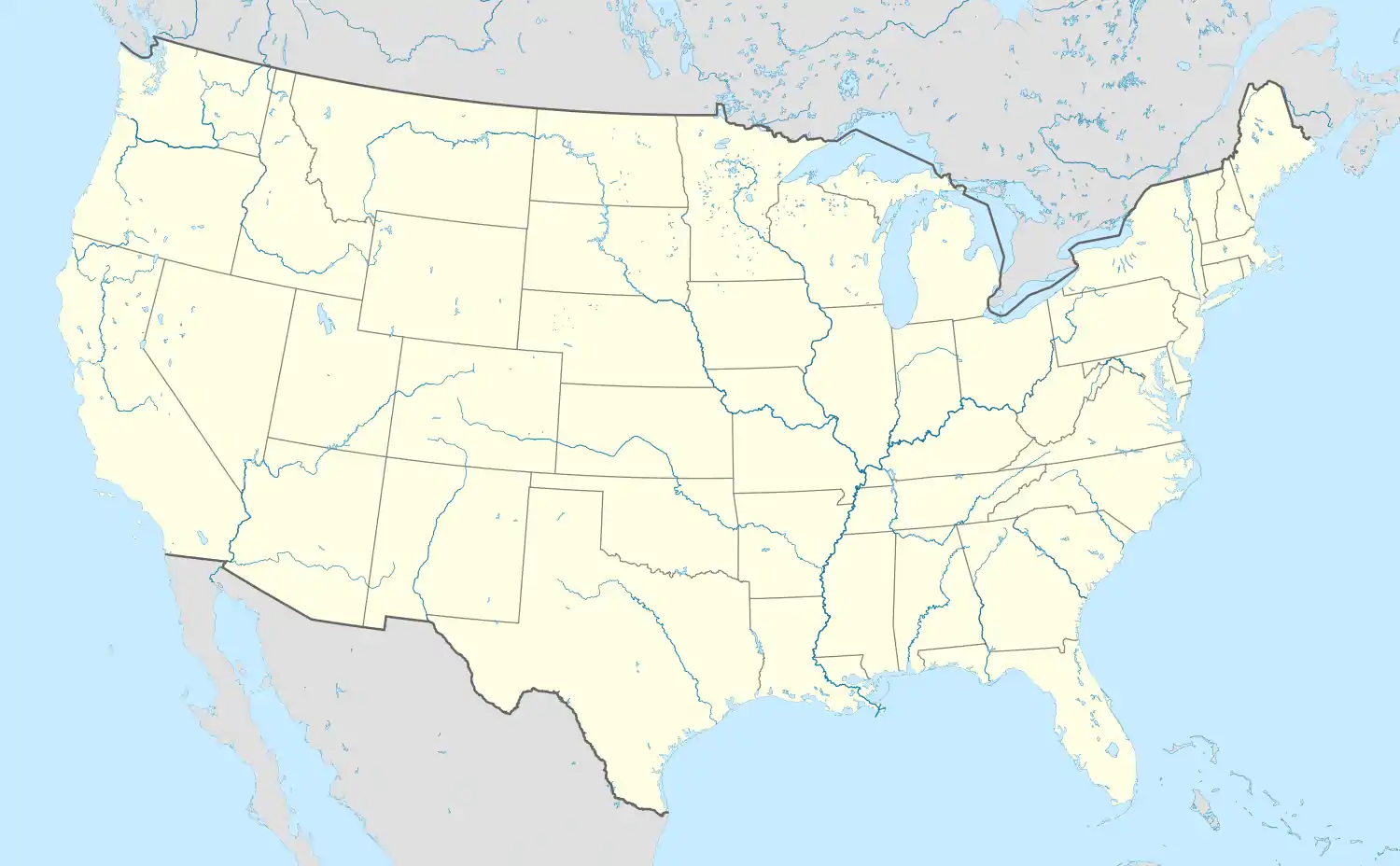
Map of schools


Advocacy
In 2014, the AAU supported the proposed Research and Development Efficiency Act arguing that the legislation "can lead to a long-needed reduction in the regulatory burden currently imposed on universities and their faculty members who conduct research on behalf of the federal government."[30] According to the AAU, "too often federal requirements" for accounting for federal grant money "are ill-conceived, ineffective, and/or duplicative."[30] This wastes the researchers' times and "reduces the time they can devote to discovery and innovation and increases institutional compliance costs."[30] AAU institutions are frequently involved in U.S. science policy debates. In 2008, AAU Vice President for Policy, Tobin Smith, co-authored a textbook on U.S. science policy.
See also
Notes
- The Association of American Universities was founded by the University of California, The University of Chicago, Catholic University of America, Clark University, Columbia University, Cornell University, Harvard University, Johns Hopkins University, the University of Michigan, Princeton University, the University of Pennsylvania, Stanford University, the University of Wisconsin, and Yale University, all of which were its first members.[1]
- Over $15.9 billion: NIH: $9.1 billion, 60 percent of total academic research funding. Research Funding: National Science Foundation: $2.0 billion, 63 percent of total academic research funding Department of Defense: $1.2 billion, 56 percent of total academic research funding Department of Energy: $505.2 million, 63 percent of total academic research funding NASA: $673.2 million, 57 percent of total academic research funding Department of Agriculture: $271.9 million, 41 percent of total academic research funding.
- Although Emory shares a joint engineering department with Georgia Tech, the program is accredited through Georgia Tech.[20]
- Rice will move to the American Athletic Conference in 2023.
- UNC-Chapel Hill offers an ABET accredited Biomedical Engineering degree jointly with North Carolina State University. The engineering courses are offered through the NC State College of Engineering, while the medical courses are offered through UNC-Chapel Hill.[23]
- Texas will move to the Southeastern Conference in 2025.
- Departed as a result of "institutional emphases and energies" that differed from the other AAU members.
- Departed because of a shift in the AAU's emphasis to large research universities.
- Removed from the AAU. Chancellor Harvey Perlman said that the lack of an on-campus medical school (the Medical Center is a separate campus of the University of Nebraska system) and the AAU's disregarding of USDA-funded agricultural research in its metrics hurt the university's performance in the association's internal ranking system. In 2010 Perlman stated that had Nebraska not been part of the AAU, the Big Ten Conference would likely not have invited it to become the athletic conference's 12th member.
- Because of a dispute over how to count nonfederal grants, Syracuse voluntarily withdrew from the AAU in 2011. The Chronicle of Higher Education reported that after "it became clear that Syracuse wouldn't meet the association's revised membership criteria, university officials decided that they would leave the organization voluntarily, rather than face a vote like Nebraska's, and notified the leadership of their intentions."
References
- "Colleges Will Co-operate: Organization of the Association of American Universities". The Washington Post. March 1, 1900. p. 2.
- "Association Of American Colleges And Universities". Tax Exempt Organization Search. Internal Revenue Service. December 20, 2018.
- "Case Western President Named Head of AAU". Inside Higher Ed. Retrieved February 19, 2020.
- "Editorial: Association of American Universities". Educational Review. 19: 404–405. April 1900.
- "For Uniform Requirements: Universities Will Fix Standard For Higher Degrees". The Baltimore Sun;. March 1, 1900. p. 2.
- "The Association of American Universities: A Century of Service to Higher Education 1900–2000". Association of American Universities. Retrieved February 25, 2018.
- Rosenzweig, Robert M. (2001). The Political University: Policy, Politics, and Presidential Leadership in the American Research University. Baltimore: Johns Hopkins University Press. p. 20. ISBN 9780801868191. Retrieved August 4, 2020.
- Rosenzweig, Robert M. (2001). The Political University: Policy, Politics, and Presidential Leadership in the American Research University. Baltimore: Johns Hopkins University Press. p. 21. ISBN 9780801868191. Retrieved August 4, 2020.
- Fain, Paul (April 21, 2010). "As AAU Admits Georgia Tech to Its Exclusive Club, Other Universities Await the Call". Chronicle of Higher Education. Archived from the original on June 11, 2011. Retrieved April 29, 2011.
- Hine, Chris (June 13, 2010). "Nebraska has it all to attract Big Ten, most importantly AAU membership". Chicago Tribune. Archived from the original on September 6, 2011. Retrieved April 29, 2011.
- UMass Amherst: Kumble R. Subbaswamy – Feature Story Archived July 11, 2012, at the Wayback Machine. Umass.edu (May 13, 2012). Retrieved on 2013-07-15.
- AAU Facts and Figures Archived September 12, 2008, at the Wayback Machine. Accessed August 24, 2008.
- Abourezk, Kevin (April 29, 2011). "Research universities group ends UNL's membership". Lincoln Journal Star. Archived from the original on May 3, 2011. Retrieved April 29, 2011.
- Selingo, Jeffrey J. (April 29, 2011). "U. of Nebraska-Lincoln Is Voted Out of Assn. of American Universities". Chronicle of Higher Education. Archived from the original on May 2, 2011. Retrieved April 29, 2011.
- "Member Institutions and Years of Admission". Association of American Universities. Archived from the original on October 26, 2014. Retrieved October 25, 2014.
- "Accredited MD Programs in the United States". LCME. Liaison Committee on Medical Education. Retrieved May 18, 2018.
- "AAU Peer Institutions". Data Analytics. August 10, 2016. Retrieved May 14, 2018.
- "ABET ACCREDITED PROGRAM SEARCH". ABET. ABET. Retrieved May 17, 2018.
- "Dartmouth Joins the Association of American Universities | Dartmouth News". news.dartmouth.edu. Retrieved November 7, 2019.
- "Accreditation and Assessment". Coulter Department of Biomedical Engineering. Coulter Department of Biomedical Engineering Georgia Institute of Technology & Emory University School of Medicine. Retrieved May 17, 2018.
- https://www.ricethresher.org/article/2021/10/rice-set-to-join-american-athletic-conference
- Hernandez-Jason, Scott (November 6, 2019). "Radical excellence: UC Santa Cruz joins Association of American Universities". UC Santa Cruz. Archived from the original on November 6, 2019. Retrieved November 6, 2019.
- "Joint Department of Biomedical Engineering". Joint Department of Biomedical Engineering. Joint Department of Biomedical Engineering @ UNC & NC State. Retrieved May 17, 2018.
- https://www.si.com/college/2021/07/29/sec-accepts-texas-oklahoma-conference-vote
- "The U invited to join the Association of American Universities | @theU".
- "Three Leading Research Universities Join the Association of American Universities (AAU)".
- O'Connell, The Most Rev. David M. (2002). "From the President's Desk". The Catholic University of America. Archived from the original on June 1, 2013. Retrieved August 25, 2013.
- Peter Schmidt, "Clark U. Leaves Association of American Universities; Others May Follow" (September 10, 1999). Chronicle of Higher Education.
- Selingo, Jeffrey J. (May 2, 2011). "Facing an Ouster From an Elite Group of Universities, Syracuse U. Says It Will Withdraw". Chronicle of Higher Education. Archived from the original on May 4, 2011. Retrieved May 3, 2011.
- "AAU Statement on the Research and Development Efficiency Act". Association of American Universities. July 14, 2014. Archived from the original on July 25, 2014. Retrieved July 17, 2014.
External links
Authority control  | |
|---|---|
| General | |
| National libraries | |
| Other | |