Amersham Market Hall
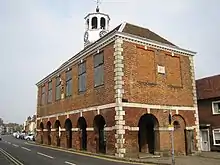
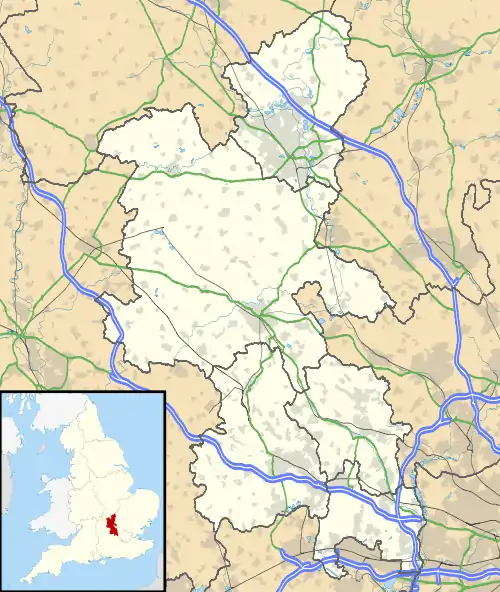
Amersham Market Hall, formerly known as Amersham Town Hall, is a municipal building in the High Street in Amersham, Buckinghamshire, England. The structure, which was the meeting place of Amersham Rural District Council, is a Grade II* listed building.[1]
| Amersham Market Hall | |
|---|---|
 Amersham Market Hall | |
| Location | High Street, Amersham |
| Coordinates | 51.6665°N 0.6169°W |
| Built | 1682 |
| Architectural style(s) | Neoclassical style |
Listed Building – Grade II* | |
| Official name | Market Hall |
| Designated | 22 December 1958 |
| Reference no. | 1221420 |
  Shown in Buckinghamshire | |
History
The town received a royal charter, allowing it to hold markets, from King John in 1200.[2] For several centuries the market took the form of a series of stalls in an area which extended from the High Street in the west to Broadway in the east until a medieval market hall was erected in Broadway in the early 17th century.[3] A series of seditious papers were posted in the building in 1653.[3] After the old structure became dilapidated, the local member of parliament, Sir William Drake, who lived at Shardeloes, decided to construct a more substantial market building for the benefit of the town: the site he selected was in the High Street, to the west of the original building.[4]
The new building was designed in the neoclassical style, built in red brick with stone dressings and was completed in 1682.[1] It was arcaded on the ground floor so that markets could be held, with an assembly room on the first floor.[1] The design involved a symmetrical main frontage with six bays facing onto the south side of the High Street: this elevation featured a row of casement windows on the first floor with a coat of arms of the Drake family in the centre.[1] There were quoins at the corners, a modillioned cornice at roof level and an octagonal wooden cupola above.[1] An inscription stated that the bell in the cupola was manufactured by a Christopher Hudson.[4] A village lock-up for petty criminals was installed in the north-east corner of the building at an early stage, a water pump was erected in 1785 and a horse-drawn fire station was installed in the arcaded area in the late 19th century.[4] Trade guild meetings, school classes, magistrates' court hearings and political meetings were all held in the assembly room.[5]
After significant population growth, partly due to its status as a market town, the area became a rural district with the market hall as the council's meeting place in 1894.[6] It was restored in 1911 at the expense of the then lord of the manor, William Wykeham Tyrrwhitt-Drake, and a plaque, bearing the inscription "Restored 1911 W. W. T. D." was installed below the coat of arms on the High Street elevation.[4][7]
The new council acquired ownership of the building, which became known as the "Town Hall",[8][9] from the Drake family.[5] It was used as a recruiting station for Kitchener's Army at the start of the First World War.[5] Civic meetings continued to be held in the assembly room on the first floor of the building until 1931 when the council moved to Elmodesham House in the High Street.[10] The building was used by the BBC as a filming location for its comedy series, Cuckoo, in 2013.[11]
References
- Historic England. "Market Hall (1221420)". National Heritage List for England. Retrieved 6 June 2021.
- Page, William (1925). "'The hundred of Burnham: Amersham', in A History of the County of Buckingham". London: British History Online. pp. 141–15. Retrieved 6 June 2021.
- "1-13 Market Square (North)". Amersham Museum. Retrieved 6 June 2021.
- "Market Hall". Amersham Museum. Retrieved 6 June 2021.
- "Venues". Amersham Town Council. Retrieved 6 June 2021.
- "Amersham RD". Vision of Britain. Retrieved 6 June 2021.
- Hunt, Julian (2001). A History of Amersham. Phillimore & Co. ISBN 978-1860771873.
- "Amersham Town Hall: Early Picture Post Card". Retrieved 6 June 2021.
- Seabright, Colin J. (2009). Amersham Through Time. Amberley Publishing. ISBN 978-1848684041.
- "40-44 High Street". Amersham Museum. Retrieved 6 June 2021.
- Jones, Mark (2014). Film and TV locations in The Chilterns and Thames Valley 1940-2014. Cloud 39 Publications. p. 11.