Amin Osman
Amin Osman, also known as Amin Osman Pasha, KBE (28 November 1898–5 January 1946) was an Egyptian judge and politician who served as finance minister in the period 1943–1944. He was assassinated by Hussein Tawfik, who was connected with the Egyptian army officers, on 5 January 1946.
Amin Osman | |
|---|---|
| Minister of Finance | |
| In office June 1943 – October 1944 | |
| Prime Minister | Mustafa El Nahas |
| Preceded by | Kamel Sidki |
| Personal details | |
| Born | 28 November 1898 Alexandria |
| Died | 5 January 1946 (aged 47) Cairo |
| Resting place | Tomb of Imam Al Shafi'i, Cairo |
| Spouse(s) | Katie Osman |
| Children | 1 |
| Alma mater | Victoria College Brasenose College, Oxford |
Early life and education
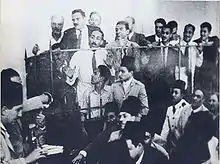
Amin Osman was born in the Muharram Bey neighborhood of Alexandria on 28 November 1898.[1] His father was a secretary general in the municipality of Alexandria.[1]
Educated at Victoria College and then at Brasenose College, Oxford, Amin Osman was a judge by profession.[2][3] He continued his studies in law in Paris.[4]
Career
Following graduation Osman joined the ministry of finance in Cairo.[3] He was a member of the Egyptian delegation led by the Prime Minister Mustafa El Nahas which signed the Anglo-Egyptian Treaty in August 1936.[5] Osman adopted a pro-British political stance[6][7] and was the primary liaison between the Prime Ministers Mustafa El Nahas and then Mohammed Mahmoud Pasha and the British Embassy in Cairo.[8] However, next Prime Minister Ali Maher Pasha fired Osman soon after he took over the office in August 1939.[3][9] Osman was serving as the undersecretary of finance before his dismissal.[10]
Osman's next post was the director of the National Bank of Egypt.[3] Following the Waft Party's formation of the government he was named as the head of the audit department of the finance ministry in February 1942.[3] In June 1943 he was appointed minister of finance in the cabinet led by Mustafa El Nahas and replaced Kamel Sidki in the post.[11][12] It was the fifth cabined headed by Mustafa El Nahas.[11] Osman served in the post until October 1944 when the term of the Waft Party ended.[3] However, he was not a member of the party.[13]
Personal life and assassination
Osman married a British woman, Katie.[2][4] They had a daughter.[3]
Osman was the recipient of the Order of the British Empire (KBE) which was awarded as a result of his contributions in the sign of the Anglo-Egyptian Treaty in 1936.[13]
He was assassinated in front of the Old Victorian Club in Cairo on the evening of 5 January 1946.[3] He died shortly after the attack.[6] The assassination was planned by the Egyptian army officers, including Anwar Sadat who would be the president of the country, and their target was also Prime Minister Mustafa El Nahas.[7] When the assassins led by Hussein Tawfiq did not manage to kill Mustafa El Nahas on 26 December 1945, they targeted and murdered Amin Osman.[2][14] A funeral ceremony for Amin Osman was held on 6 January in Cairo, and he was buried in the tomb of Imam Al Shafi'i there.[3]
Tawfik was arrested soon and based on his confession Anwar Sadat, Mohammed Ibrahim Kamel, and others were also arrested and jailed.[3][15]
References
- "جريمة في العقار 24.. لماذا شارك الرئيس السادات في اغتيال أمين عثمان؟". Al Jazeera (in Arabic). 29 September 2021. Retrieved 7 November 2021.
- Donald M. Reid (1982). "Political Assassination in Egypt, 1910-1954". The International Journal of African Historical Studies. 15 (4): 632–634. doi:10.2307/217848.
- "British Embassy Cairo Documents" (PDF). Gamal Abdel Nasser Digital Archive - Bibliotheca Alexandrina. 30 November 1946. Archived from the original (PDF) on 7 November 2021. Retrieved 7 November 2021.
- Stefanie Katharine Wichhart (2007). Intervention: Britain, Egypt, and Iraq during World War II (PDF) (PhD thesis). University of Texas at Austin. pp. 67–68. Archived from the original (PDF) on 15 August 2017.
- "Egyptian Treaty". The Times. London. 22 August 1936. Retrieved 7 November 2021.
- "Ex-Minister of Egypt Killed by Assassin". The New York Times. Cairo. UP. 6 January 1946. Retrieved 7 November 2021.
- Barry James (10 October 1981). "Sadat killing seen to fit pattern: Random and isolated". United Press International. Cairo. Retrieved 7 November 2021.
- Laila Amin Morsy (January 1994). "Indicative Cases of Britain's Wartime Policy in Egypt, 1942-44". Middle Eastern Studies. 30 (1): 95, 106. JSTOR 4283617.
- "Economy In Egypt". The Times. Alexandria. 21 August 1939. Retrieved 7 November 2021.
- "The Palestine Conference". The Times. 4 March 1939. Retrieved 7 November 2021.
- Mohammed Al. A. S. El Hadidy (1985). Mustafa Al Nahhas: A Case Study of Egyptian Political Leadership (PDF) (PhD thesis). SOAS, University of London. pp. 164, 277. Archived from the original (PDF) on 13 December 2020.
- "Cabinet Changes In Egypt". The Times. Cairo. 3 June 1943. Retrieved 7 November 2021.
- "Obituary. Sir Amin Osman Pasha". The Times. 7 January 1946. Retrieved 7 November 2021.
- Martin Kramer (27 March 2014). "35 years after the Egyptian-Israeli peace treaty". Martin Kramer. Retrieved 7 November 2021.
- Abdul Hadi Jiad (11 December 2001). "Mohammed Ibrahim Kamel". The Guardian. Retrieved 7 November 2021.