Amynodontidae
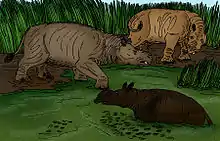
Amynodontidae ("defensive tooth")[2][3] is a family of extinct perissodactyls related to true rhinoceroses. They are commonly portrayed as semiaquatic hippo-like rhinos[4][5] but this description only fits members of the Metamynodontini; other groups of amynodonts like the cadurcodontines had more typical ungulate proportions and convergently evolved a tapir-like proboscis.
| Amynodontidae Temporal range: | |
|---|---|
 | |
Scientific classification  | |
| Kingdom: | Animalia |
| Phylum: | Chordata |
| Class: | Mammalia |
| Order: | Perissodactyla |
| Superfamily: | Rhinocerotoidea |
| Family: | †Amynodontidae |
| Genera[1] | |
|
See text | |
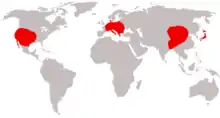 | |
| Range of Amynodontidae based on fossil record | |

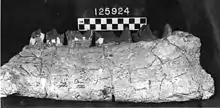
The Greek name of the family describes their tusks, derived from enlarged canine teeth. Odd-toed ungulates are herbivores, so these tusks would have been used either to deter or defend against predators (as suggested by the name) or perhaps in fights among males.[6]
Their fossils have been found in North America, and Eurasia ranging in age from the Middle Eocene to the Early Oligocene, with a single genus (Cadurcotherium) surviving into the Late Oligocene in South Asia (Pakistan).[7] The genus Metamynodon may have survived into the early Miocene.
Taxonomy
†Amynodontidae
- Subfamily Amynodontinae
- Tribe Cadurcodontini
- Genus Cadurcodon[8]
- Genus Lushiamynodon[8]
- Genus Sharamynodon[8]
- Tribe Metamynodontini
- Genus Gigantamynodon[8]
- Genus Metamynodon
- Genus Paramynodon[8]
- Genus Zaisanamynodon[8]
- Tribe incertae sedis
- Genus Amynodon[8]
- Tribe Cadurcodontini
- Subfamily incertae sedis
References
- McKenna, M. C.; S. K. Bell (1997). Classification of Mammals Above the Species Level. Columbia University Press. ISBN 0-231-11012-X.
- American Museum of Natural History, "Perissodactyls Glossary"
- https://logeion.uchicago.edu/%E1%BC%80%CE%BC%CF%8D%CE%BD%CF%89
- Savage, RJG; Long, MR (1986). Mammal Evolution: an illustrated guide. New York: Facts on File. pp. 194. ISBN 0-8160-1194-X.
- Palmer, D., ed. (1999). The Marshall Illustrated Encyclopedia of Dinosaurs and Prehistoric Animals. London: Marshall Editions. p. 264. ISBN 1-84028-152-9.
- http://www.rhinoresourcecenter.com/pdf_files/141/1415340780.pdf
- Wall, William P. (1989). "The phylogenetic history and adaptive radiation of the Amynodontidae". In Prothero, Donald R.; Schoch, Robert M. (eds.). The Evolution of perissodactyls. Oxford University Press. ISBN 9780195060393.
- Averianov, A.; Danilov, I.; et al. (2017). "A new amynodontid from the Eocene of South China and phylogeny of Amynodontidae (Perissodactyla: Rhinocerotoidea)". Journal of Systematic Palaeontology. 15 (11): 927–945. doi:10.1080/14772019.2016.1256914. S2CID 89118812.
- von Koenigswald, W.; Holbrook, L.T.; et al. (March 2011). "Diversity and Evolution of Hunter-Schreger Band Configuration in Tooth Enamel of Perissodactyl Mammals". Acta Palaeontologica Polonica. 56 (1): 11–32. doi:10.4202/app.2010.0021. S2CID 33679289.
- Huang, X.; Wang, J. (January 2001). "New materials of tapiroid and rhinocerotoid remains (Mammalia, Perissodactyla) from the Middle Eocene of Yuanqu Basin, Central China". Vertebrata PalAsiatica. 39 (3): 197–203. Retrieved 14 August 2020.
- Antoine, P.; Ducrocq, S.; et al. (2003). "Early rhinocerotids (Mammalia: Perissodactyla) from South Asia and a review of the Holarctic Paleogene rhinocerotid record". Canadian Journal of Earth Sciences. 40 (3): 365–374. Bibcode:2003CaJES..40..365A. doi:10.1139/e02-101.
- Wall, W.P.; Manning, E. (July 1986). "Rostriamynodon grangeri n. gen., n. sp. of amynodontid (Perissodactyla, Rhinocerotoidea) with comments on the phylogenetic history of Eocene Amynodontidae". Journal of Paleontology. 60 (4): 911–919. doi:10.1017/S0022336000043079. JSTOR 1305081.