Anantanarayanan Raman
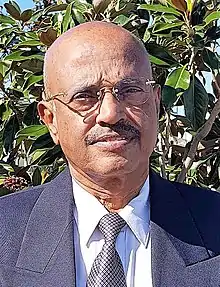
Anantanarayanan Raman is a Professor of Ecology with Charles Sturt University, NSW[1] and a scientist with CSIRO, Australia.[2]
Anantanarayanan Raman | |
|---|---|
 | |
| Nationality | Indian |
| Alma mater |
|
| Occupation | Professor of Ecology |
| Organization |
|
| Known for | Ecology, Entomology, Chemical and molecular ecology of insect—plant interactions |
| Awards |
|
Education
Raman received his bachelor's degree in biology from Loyola College, Madras followed by a master's degree in biology from Presidency College, Madras, and PhD & DSc degrees in ecology from Madras University.[3] As a graduate student, he researched at the Université Louis Pasteur, France, on the nutritional physiology of gall-inducing Tubulifera.[4]
Research
Raman received a Fulbright Award[3] in 1990 to work with Warren G. Abrahamson, of Bucknell University on population ecology and evaluated energetics using the Solidago–Rhopalomyia system.[5] Raman received a German Academic Exchange Service (DAAD) grant[6] to study the aseptic dual culture technique using Pemphigus and its primary host Populus and secondary host Taraxacum, and hypersensitive responses among species of Vitis to infestations of Daktulusphairia vitifoliae.[7] Raman collaborated with Rolf Beiderbeck of Rurpecht–Karls Universität, to work on a protocol for raising plant‑feeding insects on aseptically‑grown tissue callus of its host plant, using the Trialeyrodes–Stellaria system.[8]
In 2000, he received the Ian Potter Foundation’s award[9] and visited the University of Nebraska, to evaluate the nutrient mobilization in the moth-induced galls of the parthenium weed using stable isotope mass spectrometry.[9] Raman received an Australian Academy of Science fellowship[10] to visit the National Chung Hsing University, Taiwan to study the nutritional ecology of insects invading Machilus thunbergii.[11][12] Raman was invited by the Indian National Science Academy (INSA), on a Vulimiri Ramalingaswami Fellowship,[13] through which he conducted workshops and training programs at Indian universities.[14][15]
Most cited papers
- Shorthouse JD, Wool D, Raman A. Gall-inducing insects–Nature's most sophisticated herbivores. Basic and Applied Ecology. 2005 Oct 14;6(5):407-11. (Cited 233 times, according to Google Scholar[16]
- Raman A. Insect-induced plant galls of India: unresolved questions. Current Science. 2007 Mar 25:748-57. (Cited 137 times, according to Google Scholar.[16])
- Raman A. Morphogenesis of insect-induced plant galls: facts and questions. Flora-Morphology, Distribution, Functional Ecology of Plants. 2011 Jun 1;206(6):517-33. (Cited 103 times, according to Google Scholar.[16])
- Hossain Z, Gurr GM, Wratten SD, Raman A. Habitat manipulation in lucerne Medicago sativa: arthropod population dynamics in harvested and'refuge'crop strips. Journal of Applied Ecology. 2002 Jun 1:445-54. (Cited 103 times, according to Google Scholar.[16])
- Perović DJ, Gurr GM, Raman A, Nicol HI. Effect of landscape composition and arrangement on biological control agents in a simplified agricultural system: a cost–distance approach. Biological Control. 2010 Mar 1;52(3):263-70. (Cited 96 times, according to Google Scholar.[16])
- S. K. Florentine, A. Raman & K. Dhileepan. Effects of Gall Induction by Epiblema Strenuana on Gas Exchange, Nutrients, and Energetics in Parthenium Hysterophorus. Biological Control. 2005 Oct 50,787–801 (cited 87 times according to Google Scholar [17])
- Anamika Sharma, Anwar N. Khan, Sreenath Subrahmanyam, A. Raman, G.S. Taylor and M.J. Fletcher. Salivary proteins of plant-feeding hemipteroids – implication in phytophagy. 2013 Nov 104(2), 117–136. doi:10.1017/S0007485313000618. (Cited 72 times, according to Google Scholar [18])
References
- "Anantanarayanan Raman". Charles Sturt University Research Output. Retrieved 2021-06-14.
- "People – Ecosystem Change Ecology". ecosystemchangeecology.org. Retrieved 2021-06-14.
- Seckbach, Joseph; Dubinsky, Zvy (2010-10-11). All Flesh Is Grass: Plant-Animal Interrelationships. Springer Science & Business Media. ISBN 978-90-481-9316-5.
- Taptamani, Heishnam; Varatharajan, Rameiyer; Raman, Anantanarayanan (2012-05-15). "Biology of leaf gall-inducing Thlibothrips manipurenis Muraleedharan, 1982 on Ardisia sp. (Myrsinaceae) in north-eastern India (Thysanoptera: Tubulifera: Phlaeothripidae)". Beiträge zur Entomologie = Contributions to Entomology. 62 (1): 69–76. doi:10.21248/contrib.entomol.62.1.69-76. ISSN 2511-6428.
- Raman, Anantanarayanan (May 2003). "Cecidogenetic Behavior of some gall-inducing thrips, psyllids, coccids, and gall midges, and morphogenesis of their galls". Oriental Insects. 37 (1): 359–413. doi:10.1080/00305316.2003.10417356. ISSN 0030-5316. S2CID 84634798.
- "Heidelberg Alumni International - Service: Alumni Revue - September 2000: Alumni persönlich". www.alumni.uni-heidelberg.de. Retrieved 2021-06-15.
- Raman, Anantanarayanan; Beiderbeck, Rolf; Herth, Werner (August 2009). "Early subcellular responses of susceptible and resistant Vitis taxa to feeding by grape phylloxera Daktulosphaira vitifoliae". Botanica Helvetica. 119 (1): 31–39. doi:10.1007/s00035-009-0054-4. ISSN 0253-1453. S2CID 34820953.
- Raman, A.; Beiderbeck, R. (1992-01-12). "Aseptic dual culture of the greenhouse whitefly, Trialeurodes vaporariorum Westwood (Hom., Aleyrodidae) and its host, Stellaria media (L.) Vill. (Caryophyllaceae)". Journal of Applied Entomology. 113 (1–5): 252–257. doi:10.1111/j.1439-0418.1992.tb00662.x. S2CID 84919508.
- Raman, A.; Madhavan, S.; Florentine, S.K.; Dhileepan, K. (May 2006). "Metabolite mobilization in the stem galls of Parthenium hysterophorus induced by Epiblema strenuana inferred from the signatures of isotopic carbon and nitrogen and concentrations of total non-structural carbohydrates". Entomologia Experimentalis et Applicata. 119 (2): 101–107. doi:10.1111/j.1570-7458.2006.00403.x. hdl:1959.17/56858. ISSN 0013-8703. S2CID 84501345.
- Raman, Anantanarayanan (25 January 2008). "Workshop on Scientific writing for professional journals and theses" (PDF). Retrieved 15 June 2021.
- Pan, Liang-Yu; Chen, Wen-Neng; Chiu, Shau-Ting; Raman, Anantanarayanan; Chiang, Tung-Chuang; Yang, Man-Miao (June 2015). "Is a Gall an Extended Phenotype of the Inducing Insect? A Comparative Study of Selected Morphological and Physiological Traits of Leaf and Stem Galls on Machilus thunbergii (Lauraceae) Induced by Five Species of Daphnephila (Diptera: Cecidomyiidae) in Northeastern Taiwan". Zoological Science. 32 (3): 314–321. doi:10.2108/zs140244. ISSN 0289-0003. PMID 26003988. S2CID 207285754.
- Muthiah, S. (2018-04-16). "The Serbian connection". The Hindu. ISSN 0971-751X. Retrieved 2021-06-14.
- "Academy News". 1library.net. Retrieved 2021-06-14.
- "Calicut varsity to host GIAN programme". Charles Sturt University Research Output. Retrieved 2021-06-14.
- Staff Reporter (2019-02-25). "Calicut varsity to host GIAN programme". The Hindu. ISSN 0971-751X. Retrieved 2021-06-14.
- Google Scholar Author page, Accessed Sept. 19, 2021
- Florentine, S. K.; Raman, A.; Dhileepan, K. (2005). "Effects of Gall Induction by Epiblema Strenuana on Gas Exchange, Nutrients, and Energetics in Parthenium Hysterophorus". Biocontrol. 50 (5): 787–801. doi:10.1007/s10526-004-5525-3. ISSN 1386-6141.
- Sharma, A.; Khan, A.N.; Subrahmanyam, S.; Raman, A.; Taylor, G.S.; Fletcher, M.J. (2013-11-26). "Salivary proteins of plant-feeding hemipteroids – implication in phytophagy". Bulletin of Entomological Research. 104 (2): 117–136. doi:10.1017/s0007485313000618. ISSN 0007-4853.
Authority control  | |
|---|---|
| General | |
| National libraries | |
| Scientific databases | |
| Other | |