Andrey Avinoff
Dr. Andrey Avinoff (14 February 1884 – 16 July 1949; Russian: Андрей Николаевич Авинов Andrey Nikolayevich Avinov, sometimes referred to as Andrei Avinoff), was a entomologist, lepidopterist, artist, mystic, and an American of Russian and Ukrainian ancestry who was culturally influential in America.[1]
Andrey Avinoff | |
|---|---|
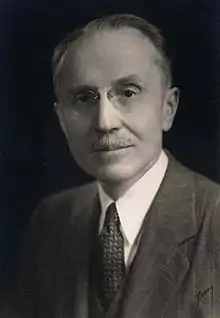 Andrey Avinoff | |
| Born | 14 February 1884 |
| Died | 16 July 1949 (aged 65) |
| Alma mater | University of Pittsburgh |
| Scientific career | |
| Fields |
|
His sister was Elizabeth Shoumatoff, the most well-known portrait painter of the 20th century. Together, they were integrated with the high society of politicians, industrialists, and socialites. Igor Sikorsky delivered his eulogy. He was featured in New Yorker Magazine[2] in 1948, and was to be featured by Life Magazine at the time of his death.
Prior to emigrating to the United States, Avinoff served as an advisor and in a diplomatic role in the Nicholas II of Russia's court, and at the time was likely the world's greatest butterfly collector. He amassed some 80,000 specimens primarily in the mountains of central Asia. In 1917 he permanently emigrated to the United States following the collapse of the Russian Empire.
For seven years he had a successful career as an illustrator and logo designer. His most well-known remaining illustration is the Winged S logo for Sikorsky Aviation, which became the title of Sikorsky's autobiography and today remains the logo of their awards. He also created marketing material for Colgate and other brands. From 1926 to 1946 Avinoff was Director of the Carnegie Museum of Natural History under the Carnegie and Mellon families. He is also widely known for his hundreds of paintings and drawings, almost all of which are in private collections.
Biography
Avinoff was born in Tulchyn, Podolia Governorate, then called Little Russia and today the Ukraine, to a family of White Russian nobility stretching back over 1000 years.[3] Avinoff learned to speak near-perfect English fluently during his childhood, as did his sister, Elizabeth. He was in United States at the time Revolution chose to permanently remain in America. He older brother, Nika, stayed in Russia and worked to bring Russia to a constitutional monarchy with the father of Vladimir Nabokov and other associates. Nika helped lead a vote of citizens in St. Petersburg where 3/4rds of Russian citizens chose to vote for this form of democracy but the movement was quashed by Vladimir Lenin and Bolsheviks under military cue in the Russian Revolution. Nika is rumored to have been assassinated in 1937 after years of hard labor in Siberia. All three childred were raised in a palace in called Shideyevo, today near the city of Poltava. Much of the research and documentation on Avinoff, Elizabeth, Nika, and the Avinoff line of the Shoumatoff family was done by Alex Shoumatoff, a journalist for Vanity Fair and New Yorker and author, who profiled his family in the 1982 book Russian Blood. Alex Shoumatoff's father, Nicholas, also created a preservation of Avinoff's and Elizabeth Shoumatoff's work on linage and assets in a private museum housed on his property called "the barn." Avinoff believed he was a descendant of Cleopatra and documented a considerable amount of this work in these assets.
In the United States, Elizabeth's husband, Leo Shoumatoff, a direct descendant of Kaiser Wilhelm II, became the financial manager for Sikorsky Aircraft at one point owning 1/3rd of the company before his death in a downing accident at Jones Beach, Long Island in 1928. Avinoff created the logo and early marketing materials for the fledgling aircraft company that would become the first to produce passenger aircraft and the first commercial helicopter, and this led to a long friendship and years of correspondence between Igor Sikorsky and Avinoff.
In 1924, Avinoff changed his career to become assistant curator of entomology at the Carnegie Museum of Natural History. He was promoted to director, in 1926, which he held thought 1946 when he left due to the ailing health of his lungs, and was appointed a trustee of the museum.[4] Likely a homosexual, Avinoff never had children. Avinoff generally lived a secluded upper-class life in Pittsburgh, a popular and thriving metropolis with an elitist society. In 1927, he was awarded an honorary Doctorate of Science from the University of Pittsburgh. His associates at the Carnegie Museum included William P. Comstock, E. Irving Huntington, Cyril F. dos Passos, and the author Vladimir Nabokov whose family he was close with his in Russia. In his novel Gar (“The Gift”), Nabokov based some the character Konstantin Godunov-Cherdyntsev, his formidable Central Asian butterfly collector, on Avinoff. According to Kurt Johnson and Steve Coates's book Nabokov's Blues (1999), Avinoff was one of the first people Nabokov contacted when he came to the United States.
In 1945, Avinoff's sister became a household name because of the death of President Frankin Delano Roosevelt, who collapsed and died before her while she was painting his portrait. Avinoff spent the last three years of his life primarily residing in an apartment in New York City where he was most-productive with paintings and art. He sister also resided in an apartment in the building during this period. The two also spent considerable time at her property in Locust Valley, New York, where they were buried.[5]
Butterflies
While in Europe, Avinoff spent his spare time traveling throughout the mountainous areas in Europe and Asia collecting butterflies. Avinoff would trace their genetic evolution through different valleys, since the mountains separating those valleys prevented different butterflies from mating. He found the Himalayas to be the ultimate proving ground. Avinoff's collection of Rhopalocera from the Pamir Mountains and Central Asia currently resides in the Zoological Museum in St. Petersburg. This collection of some eighty thousand specimens was appropriated by the Soviet government. Following World War II, the Mellon family asked to retrieve Avinoff's collection but was refused. Avinoff was close associates with the biologist and sex researcher Alfred Kinsey, largely due to their mutual interests in sexuality, and insects, from Dr. Kinsey's work with gall wasps and Dr. Avinoff's work with lepidopera. Once in the US, through trading, purchase, and financing of expeditions, Avinoff supposedly managed to build up a near duplicate collection. Much of his work remains at the Carnegie Museum [6]and at the Museum of Natural History in New York. Avinoff also made six butterfly-collecting trips to Jamaica, which he described as "a dreamland of tropical splendor," between 1926 and 1940. He and his sister's son, Nicholas, are believed to have created the definitive catalog of lepidoptera of the island. A year prior, Avinoff joined Entomological Society of America.[7] The two caught more than fourteen thousand bots, doubling the number of known species on the island to more than a thousand.
Painting
Later in his life, unable to travel from his health conditions, he renewed his focus on painting. Avinoff's paintings were highly skilled images of flora or fauna, or paintings with deep meanings with themes of religious, sexual, apocalyptic nature, or combinations of the three. He worked in a wide variety of mediums from precise pencil and ink drawings to oil to watercolor. His paintings of flowers, and 350 of his works illustrate the book Wildflowers of Western Pennsylvania and the Upper Ohio Basin. One of his most famous series of paintings depict The Fall of Atlantis, a poem by George V. Golokhvastoff published in limited edition in 1938.[8] The Birth of Atlantis, illustrated in his series of paintings, exemplifies the Art Deco style popular in the 1930s. The image is of a young male figure rising out of the sea, symbolic of the legendary island said by Plato to have later disappeared beneath the waves during an earthquake.
Selected publications
- 1946, with N. Shoumatoff, "An Annotated List of the Butterflies of Jamaica." Ann. Carnegie Museum, vol. 2O: pp. 263–295, pi. I
- 1950, An Analysis of Color and Pattern in Butterflies of the Asiatic genus Karanasa. 10 p. 2 plates.
- 1951, with Swedner, "The Karanasa butterflies, a study in evolution". Ann. Carnegie Mus., 32:1-250. (Also Monograph of the Satyrids of Central Asia)
References
- "Recollectig Andrey Avinoff". Carnegie Magazine. Spring 2009.
- "Black Tie and Cyanide Jar: A Profile of Dr. Andrey Avinoff". The New Yorker. August 18, 1948.
- "Chasing Beauty". Carnegie Magazine. Spring 2011.
- "Chasing Beauty". Carnegie Magazine. Spring 2011.
- "Andrey Avinoff on FindAGrave.com". Cite magazine requires
|magazine=(help) - "Recollecting Andrey Avinoff". Carnegie Magazine. Spring 2009.
- "List of ESA Fellows". Entomological Society of America. Retrieved 2019-09-08.
- Osborn, H. 1937: Fragments of Entomological History Including Some Personal Recollections of Men and Events. Columbus, Ohio, Published by the Author 1 1-394, 47 portraits.
- Osborn, H. 1952: A Brief History of Entomology Including Time of Demosthenes and Aristotle to Modern Times with over Five Hundred Portraits.. Columbus, Ohio, The Spahr & Glenn Company : 1-303.
External links
- A Profile of Andrey Avinoff in The New Yorker
- Andrey Avinoff: The Man 1886 - 1949 A Profile by the Carnegie Museum
- The Andrey Avinoff foundation
- The Kinsey Institute
- Andrey Avinoff is widely discussed by his great nephew, the author Alex Shoumatoff from excerpts from his book on his family, Russian Blood - Please use the search function to find information.
 |
Wikimedia Commons has media related to Andrey Avinoff. |
Authority control  | |
|---|---|
| General | |
| National libraries | |
| Art research institutes | |
| Other | |