Anna Laminit
Anna Laminit (1480 in Augsburg – 1518) was a German personality of the Late Middle Age. Using her self-styled status as a "hunger saint" (a saint who starved oneself), she was able to gain considerable influence on her contemporaries, including members of the imperial family, before being exposed by Archduchess Kunigunde, the younger sister of Emperor Maximilian, and ended up being executed as a witch.
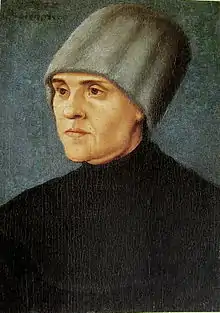
Biography
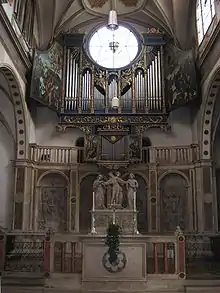
Anna Laminit came from a family of craftsmen in Augsburg. Around 1495–1496, due to her lifestyle which was considered debauched, she was pilloried, beaten with rods and expelled from the city. However, in 1497, thanks to contacts to notable personalities, she was able to making access to the city again, where she found shelter in the Seelhaus at the Carmelite Monastery of St. Anna. The environment influenced Anna's thinking. She established herself as a “hunger saint”, received communion only on Sundays and pretended to live from it. Soon rumours spread that the prayers presented to her would attain fulfillment through her prayers. Thanks to her fame which lasted for decades, she was able to build for herself a fortune of 1.500–1.600 Gulden.[2]
Laminit managed to approach even Emperor Maximilian himself, who paid personal visits to her and provided her and her maid with clothing. She told him about a vision, in which the Heavenly Father had become angered by the confederalists due to the blood money matter, and also that He was also displeased by the blasphemy and the pledging of healths. But Jesus Christ and the Virgin had begged him to allow the world to repent. In 1503, Laminit attained her greatest success in persuading Bianca Maria Sforza, her brother's Queen (later Empress), to lead a penitent procession with the city's leading officials – probably the largest one the city had ever seen. In 1511, Martin Luther also visited her while he was in Augsburg. Later, rumours arose though, that some people had seen the "saint" eat. Archduchess Kunigunde, younger sister of the emperor, decided to carry out an investigation herself. She invited Laminit to her monastery. When Laminit arrived on 16 October 1512, she was quartered in a guest room, which had been prepared beforehand with peepholes. As soon as the door was locked, Laminit unpacked bags of fruit that she had hidden under the bed. Despite Laminit tried to cover the scandal, on 13 October 1513, Kunigunde demanded a just punishment from the Imperial City Council Of Augsburg. On 30 January 1514, Maximilian personally decreed that Laminit would not be allowed to approach him or the city within a day's travel distance. Laminit then arrogantly left Augsburg and moved to Freiburg, where she married a widowed crossbow-maker and established herself as a herbalist. After a new fraud was exposed and one of her herbal drinks caused the death of a person in Freiburg though, she was condemned as a witch and executed by drowning.[3][4][2]
Jörg Breu the Elder recounted that the emperor, princes and other rich and powerful people had great faith in Anne Laminit while the common people thought little of her. This was compatible with his later fierce criticism of the Church with its material culture and the wealthy supporters. Andrew Morrall opines that this was a revealing instance in which a layman displayed distance towards the official religion protected by the Church and supported by the society's upper echelons.[5]
References
- Nixon, Virginia (2004). Mary's Mother: Saint Anne in Late Medieval Europe. Penn State Press. p. 173. ISBN 978-0-271-02466-0. Retrieved 6 November 2021.
- "Stadt Augsburg". www.augsburg.de (in German). Retrieved 6 November 2021.
- Bendix, Regina F.; Fenske, Michaela (2014). Politische Mahlzeiten. Political Meals. LIT Verlag Münster. pp. 128–129. ISBN 978-3-643-12688-7. Retrieved 6 November 2021.
- Tlusty, B. Ann (15 September 2012). Augsburg During the Reformation Era: An Anthology of Sources. Hackett Publishing. pp. 240–241. ISBN 978-1-60384-920-3.
- Morrall, Andrew (29 September 2017). Jörg Breu the Elder: Art, Culture, and Belief in Reformation Augsburg. Routledge. p. 142. ISBN 978-1-351-75720-1. Retrieved 6 November 2021.
