Anolis auratus
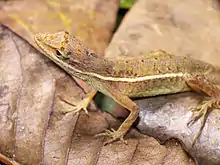
Anolis auratus, the grass anole, is a species of lizard in the family Dactyloidae. The species is found in Costa Rica, Panama, Venezuela, Colombia, French Guiana, Guyana, and Brazil.[2]
| Anolis auratus | |
|---|---|
 | |
Scientific classification  | |
| Kingdom: | Animalia |
| Phylum: | Chordata |
| Class: | Reptilia |
| Order: | Squamata |
| Suborder: | Iguania |
| Family: | Dactyloidae |
| Genus: | Anolis |
| Species: | A. auratus |
| Binomial name | |
| Anolis auratus Daudin, 1802 | |

Habitat
Anolis auratus is mainly found in Panama but can be found across Northern South America in open, grassy areas such as fields. They tend to avoid shaded areas. [3]
Territoriality
Males almost exclusively use their territories for access to mates rather than access to food since competition for food is low within the species. Males use displays to assert dominance over others males and attract females.[4] These displays consist of moving their head and dewlap up and down in a sinusoidal fashion.[4] Territorial males will approach another lizard to perform their display and the sex and response of the conspecific determines the result of the challenge. If the conspecific is female or a juvenile, they are tolerated within the male’s territory. If the conspecific is another adult male, they are tolerated if they give a head nod, but are chased away or engaged in agonistic behavior if do not give a head nod or give a challenge display. If the adult male conspecific loses the challenge, he can stay within the territory as a subordinate.[3]
Since A. auratus’ habitat has abundant vegetation, the effectiveness of head displays may be affected by the moving vegetation, especially in the wind. Displays can also be affected by the vantage point of females, which are usually low in the grass and become habituated to movement patterns in the moving vegetation. Therefore, displays are most successful when using a sinusoidal movement pattern when there is no wind, but even with wind their displays are able to generally avoid reduction in effectiveness from habituation.[4]
Social Behavior
Adult Sociality
When given the choice of interacting with the same species or a morphologically similar species, this lizard almost always chooses to interact with individuals of their own species. A. auratus only chooses to interact with other species when conspecifics are not around. This behavior suggests that being selective aids in reproductive isolation. It also suggests that being around conspecifics is important in habitat selection. [5]
References
- Ibáñez, R.; Jaramillo, C.; Köhler, G.; Rivas, G.; Gutiérrez-Cárdenas, P.; Bolívar, W.; Velasco, J.; Avila-Pires, T.C.S. (2020). "Anolis auratus". IUCN Red List of Threatened Species. 2020: e.T203078A2759962. doi:10.2305/IUCN.UK.2020-3.RLTS.T203078A2759962.en. Retrieved 19 November 2021.
- "Anolis auratus ". The Reptile Database. http://reptile-database.reptarium.cz/species?genus=Anolis&species=auratus
- Fleishman, Leo J. (1988). "The Social Behavior of Anolis auratus, a Grass Anole from Panama". Journal of Herpetology. 22 (1): 13. doi:10.2307/1564352.
- Fleishman, Leo J. (1988-05-01). "Sensory and environmental influences on display form in Anolis auratus, a grass anole from Panama". Behavioral Ecology and Sociobiology. 22 (5): 309–316. doi:10.1007/BF00295099. ISSN 1432-0762.
- Kiester, A. Ross (1979-12-01). "Conspecifics as cues: A mechanism for habitat selection in the Panamanian grass anole (Anolis auratus)". Behavioral Ecology and Sociobiology. 5 (4): 323–330. doi:10.1007/BF00292522. ISSN 1432-0762.