Anti-American sentiment in Germany
Anti-American sentiment in Germany is the dislike of the American government or people[1] present in Germany. Anti-Americanism has been present in Germany throughout history with several notable incidents. Anti-Americanism became government policy during the Cold War in East Germany, with dissenters being punished. In West Germany, this sentiment was generally limited to left wing politicians.[2] With the election of eurosceptic president Donald Trump, some people observe that Anti-Americanism may be growing in Germany.[3]

Scholars such as Noam Chomsky and Nancy Snow have argued that the application of the term "anti-American" to the population of other countries does not make any sense, as it implies that not liking the American government or its policies is socially undesirable or even comparable to a crime.[4][5] In this regard, the term has been likened to the propagandistic usage of the term "anti-Sovietism" in the USSR.[4]
History
During 1820-40 era, hostility toward America stemmed from its perceived cultural inferiority.[6] Between 1820 and 1870, more than seven and a half million German immigrants came to the United States, buying farms or taking industrial jobs. Few returned to their homeland.[7]
World Wars
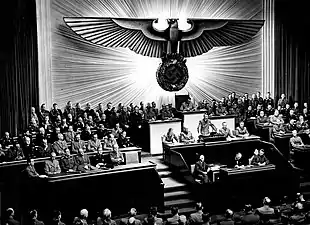
Germany and the United States were at war 1917-1918 and 1941-1945.
Postwar
In the postwar era from 1945-1970, Americanisation was part of the process of becoming a Western European, and anti-American sentiment was weak. However in the late 1960s, West Germany's youth contrasted the images of Woodstock -- which they liked -- and the Vietnam War -- which they hated. Young rebels turned to violence to destroy the foundations of a society that backed American cultural imperialism. Anti-Americanism reappeared among some intellectuals after the attacks on 11 September 2001 because of the perceived links between globalisation, Americanisation, and terrorism.[8]
After World War II, Germany was split into two parts, East Germany and West Germany. In socialist East Germany, anti-Americanism was official government policy. Anti-Americanism was strong among left wingers. Some right wingers saw the United States as a protector against communism, while others saw the American way of life as uncultured.[9]
Iraq War of 2003
The War in Iraq in 2003 was highly unpopular at all levels of German society.[10] Chancellor Gerhard Schröder stated that Germany would refuse to provide troops or money for the Invasion of Iraq.[11][12]
Donald Trump
.jpg.webp)
With the election of Donald Trump, there have been renewed fears among American think-tanks about the rise of Anti-American sentiment in Germany.[13] Donald Trump, the grandson of a German immigrant, has been noted for his euroscepticism,[14] while Germany is one of the most Pro-EU countries in the world. In 2017, German magazine Stern published a cover depicting Donald Trump performing the Nazi salute, with the inscription Sein Kampf, obviously referencing Mein Kampf.[15] Germans have generally been more negative about their relations with the United States than most other European countries.[16]
References
- Chiozza, Giacomo (2009). Anti-Americanism and the World Order. Baltimore, Maryland: The Johns Hopkins University Press.
- Dan Diner, America in the eyes of the Germans: an essay on anti-Americanism (1996).
- "Terms of Service Violation". bloomberg.com.
- Chomsky, Noam (1993). "Totalitarian Culture in a Free Society". Internet Archive. Retrieved 2021-01-27.
- Snow, Nancy (2006). The Arrogance of American Power: What U.S. Leaders Are Doing Wrong and Why It's Our Duty to Dissent. Lanham, MD: Rowman & Littlefield. pp. 27ff. ISBN 0-7425-5373-6. OCLC 69992247.
- Gerrit-Jan Berendse, "German anti-Americanism in context." Journal of European Studies 33.3-4 (2003): 333-350.
- Guido A. Dobbert, "German-Americans between New and Old Fatherland, 1870–1914". American Quarterly 19 (1967): 663–680 online.
- Berendse, "German anti-Americanism in context." Journal of European Studies 33.3-4 (2003): 333-350.
- "Ami Go Home". The Economist. February 5, 2015. Retrieved December 6, 2021.
- Tuomas Forsberg, "German foreign policy and the war on Iraq: Anti-Americanism, pacifism or emancipation?." Security Dialogue 36.2 (2005): 213-231.
- Hooper, John (6 August 2002). "German leader says no to Iraq war". the Guardian.
- https://dk-media.s3.amazonaws.com/AA/AT/gambillingonjustice-com/downloads/275731/German_foreign_policy_and_the_war_on_Iraq-_anti-Americanism__pacifism_or_emancipation.pdf
- Erlanger, Steven (October 11, 2017). "German Foreign Policy Experts Warn Against Anti-Americanism". The New York Times. Retrieved December 6, 2021.
- Kleefeld, Eric (August 18, 2016). "Why is Donald Trump calling himself "Mr. Brexit"?". The New Republic. Retrieved December 6, 2021.
- "'Sein Kampf': German magazine Stern's controversial cover". Toronto Sun. Associated Press. August 25, 2017. Retrieved December 6, 2021.
- "1. America's Global Image". pewresearch.com. 23 June 2015. Retrieved December 6, 2021.
Further reading
- Berendse, Gerrit-Jan. "German anti-Americanism in context." Journal of European Studies 33.3-4 (2003): 333-350.
- Berman, Russell A. Anti-Americanism in Europe: A cultural problem (Hoover Press, 2004).
- Diner, Dan. America in the Eyes of the Germans: An Essay on Anti-Americanism (1996) on critics who saw the USA in terms of greedy hypocrites who hated all higher culture. excerpt
- Forsberg, Tuomas. "German foreign policy and the war on Iraq: Anti-Americanism, pacifism or emancipation?." Security Dialogue 36.2 (2005): 213-231. online
- Klautke, Egbert. "Anti-Americanism in twentieth-century Europe." Historical Journal 54.4 (2011): 1125-1139. online
- Muller, Christoph Hendrik. West Germans Against the West: Anti-Americanism in Media and Public Opinion in the Federal Republic of Germany, 1949-68 (Palgrave 2010) excerpt
- O’Connor, Brendon and Martin Griffiths, eds. The Rise of Anti-Americanism (2005)
- Rubin, Barry M., and Judith Colp Rubin. Hating America: a history (Oxford University Press, 2004).