Antonije Orešković
Colonel Antonije "Ante" V. Orešković (Dvor na Uni, Banija, Habsburg Empire, 7 January 1829 - Belgrade, Kingdom of Serbia, 14 October 1906) was a Serb of Military Krajina origin.[1]
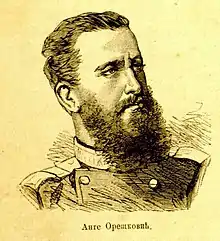
Antonije Orešković was a veteran of many battles, Austrian-Hungarian war, Franco-Austrian War, the first Serbian-Turkish war (1876), Second Serbian-Turkish war (1877-1878), Serbo-Bulgarian war. He was a colonel in the Serbian army, an intelligence officer, a diplomat,[2] and a military theorist.
Origin and family
He was born on 7 January 1829, at the Dvor na Uni[3](in Banija) in a Serbian [4][5][6][7] border family in the Military Frontier (Military Militärgrenze), however, of the Roman Catholic faith.[8]
Not long after his birth was the day of St. Antonije (17 January 1829), therefore, his parents gave him the name - Antonije.
Ante's father Vuk Orešković was a border officer, so his son followed his father with the choice of occupation.[9]
The Oreškovićs (Antonija's family branch) are a noble family descended from Mihailo Orešković (from Prozor) and his brothers (Generals Toma Orešković, Danijel and Ilija Orešković).
On the family coat of arms of Antonio Orešković, in the upper field, there are two severed Turkish heads with turbans.
The first recorded representative of this family is Đorđe Orešković, who (1498 and 1509) is mentioned along with Jovan Serbljin, as a resident in the Serbian village of Potok (on the mountain Kalnik in today's Republic of Croatia), and on that occasion, it is especially emphasized that Orešković family also referred to themselves as Rasciani.[10][11][12]
Stjepan Pavičić (1887-1973), a well-known Croatian historian and academician of JAZU, when he lists the military families (based on the census from 1644), who settled in Otočac in Lika (between 1551 and 1644), he along with Kolaković, Nikšić, Ostojić and Rajković is mentioned as a large family - Orešković, who later branched out (along the Military Border).[13][14]
The Hungarian Revolution of 1848
In the Austro-Hungarian War from 1848 to 1849, Orešković was a leading officer in the Austrian army.[15]
From 1858, he established contact (and began cooperation) with Ilija Garašanin (1812-1874) to realize his national program (Garašanin's Načertanije from 1844) aimed at the liberation and unification of the divided Serbian lands in the Balkans (Garašanin consciously left out the liberation from the Austrian Empire from "Načertanje" (1804-1867), because he did not want a war on two fronts [16]).
It was Garašanin who planned for the very capable Orešković to be recruited to work for the Principality of Serbia.[17]
From 1853 to 1862 he served in the Military Frontier (1538-1881), as an active officer of the Austrian Empire.
While at war with the Austrian army on the Apennine Peninsula, he came into contact with Italian revolutionaries and became acquainted with the conspiratorial work of the Carbonari (Italian secret society), which would decisively affect his entire later life.[18]
Austro-Sardinian War of 1859
Orešković also took part (1859) in the Franco-Austrian War (Sardinian War).[19]
From 1853 to 1862 he served in the Military Frontier (1538–1881), as an active officer of the Austrian Empire. While at war with the Austrian army on the Apennine Peninsula, he came into contact with Italian revolutionaries and became acquainted with the conspiratorial work of the Carbonari (Italian secret society), which would decisively affect his entire later life.[18]
Initiator of the border guards' conspiracy against Austria
In July 1859, after returning from the war (which was fought in the north of today's Italy), Antonije was imbued with pan-Slavic ideas and began working on a conspiracy against the Habsburgs, looking for supporters among his fellow Serbs, but also among neighboring Croats. he also came into contact with Bosnian beys, working on the idea of Yugoslav military action.[20][12]
After the Austrian authorities suspected him and his friends from the "Second Banija Militärgrenze Zweites Banal Infanterie Regiment, No. 11" in Petrinja, they reassigned them to various places.[21] Orešković was transferred to Moravia, and he came to Vienna as a captain, where he met the philologist Vuk Stefanović Karadžić (1787-1864), who soon introduced him to Prince Mihailo M. Teodorović Obrenović (1823-1868).[21] Prince Mihailo and Antonija Orešković became great friends from then on, that is, Orešković would become the prince's most loyal confidante.
Military career in the Principality of Serbia and the Kingdom of Serbia
The Austrian authorities invited Ante Orešković to Zagreb (1862), but he refused to go there because he knew that his anti-Habsburg activities among the border guards were already well-known to them.[22]
In April 1862, at the invitation of Mihailo Obrenović, Prince of Serbia (ruled: 1839-1842 and 1860-1868), Orešković left the military [23][24][25] in Austria and joined the Serbian army (where he received the rank of infantry major).[26]
Military duties in Serbia: [15][27]
- From April to June 1862, he made himself available to the Minister of War and the Minister of Foreign Affairs for extraordinary missions (residing outside the Principality of Serbia)
- From June (during the conflict between Serbs and Turks) to November 1862, he was the commander of the Volunteer Corps
- From November 1862 to 15 May 1876, he was again at the disposal of the Minister of War and the Minister of Foreign Affairs.
- He was promoted to the rank of colonel on 15 May 1876
- From 15 May 1876 to 1 July 1876, he was Chief of Staff of the Drina Army and Commissioner in Vidin (Turkish Empire: 1299-1922).
- From 1 December 1876, to 1 June 1877, he was an infantry officer in the Ministry of Defense
- From 1 June 1877 to October 1877, he was a deputy commander of the Drina Army and an assistant in the headquarters of the Supreme Command.
- From October 1877 to November 1877, he was the commander of the Moravian Division
- From 15 November 1878, he was the commander of the Drina Division
- From 1880 to 1885, he was the commander of the Danube Divisional Area
- From 1885 to 1886, he was the commander of the Drina divisional area
- In the Serbo-Bulgarian war (1885), he was the commander of the Drina Division
- He retired on April 27, 1888.[28][29]
As a sworn opponent of Austria, Antonije Orešković openly expressed his disagreements with the Austrophile policy of Milan M. Teodorović Obrenović (1854-1901), King of Serbia (reigned: 1882-1889), who even in 1883 delivered Garašanin's "Načertanije" to the Viennese court, which particularly angered Orešković, who dedicated almost his entire working life to its realization.
In the conflict between Queen Natalija (Keško) Obrenović (1859-1941) and the king "on the issue of divorce" (because of his infidelity), which shook the whole country at the end of the 19th century, Colonel Orešković without hesitation sided with the queen.[30]
Because of all the above (despite numerous military merits), King Milan Obrenović did not promote him to general but retired him in 1888.
Immediately afterward, the king was forced to abdicate (1889).
Intelligence-national work
Formally, Orešković was Prince Mihailo Obrenović's man, but de facto, he was the main operative and implementer of military intelligence activities[31] of Ilija Garašanin[32] and Matija Ban (1818-1903), behind whom stood the Serbian prince.
Prince Mihailo brought him to the Serbian capital Belgrade, to prepare Serbia for the liberation wars against the Turkish occupier with his rich military experience.
On the unification of the Serbian ethnic corps into one state, Antonije Orešković in his book "Slavic Cooperative" (1872) states the following:
Having briefly observed all the existing external and internal relations of Serbia in this way, I repeat: for Serbia to be able to separate and unite and unite into one body, an independent Serbian state, it should be assumed in the first place that is in agreement with each other, then to silence the rivalry between Croats and Bulgarians, and finally to defeat Austria-Hungary and Turkey, and Germany behind Austria; for Austria will not be allowed to disintegrate before it has carried out its German Mission if they only have the strength in Berlin.[33] Even before moving to Serbia, Captain Orešković provided a connection (1858) to Prince Miloš Teodorović Obrenović (1780-1860) with the naval [34] steamship captain [35][36] Francesco-Fran P. Franasović, a Dalmatian Serb [37][38](originally from Korčula.[39][40] and Brač[41]), and at that time (according to his professional formation) a line inspector (branch in Orsha) of the Austrian First Danube Steamship Company[42](German: Erste Donau-Dampfschiffahrts-Gesellschaft, abbr. DDSG), from where he delivered a lot of important information to the Serbian prince because he had his own private intelligence network in the Djerdap area.
Garašanin's military-diplomatic strategy with Austrian foes,[43] after the armed incident near Čukur Fountain (and the later bombing of Belgrade), which in 1862 led to the partial withdrawal of the Turks from the Principality of Serbia, was Orašković's first successful engagement[44]
Serbia expected that this Turkish incident (in addition to Belgrade, there was also a conflict in the interior of the principality) would result in a wider war conflict in the Balkans, so it was rapidly preparing for it, and rightfully so.
England and Austria sided with Turkey as usual, so the epilogue of these events was the Turkish abandonment of two fortresses (Užice and Soko), which will be destroyed, as well as the eviction of the Turkish population (which Serbia had to compensate).
The People's Army of the Principality of Serbia had two major shortcomings: (1) the lack of quality officer personnel and (2) the lack of modern weaponry.
Since Orešković was the only one who could get information from the Military frontier at first,[45][46] the Serbian government entrusted Orešković with the task of organizing an action in that direction, and weapons were requested from the Russian Empire (1721-1917).[22]
In terms of the realization of Serbian national interests, through his intelligence work (as well as the achieved results), Orešković paved the way for future Serbian intelligence officers such as Jovan S. Milovanović (1845-1933), Radomir D. Putnik (1847-1917), Dragutin T. Dimitrijević-Apis (1876 -1917), Dušan Radović-Kondor (1900- 1944) and Žarko Todorović (1908-2000).
Secret Agency Network and Volunteer Corps
As part of the Serbian army's preparations for future armed conflicts with the Turks, Orešković maintained secret ties between the Serbian government and prominent Serbian officers (Orthodox and Catholic) in the Military Border, that is, he was the main figure in the Serbian government's operational (secret) affairs with border guards.
Orešković's task was to organize the recruitment of border guards, their transfer to Serbia, and then their inclusion in a Volunteer Corps (pus) stationed in Valjevo.
In the largest cities of the Military Border, Antonije has secret recruitment boards or instructs emissaries from Serbia to work on it.
The committee in Karlovac was important, consisting of local patriots Edmund Kovačić (wholesaler from Osijek), Maša Solarž, Gustav Pfajfinger (later moved to Sisak), and Petar Uzelac (a merchant from Karlovac). This board managed to smuggle weapons and ammunition into Serbia.[47]
In Bosanski Brod, the action was successfully led by Lieutenant Sima Jovanović who was also a border lawyer[48][49] Andrej Berlić (German Andreas Torquat Berlić), and in Sisak by merchants Sestić and Kotur, while in Klenk this action was led by agents of the First Danube Steamship Company, the Kosta brothers. Pavle and Nikola Tomašević.
In Petrovaradin, Orešković's agents were retired lieutenant Kosta Krstić and Mitar Kovačević, sergeant of the Petrovaradin Border Infantry Regiment no. 9 (German: Peterwardeiner Grenz-Infanterie-Regimente Nr. 9), who (in October 1862) were preparing to forcibly break through the cordon near Klenk (in Srem) with about a thousand soldiers from Petrovaradin and then cross into Serbia.[48][49]
At that time, the Volunteer Corps reached the number of 3,000 fighters.
Retirement
In 1889 Orešković decided to withdraw from politics altogether and retire.[50]
References
- Translated and adapted from Serbian Wikipedia: https://sr.wikipedia.org/wiki/%D0%90%D0%BD%D1%82%D0%BE%D0%BD%D0%B8%D1%98%D0%B5_%D0%9E%D1%80%D0%B5%D1%88%D0%BA%D0%BE%D0%B2%D0%B8%D1%9B
- "Orešković, Antonije | Hrvatska enciklopedija".
- name="autogenerated161">Јовановић-Стојимировић, Милан: „Силуете старог Београда“ (Београд: Иван Јовановић-Стојимировић, 1971. pp. 161.)
- Станојевић, Станоје Л.: „Narodna enciklopedija srpsko-hrvatsko-slovenačka“ Књига III (Zagreb: Bibliografski zavod d.d., 1928. pp. 261.)
- Лист „Србски дневник“ је хвалио »Србина католичке вере« Орешковића, који је »за кратко време свог бављења у Србији обште уважавање и поштовање стекао« – Ђорђевић, Јован М.: „Новости из Београда“, Србски дневник Број 68 (Нови Сад: Епископска књигопечатња, 28. август 1862. године. pp. 2)
- MacKenzie, David: „Ilija Garasanin: Balkan Bismarck“, Series: East European Monographs № 181 (New York: Columbia University Press, 1985. pp. 63.)
- Мекензи, Дејвид: „Илија Гарашанин државник и дипломата“ (Београд: Просвета, 1987. pp. 85.)
- Крестић, Василије Ђ.: „Зборник о Србима у Хрватској“, Том 3 (Београд: Српска академија наука и уметности, 1995. pp. 310.)
- name="autogenerated113">Vukčević, Ivo: „Croatia 3: New Language, New Nationality, and New State“ (Bloomington: Xlibris Corporation LLC, 2013. pp. 113.)
- Јовановић-Стојимировић, Милан: „Силуете старог Београда“ (Београд: Просвета, 2008. pp. 205.)
- Грујић, Радослав: „Споменица о српском православном владичанству пакрачком“ (Београд: Музеј српске православне цркве, 1906. pp. 18.)
- Милојевић, Боривоје Ж.: „Гласник Српског географског друштва“ (Београд: Српско географско друштво, 1948. pp. 157.)
- br
- Pavičić, Stjepan: „Seobe i naselja u Lici“ (pp. 5-330), Zbornik za narodni život i običaje južnih Slavena Књига 41, Antropogeografska istraživanja III (Zagreb: Jugoslavenska akademija znanosti i umetnosti, 1962. pp. 143.-144)
- Pavičić, Stjepan: „Seobe i naselja u Lici“ (pp. 5-330), Zbornik za narodni život i običaje južnih Slavena Књига 41, Antropogeografska istraživanja III (Zagreb: Jugoslavenska akademija znanosti i umetnosti, 1962. pp. 183.)
- Станојевић, Станоје Л.: „Narodna enciklopedija srpsko-hrvatsko-slovenačka“ Књига III (Zagreb: Bibliografski zavod d.d., 1928. pp. 262.)
- Вучковић, Војислав Ј.: „Национално-револуционарна акција Србије у Војној граници“ (pp. 5-25), Зборник Матице српске: Серија друштвених наука № 9 (Нови Сад: Матица српска, 1954. pp. 6.)
- name="autogenerated5">Вучковић, Војислав Ј.: „Национално-револуционарна акција Србије у Војној граници“ (pp. 5-25), Зборник Матице српске: Серија друштвених наука № 9 (Нови Сад: Матица српска, 1954. pp. 7.)
- Јовановић-Стојимировић, Милан: „Силуете старог Београда“ (Београд: Просвета, 2008. pp. 206.)
- name="autogenerated262"
- Јовановић-Стојимировић, Милан: „Силуете старог Београда“ (Београд: Просвета, 2008. pp. 207.)
- Јовановић-Стојимировић, Милан: „Силуете старог Београда“ (Београд: Иван Јовановић-Стојимировић, 1971. pp. 160.)
- name="autogenerated5"
- Павловић, Иван С.: „Војна граница и српска војска“, Гласник историјског друштва у Новом Саду Књига IX, Свеска 24 (Нови Сад: Историјско друштво у Новом Саду, 1936. pp. 221.-223)
- Поповић, Васиљ: „Аграрно питање у Босни и турски нереди за време реформног режима Абдул Меџида 1839-1861“ (Београд: Научна књига, 1949. pp. 223.)
- Вучковић, Војислав Ј.: „Политичка акција Србије у јужнословенским покрајинама Хабзбуршке монархије 1859-1874“, Зборник за историју, језик и књижевност српског народа Књига XXVII (Београд: Српска академија наука и уметности, 1865. pp. 2.-6)
- Атанасије Николић (1803-1882): „Опис радње по предмету општег споразумљења за устанак и сједињење (1860–1868) “, Београд 20. априла 1876. године. Један примерак рукописа је изгорео 6. априла 1941. године у пожару Народне библиотеке у Београду, а други се налазио у Архиви Министарства иностраних послова у Београду до 1941. године.
- Страњаковић, Драгослав: „Политичка пропаганда Србије у југословенским покрајинама: 1844—1858. године“ (Београд: Штампарија Драгослава Грегорића, 1938. pp. 39.)
- Војни архив у Београду, П-14, К-22, Ф-1, д 1/1
- Павловић, Иван С.: „Војна граница и српска војска“, Гласник историјског друштва у Новом Саду Књига IX, Свеска 24 (Нови Сад: Историјско друштво у Новом Саду, 1936. pp. 6.-8)
- Ћирковић, Симо Ц. / Вукићевић, Даница: „Српска породична енциклопедија“, Том 6 (Београд: Народна књига, 2006. pp. 106.)
- Мекензи, Дејвид: „Илија Гарашанин државник и дипломата“ (Београд: Просвета, 1987. pp. 87.)
- South Slav Nationalisms--textbooks and Yugoslav Union Before 1914. Ohio State University Press. 1990. ISBN 9780814205006.
- Орешковић, Антоније В.: „Славенска задруга“ (Београд: Штампарија „Николе Стефановића и Дружине“, 1872. pp. 38.-39)
- Савин, Милош: „Пароброд Делиград“, Годишњак града Београда Књ.IX-X (Београд: Музеј града Београда, 1962-1963. pp. 332)
- Ристић, Јован Р.: „Србија и порта после бомбардања Београда, 1862-1867“ (Београд: Државна штампарија, 1881. pp. 325.)
- Суботић, Савка: „ Успомене“ (Београд: Српска књижевна задруга, 2001. pp. 34.)
- Архив Србије (Београд): Попечитељство финансија (Министарство финансија) VII, 149/1860 (деловодни број: 1581)
- Указ № 285, кнеза Михаила М. Обреновића од 22. септембра 1862. године: »Уважавајући предлог Попечитељства финасије од 26. пр. м. П. Но 4648 и соглашавајући се с мњенијем Совета од 3 тек. Но 360 Ја одобравам: да се званије изванредног чиновника у Попеч. финансије привремено установи с годишњом платом од 500 талира. Исто тако, на основу закона од 25. маја 1855. год. в. Но 552, одобравам: да се Фрањо Франасовић приморски Србин, за указану службу преставити и примити може. Решење ово овлашћено је да изврши Попеч. финансије. М. М. Обреновић.« – Савин, Милош: „Пароброд Делиград“, Годишњак града Београда Књ.IX-X (Београд: Музеј града Београда, 1962-1963. pp. 332)
- Fisković, Cvito V.: „Anali Historijskog instituta u Dubrovniku“, Том 2 (Dubrovnik: Historijski institut Jugoslavenske akademije znanosti i umjetnosti u Dubrovniku, 1953. pp. 391.)
- name="poljoprivredna188">Vekarić, Stjepan V.: „Pelješki zbornik“, Св. 3 (Zagreb: Poljoprivredna zadruga i vinarija „Dingač“, 1984. pp. 188.)
- name="poljoprivredna188"
- Савин, Милош: „Пароброд Делиград“, Годишњак града Београда Књ.IX-X (Београд: Музеј града Београда, 1962-1963. pp. 331)
- War and Society in East Central Europe: East central European war leaders: Civilian and military. Brooklyn College Press. 1988. ISBN 9780930888046.
- Стојанчевић, Владимир: „Србија и ослободилачки покрет на Балканском полуострву у XIX веку“ (Београд: Завод за уџбенике и наставна средства, 1990. pp. 318.)
- Архив Србије, Министарство унутрашњих дела – президијал, 1862: депеша (од 6. јуна 1862. године) Косте Јовановића (1832–1895), из Министарства унутрашњих дела (Кнежевине Србије)
- Ђорђевић, Јован М.: „Новости из Београда“, Србски дневник Број 47 (Нови Сад: Епископска књигопечатња, 16. јун 1862. године. pp. 2)
- name="autogenerated1954">Вучковић, Војислав Ј.: „Национално-револуционарна акција Србије у Војној граници“ (pp. 5-25), Зборник Матице српске: Серија друштвених наука № 9 (Нови Сад: Матица српска, 1954. pp. 8.)
- name="autogenerated1954"
- Ракић, Лазар: „Манастирска уредба (1908)“, (pp. 7-48) Зборник за историју Матице српске № 27 (Нови Сад: Матица српска - Одељење за друштвене науке, 1983. pp. 34.)
- Croatia 3: New Language, New Nationality, and New State. Xlibris Corporation. 28 October 2013. ISBN 9781493107490.