Anypotactini
The Anypotactini are a Neotropical weevil tribe in the subfamily Entiminae. It includes 81 described species.[1]
| Anypotactini | |
|---|---|
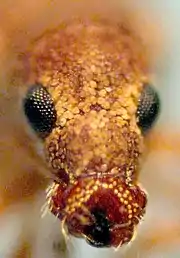 | |
| Head of Anypotactus exilis | |
| Scientific classification | |
| Kingdom: | |
| Phylum: | |
| Class: | |
| Order: | |
| Suborder: | |
| Infraorder: | |
| Superfamily: | |
| Family: | |
| Subfamily: | |
| Tribe: | Anypotactini Champion, 1911 |
| Genera | |
|
See text | |
Distribution
The tribe ranges from south-western USA (Texas) to Argentina and Chile and some Caribbean islands.[2] Most genera are distributed in Central America and northern South America, but the largest genus, Hyphantus Germar, 1824 [3] (45 species [4]), is distributed in southern Brazil, Argentina, Paraguay and Uruguay.
The Central american species were studied by Champion (1911).[5]
Diagnosis
Most anypotactines are small (approx. 4–11 mm), covered by brown scales, with some members of the genus Prepodellus covered by metallic green or blue scales.[6] The dorsal surface of the body usually bears thick and erect scale-like setae, rather uniformly distributed. Members of the genus Hyphantus tend to be larger and dark in coloration.[4]
Genera
- Anypotactus
- Bothinodontes
- Cylloproctus
- Helicorrhynchus
- Hyphantus
- Hypsometopus
- Neoanypotactus
- Nototactus
- Paonaupactus
- Phanasora
- Polydacrys
- Prepodellus
- Sitonites
References
- Wibmer, G. J.; O’Brien, C. W. (1986). "Annotated checklist of the weevils (Curculionidae sensu lato) of South America (Coleoptera: Curculionoidea)". Memoirs of the American Entomological Institute. 39: 1–563.
- Alonso-Zarazaga, M.A.; Lyal, C.H.C. (1999). A world catalogue of families and genera of Curculionoidea (Insecta: Coleoptera) (excepting Scolytidae and Platypodidae) (PDF). Barcelona, Spain: Entomopraxis. pp. 315 pp.
- Germar, E. F. (1824). Insectorum species novae aut minus cognitae, descriptionibus illustratae. Volumen primum. Coleoptera. Halae: J. C. Hendelii et filii. pp. xxiv + 624 pp. + 2 pl.
- Vaurie, Patricia (1963). "A revision of the South American genus Hyphantus (Coleoptera, Curculionidae, Otiorhynchinae)". Bulletin of the American Museum of Natural History. 125: 239–304.
- Sharp, D.; Champion, G. C. (1911). Rhynchophora. Curculionidae. Otiorhynchinae. Biologia Centrali-Americana. Insecta, Coleoptera. Vol. 4. Part: 3. London: R. H. Porter. pp. 354 pp. + 15 pl.
- Girón, J. C. (2020). "Status of knowledge of the broad-nosed weevils of Colombia (Coleoptera, Curculionidae, Entiminae)". Neotropical Biology and Conservation. 15(4): 583–674. doi:10.3897/neotropical.15.e59713. ISSN 2236-3777.
