Apostille Convention
The Hague Convention Abolishing the Requirement of Legalisation for Foreign Public Documents, the Apostille Convention, or the Apostille Treaty, is an international treaty drafted by the Hague Conference on Private International Law (HCCH). It specifies the modalities through which an official seal (e.g., notary public) on a document, issued in one of the contracting states, can be certified for legal purposes in all the other contracting states. A certification under the terms of the convention is called an apostille (from Latin post illa and then French: a marginal note) or Hague apostille.[2] It is an international certification comparable to a notarisation in domestic law, and normally supplements a local notarisation of the document. If the convention applies between two countries, such an apostille is sufficient to certify a document's validity, and removes the need for double-certification, by the originating country and then by the receiving country.
| Convention of 5 October 1961 Abolishing the Requirement of Legalisation for Foreign Public Documents | |
|---|---|
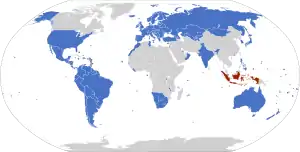 In force Ratified but not yet in force | |
| Signed | 5 October 1961 |
| Location | Hague, Netherlands |
| Effective | 24 January 1965 |
| Condition | Ratification by 3 signatories[1] |
| Parties | 121 |
| Depositary | Ministry of Foreign Affairs (Netherlands) |
| Languages | French (prevailing in case of divergence) and English |
| Full text | |
 Apostille Convention at Wikisource Apostille Convention at Wikisource | |
Procedure
Apostilles are affixed by Competent Authorities designated by the government of a state which is party to the convention.[3] A list of these authorities is maintained by the Hague Conference on Private International Law. Examples of designated authorities are embassies, ministries, courts or local governments. For example, in the United States, the Secretary of State of each state and their deputies are usually competent authorities. In the United Kingdom all apostilles are issued by the Foreign and Commonwealth Office in Milton Keynes.[4]
To be eligible for an apostille, a document must first be issued or certified by an officer recognised by the authority that will issue the apostille. For example, in the U.S. state of Vermont, the Secretary of State maintains specimen signatures of all notaries public, so documents that have been notarised are eligible for apostilles.[5] Likewise, courts in the Netherlands are eligible to place an apostille on all municipal civil status documents directly. In some cases, intermediate certifications may be required in the country in which the document originates before it is eligible for an apostille. For example, in New York City, the Office of Vital Records (which issues, among other things, birth certificates) is not directly recognised by the New York Secretary of State.[6] As a consequence, the signature of the City Clerk must be certified by the County Clerk of New York County to make the birth certificate eligible for an apostille.[7][8] In Japan all official documents are issued in Japanese; the Ministry of Foreign Affairs of Japan can then provide an apostille for these documents.[9] In India the apostille certification can be obtained from the Ministry of External Affairs[10] in New Delhi, after authentication by the administration of the Indian state where the document was issued (for educational documents).
Cost
The fee for issuing an apostille varies widely by country. In 2016, the HCCH compiled fees of 54 countries and calculated an average of 15.43 EUR.[11] Some countries, such as France and Japan, do not charge a fee,[12][13] while Australia charges 85 AUD,[14] one of the highest. In some countries, the fee also varies by location, authority, quantity, purpose or type of document. For example, in the United States, Indiana does not charge a fee for an apostille of a birth certificate,[15] while Connecticut charges 40 USD for an apostille not related to adoption.[16]
Information
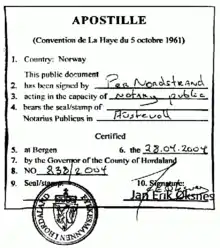
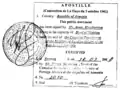
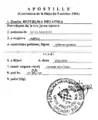
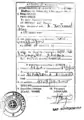
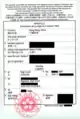
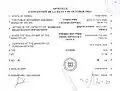
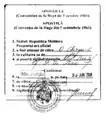
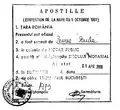
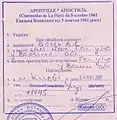
The apostille itself is a stamp or printed form consisting of ten numbered standard fields. At the top is the text Apostille, under which the text Convention de La Haye du 5 octobre 1961 (French for "Hague Convention of 5 October 1961") is placed. This title must be written in French for the apostille to be valid (article 4 of the convention). In the numbered fields, the following information is added, which may be in the official language of the authority that issues it or in a second language:
- Country ... [e.g. Hong Kong, China]
This public document - has been signed by [e.g. Henry CHO]
- acting in the capacity of [e.g. Notary Public]
- bears the seal/stamp of [e.g. High Court of Hong Kong]
Certified - at [either the authority giving the apostille or municipality, e.g. High Court]
- the ... [e.g. 16 April 2014]
- by ... [e.g. Louis TANG, Registrar, High Court]
- No ... [e.g. 2536218517]
- Seal/stamp ... [of the authority giving the apostille e.g. Emblem of Hong Kong Special Administrative Region]
- Signature [of the official giving the apostille]
The information can be placed on the document itself, on the back of the document, or attached to the document as an allonge.
Eligible documents
Four types of documents are mentioned in the convention:[1]
- court documents
- administrative documents (e.g. civil status documents)
- notarial acts
- official certificates which are placed on documents signed by persons in their private capacity, such as official certificates recording the registration of a document or the fact that it was in existence on a certain date and official and notarial authentications of signatures.
Legalization
A state that has not signed the convention must specify how foreign legal documents can be certified for its use. Two countries may have a special convention on the recognition of each other's public documents, but in practice this is infrequent. Otherwise, the document must be certified by the foreign ministry of the country in which the document originated, and then by the foreign ministry of the government of the state in which the document will be used; one of the certifications will often be performed at an embassy or consulate. In practice this means the document must be certified twice before it can have legal effect in the receiving country. For example, as Canada is not a signatory, Canadian documents for use abroad must be certified by the Deputy Minister of Foreign Affairs in Ottawa or by a Canadian consular official abroad, and subsequently by the relevant government office or consulate of the receiving state.[17]
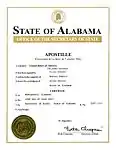 An apostille of the Hague issued by the State of Alabama
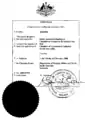
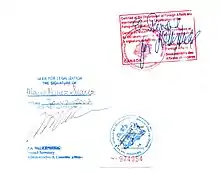 As Canada is a non-signatory, Canadian documents for use abroad must be certified twice: at the Canadian Ministry of Foreign Affairs and subsequently by the consulate of the receiving state (in this case, the Netherlands)
List of contracting states
As of October 2021, 121 states are contracting states of the Apostille Convention.[18]
The convention is in force between all contracting states, unless an existing party objects to the accession of a new state. In that case the convention enters into force for the new state, except between the new state and the objecting state(s).
| State party | Signed | Deposited | Entered into force |
|---|---|---|---|
 Albania[lower-alpha 1] Albania[lower-alpha 1] | — | 3 September 2003 | 9 May 2004 |
 Andorra Andorra | — | 15 April 1996 | 31 December 1996 |
 Antigua and Barbuda[lower-alpha 2] Antigua and Barbuda[lower-alpha 2] | — | 1 May 1985 | 1 November 1981 |
 Argentina[lower-alpha 3] Argentina[lower-alpha 3] | — | 8 May 1987 | 18 February 1988 |
 Armenia Armenia | — | 19 November 1993 | 14 August 1994 |
.svg.png.webp) Australia[lower-alpha 4] Australia[lower-alpha 4] | — | 11 July 1994 | 16 March 1995 |
 Austria[lower-alpha 5] Austria[lower-alpha 5] | 5 October 1961 | 14 November 1967 | 13 January 1968 |
 Azerbaijan[lower-alpha 6] Azerbaijan[lower-alpha 6] | — | 13 May 2004 | 2 March 2005 |
 Bahamas[lower-alpha 2] Bahamas[lower-alpha 2] | — | 30 April 1976 | 10 July 1973 |
 Bahrain Bahrain | — | 10 April 2013 | 31 December 2013 |
 Barbados[lower-alpha 2] Barbados[lower-alpha 2] | — | 11 August 1995 | 30 November 1966 |
 Belarus[lower-alpha 7] Belarus[lower-alpha 7] | — | 16 June 1992 | 31 May 1992 |
.svg.png.webp) Belgium Belgium | 10 March 1970 | 11 December 1975 | 9 February 1976 |
 Belize Belize | — | 17 July 1992 | 11 April 1993 |
.svg.png.webp) Bolivia Bolivia | — | 6 September 2017 | 7 May 2018 |
 Bosnia and Herzegovina[lower-alpha 8] Bosnia and Herzegovina[lower-alpha 8] | — | 23 August 1993 | 6 March 1992 |
 Botswana[lower-alpha 2] Botswana[lower-alpha 2] | — | 16 September 1968 | 30 September 1966 |
 Brazil Brazil | — | 2 December 2015 | 14 August 2016 |
 Brunei[lower-alpha 9] Brunei[lower-alpha 9] | — | 23 February 1987 | 3 December 1987 |
 Bulgaria Bulgaria | — | 1 August 2000 | 29 April 2001 |
 Burundi[lower-alpha 10] Burundi[lower-alpha 10] | — | 10 June 2014 | 13 February 2015 |
 Cape Verde[lower-alpha 11] Cape Verde[lower-alpha 11] | — | 7 May 2009 | 13 February 2010 |
 Chile Chile | — | 16 December 2015 | 30 August 2016 |
 China[lower-alpha 12] China[lower-alpha 12] | — | — | — |
 Colombia Colombia | — | 27 April 2000 | 30 January 2001 |
 Cook Islands Cook Islands | — | 13 July 2004 | 30 April 2005 |
 Costa Rica Costa Rica | — | 6 April 2011 | 14 December 2011 |
 Croatia[lower-alpha 8] Croatia[lower-alpha 8] | — | 23 April 1993 | 8 October 1991 |
 Cyprus Cyprus | — | 26 July 1972 | 30 April 1973 |
 Czech Republic Czech Republic | — | 23 June 1998 | 16 March 1999 |
 Denmark[lower-alpha 13] Denmark[lower-alpha 13] | 20 October 2006 | 30 October 2006 | 29 December 2006 |
 Dominica[lower-alpha 2] Dominica[lower-alpha 2] | — | 22 October 2002 | 3 November 1978 |
 Dominican Republic[lower-alpha 14] Dominican Republic[lower-alpha 14] | — | 12 December 2008 | 30 August 2009 |
 Ecuador Ecuador | — | 2 July 2004 | 2 April 2005 |
 El Salvador El Salvador | — | 14 September 1995 | 31 May 1996 |
 Estonia[lower-alpha 5] Estonia[lower-alpha 5] | — | 11 December 2000 | 30 September 2001 |
 Eswatini[lower-alpha 2] Eswatini[lower-alpha 2] | — | 3 July 1978 | 6 September 1968 |
 Fiji[lower-alpha 2] Fiji[lower-alpha 2] | — | 29 March 1971 | 10 October 1970 |
 Finland[lower-alpha 5] Finland[lower-alpha 5] | 13 March 1962 | 27 June 1985 | 26 August 1985 |
 France[lower-alpha 15] France[lower-alpha 15] | 9 October 1961 | 25 November 1964 | 24 January 1965 |
 Georgia[lower-alpha 16] Georgia[lower-alpha 16] | — | 21 August 2006 | 14 May 2007 |
 Germany[lower-alpha 17] Germany[lower-alpha 17] | 5 October 1961 | 15 December 1965 | 13 February 1966 |
 Greece Greece | 5 October 1961 | 19 March 1985 | 18 May 1985 |
 Grenada[lower-alpha 9] Grenada[lower-alpha 9] | — | 17 July 2001 | 7 April 2002 |
 Guatemala Guatemala | — | 19 January 2017 | 18 September 2017 |
 Guyana[lower-alpha 9] Guyana[lower-alpha 9] | — | 30 July 2018 | 18 April 2019 |
 Honduras Honduras | — | 20 January 2004 | 30 September 2004 |
 Hungary Hungary | — | 18 April 1972 | 18 January 1973 |
 Iceland Iceland | 7 September 2004 | 28 September 2004 | 27 November 2004 |
 India[lower-alpha 18] India[lower-alpha 18] | — | 26 October 2004 | 14 July 2005 |
 Indonesia Indonesia | — | 5 October 2021 | 4 June 2022 |
 Ireland Ireland | 29 October 1996 | 8 January 1999 | 9 March 1999 |
 Israel Israel | — | 11 November 1977 | 14 August 1978 |
 Italy Italy | 15 December 1961 | 13 December 1977 | 11 February 1978 |
 Jamaica Jamaica | — | 2 November 2020 | 3 July 2021 |
 Japan Japan | 12 March 1970 | 28 May 1970 | 27 July 1970 |
 Kazakhstan Kazakhstan | — | 5 April 2000 | 30 January 2001 |
 Kosovo[lower-alpha 19] Kosovo[lower-alpha 19] | — | 6 November 2015 | 14 July 2016 |
 Kyrgyzstan[lower-alpha 20] Kyrgyzstan[lower-alpha 20] | — | 15 November 2010 | 31 July 2011 |
 Latvia[lower-alpha 5] Latvia[lower-alpha 5] | — | 11 May 1995 | 30 January 1996 |
 Lesotho[lower-alpha 2] Lesotho[lower-alpha 2] | — | 24 April 1972 | 4 October 1966 |
 Liberia[lower-alpha 21] Liberia[lower-alpha 21] | — | 24 May 1995 | 8 February 1996 |
 Liechtenstein Liechtenstein | 18 April 1962 | 19 July 1972 | 17 September 1972 |
 Lithuania[lower-alpha 5] Lithuania[lower-alpha 5] | — | 5 November 1996 | 19 July 1997 |
 Luxembourg Luxembourg | 5 October 1961 | 4 April 1979 | 3 June 1979 |
 Malawi Malawi | — | 24 February 1967 | 2 December 1967 |
 Malta Malta | — | 12 June 1967 | 3 March 1968 |
 Marshall Islands Marshall Islands | — | 18 November 1991 | 14 August 1992 |
 Mauritius[lower-alpha 2] Mauritius[lower-alpha 2] | — | 20 December 1968 | 12 March 1968 |
 Mexico Mexico | — | 1 December 1994 | 14 August 1995 |
 Moldova[lower-alpha 22] Moldova[lower-alpha 22] | — | 19 June 2006 | 16 March 2007 |
 Monaco Monaco | — | 24 April 2002 | 31 December 2002 |
 Mongolia[lower-alpha 23] Mongolia[lower-alpha 23] | — | 2 April 2009 | 31 December 2009 |
 Montenegro[lower-alpha 8] Montenegro[lower-alpha 8] | — | 30 January 2007 | 3 June 2006 |
 Morocco[lower-alpha 24] Morocco[lower-alpha 24] | — | 27 November 2015 | 14 August 2016 |
 Namibia Namibia | — | 25 April 2000 | 30 January 2001 |
 Netherlands[lower-alpha 25] Netherlands[lower-alpha 25] | 30 November 1962 | 9 August 1965 | 8 October 1965 |
 New Zealand[lower-alpha 26] New Zealand[lower-alpha 26] | — | 7 February 2001 | 22 November 2001 |
 Nicaragua Nicaragua | — | 7 September 2012 | 14 May 2013 |
 Niue Niue | — | 10 June 1998 | 2 March 1999 |
 North Macedonia[lower-alpha 8] North Macedonia[lower-alpha 8] | — | 20 September 1993 | 17 November 1991 |
 Norway Norway | 30 May 1983 | 30 May 1983 | 29 July 1983 |
 Oman Oman | — | 12 May 2011 | 30 January 2012 |
 Palau Palau | — | 17 October 2019 | 23 June 2020 |
 Panama Panama | — | 30 October 1990 | 4 August 1991 |
 Paraguay[lower-alpha 27] Paraguay[lower-alpha 27] | — | 10 December 2013 | 30 August 2014 |
 Peru[lower-alpha 28] Peru[lower-alpha 28] | — | 13 January 2010 | 30 September 2010 |
 Philippines[lower-alpha 29] Philippines[lower-alpha 29] | — | 12 September 2018 | 14 May 2019 |
 Poland[lower-alpha 5] Poland[lower-alpha 5] | — | 19 November 2004 | 14 August 2005 |
 Portugal[lower-alpha 11][lower-alpha 12][lower-alpha 5] Portugal[lower-alpha 11][lower-alpha 12][lower-alpha 5] | 20 August 1965 | 6 December 1968 | 4 February 1969 |
 Romania[lower-alpha 5] Romania[lower-alpha 5] | — | 7 June 2000 | 16 March 2001 |
 Russia[lower-alpha 30] Russia[lower-alpha 30] | — | 4 September 1991 | 31 May 1992 |
 Saint Kitts and Nevis[lower-alpha 9] Saint Kitts and Nevis[lower-alpha 9] | — | 26 February 1994 | 14 December 1994 |
 Saint Lucia[lower-alpha 9] Saint Lucia[lower-alpha 9] | — | 5 December 2001 | 31 July 2002 |
 Saint Vincent and the Grenadines[lower-alpha 2] Saint Vincent and the Grenadines[lower-alpha 2] | — | 2 May 2002 | 27 October 1979 |
 Samoa Samoa | — | 18 January 1999 | 13 September 1999 |
 San Marino San Marino | — | 26 May 1994 | 13 February 1995 |
 São Tomé and Príncipe[lower-alpha 11] São Tomé and Príncipe[lower-alpha 11] | — | 19 December 2007 | 13 September 2008 |
 Serbia[lower-alpha 8] Serbia[lower-alpha 8] | — | 26 April 2001 | 27 April 1992 |
 Seychelles Seychelles | — | 9 June 1978 | 31 March 1979 |
 Singapore Singapore | — | 18 January 2021 | 16 September 2021 |
 Slovakia Slovakia | — | 6 June 2001 | 18 February 2002 |
 Slovenia[lower-alpha 8] Slovenia[lower-alpha 8] | — | 8 June 1992 | 25 June 1991 |
 South Africa South Africa | — | 3 August 1994 | 30 April 1995 |
 South Korea South Korea | — | 25 October 2006 | 14 July 2007 |
 Spain Spain | 21 October 1976 | 27 July 1978 | 25 September 1978 |
 Suriname[lower-alpha 31] Suriname[lower-alpha 31] | — | 29 October 1976 | 25 November 1975 |
 Sweden Sweden | 2 March 1999 | 2 March 1999 | 1 May 1999 |
 Switzerland Switzerland | 5 October 1961 | 10 January 1973 | 11 March 1973 |
 Tajikistan[lower-alpha 32] Tajikistan[lower-alpha 32] | — | 20 February 2015 | 31 October 2015 |
 Tonga[lower-alpha 2] Tonga[lower-alpha 2] | — | 28 October 1971 | 4 June 1970 |
 Trinidad and Tobago Trinidad and Tobago | — | 28 October 1999 | 14 July 2000 |
 Tunisia[lower-alpha 33] Tunisia[lower-alpha 33] | — | 10 July 2017 | 30 March 2018 |
 Turkey Turkey | 8 May 1962 | 31 July 1985 | 29 September 1985 |
 Ukraine[lower-alpha 34][lower-alpha 5] Ukraine[lower-alpha 34][lower-alpha 5] | — | 2 April 2003 | 22 December 2003 |
 United Kingdom[lower-alpha 35][lower-alpha 12] United Kingdom[lower-alpha 35][lower-alpha 12] | 19 October 1961 | 21 August 1964 | 24 January 1965 |
 United States[lower-alpha 36] United States[lower-alpha 36] | — | 24 December 1980 | 15 October 1981 |
 Uruguay Uruguay | — | 9 February 2012 | 14 October 2012 |
 Uzbekistan[lower-alpha 37] Uzbekistan[lower-alpha 37] | — | 25 July 2011 | 15 April 2012 |
 Vanuatu[lower-alpha 38] Vanuatu[lower-alpha 38] | — | 1 August 2008 | 30 July 1980 |
 Venezuela Venezuela | — | 1 July 1998 | 16 March 1999 |
Notes
- The convention entered into force between Albania and the following contracting states on different dates: Belgium on 21 December 2015, Germany on 9 December 2016, Greece on 26 February 2018, Italy on 26 May 2011, and Spain on 7 February 2017.[19]
- The United Kingdom extended the convention to the predecessor of this country effective 25 April 1965. Following its independence, the country declared itself to continue to be bound by the convention.[20]
- Argentina objected to the extension of the convention by the United Kingdom to the Falkland Islands, South Georgia and the South Sandwich Islands, and the British Antarctic Territory.[21]
- Australia extended the convention to all of its territories upon its accession.[22]
- Austria, Estonia, Finland, Latvia, Lithuania, Poland, Portugal, Romania and Ukraine declared that they would not accept documents issued under the convention by the Russian authorities in Crimea and Sevastopol.[59][60][61][62][63][64][53][65][66] Poland and Ukraine also declared that they would not accept documents issued by the authorities of the Donetsk and Luhansk People's Republics.[64][66]
- The convention is not in force between Azerbaijan and Germany. The convention entered into force between Azerbaijan and the following contracting states on different dates: Hungary on 10 March 2005, and the Netherlands on 10 August 2010.[23]
- Belarus declared itself bound by the convention as one of the successor states of the Soviet Union.[24]
- Yugoslavia signed the convention on 5 October 1961, ratified it on 25 September 1962, and it entered into force for Yugoslavia on 24 January 1965.[25] Following its dissolution, the successor states of Bosnia and Herzegovina, Croatia, North Macedonia, Serbia and Montenegro, and Slovenia declared themselves bound by the convention.[26][27][28][29][30] Following the dissolution of Serbia and Montenegro, the continuator state of Serbia and the successor state of Montenegro declared themselves bound by the convention.[31]
- The United Kingdom extended the convention to the predecessor of this country effective 25 April 1965. Following its independence, the country did not declare to continue to be bound by the convention, but acceded to the convention at a later date.[20]
- The convention is not in force between Burundi and the following contracting states: Austria, Czech Republic, Germany, and Poland.[32]
- Portugal extended the convention to all of its external territories on 21 December 1969.[53] These territories included the predecessors of Cape Verde and São Tomé and Príncipe, which did not declare to continue to be bound by the convention following their independence but acceded to the convention at a later date, and of Angola, East Timor, Guinea-Bissau and Mozambique, which have not declared to be bound to the convention following their independence or acceded to the convention.[25]
- The convention is only in force for China in Hong Kong and Macau. The United Kingdom extended the convention to Hong Kong on 25 April 1965, and Portugal extended the convention to Macau on 21 December 1969.[25] China declared that the convention would continue to be in force for both territories following their respective transfer to China.[33]
- Denmark extended the convention to the Faroe Islands effective 13 December 2021.[34] It has not extended the convention to Greenland.[35]
- The convention is not in force between the Dominican Republic and the following contracting states: Austria and Germany. The convention entered into force between the Dominican Republic and the following contracting states on different dates: Belgium on 8 March 2019, and the Netherlands on 3 November 2017.[36]
- France extended the convention to all of its territories upon its ratification.[37] These territories included the predecessors of Comoros and Djibouti, which have not declared to be bound to the convention following their independence or acceded to the convention.[25]
- The convention entered into force between Georgia and the following contracting states on different dates: Germany on 3 February 2010, and Greece on 17 December 2015.[38] The convention does not apply to documents issued by Abkhazia and South Ossetia.[39]
- Germany ratified the convention as West Germany. Following its reunification with East Germany on 3 October 1990, it declared that the convention applied to the entire territory of Germany.[40]
- The convention is not in force between India and Germany. The convention entered into force between India and the following contracting states on different dates: Belgium on 9 January 2008, Finland on 5 October 2009, the Netherlands on 16 September 2008, and Spain on 12 February 2008.[41]
- The convention is not in force between Kosovo and the following contracting states: Argentina, Armenia, Austria, Azerbaijan, Belarus, Brazil, Chile, China, Cyprus, Ecuador, Georgia, Germany, Greece, India, Israel, Mauritius, Mexico, Moldova, Namibia, Nicaragua, Paraguay, Peru, Poland, Romania, Russia, Serbia, Slovakia, Spain, Ukraine, Uzbekistan, and Venezuela.[42]
- The convention is not in force between Kyrgyzstan and the following contracting states: Austria, Belgium, Germany, and Greece.[43]
- The convention is not in force between Liberia and the following contracting states: Belgium and Germany. The convention entered into force between Liberia and the United States on 20 May 2015.[44]
- The convention is not in force between Moldova and Germany.[45]
- The convention is not in force between Mongolia and the following contracting states: Austria, Belgium, Finland, Germany, and Greece.[46]
- The convention is not in force between Morocco and Germany.[47]
- Dates are for the European part. The convention was extended to the Netherlands Antilles (predecessor of Aruba, Curaçao, Sint Maarten, as well as Bonaire, Sint Eustatius and Saba) from 30 April 1967.[25]
- New Zealand has not extended the convention to Tokelau.[48]
- The convention is not in force between Paraguay and Germany.[49]
- The convention is not in force between Peru and Greece. The convention entered into force between Peru and Germany on 1 January 2014.[50]
- The convention is not in force between the Philippines and the following contracting states: Austria, Finland, Germany, and Greece.[51] The Philippines declared that its accession would not apply to contracting parties that it does not recognize as states,[52] which is the case of Kosovo.
- Russia declared itself bound by the convention as the continuator of the Soviet Union.[54]
- The Netherlands extended the convention to Suriname on 16 May 1967. Following its independence, Suriname declared itself to continue to be bound by the convention.[55]
- The convention is not in force between Tajikistan and the following contracting states: Austria, Belgium, and Germany.[56]
- The convention is not in force between Tunisia and the following contracting states: Austria, Belgium, Germany, and Greece.[57]
- The convention entered into force between Ukraine and the following contracting states on different dates: Belgium on 5 July 2004 and Germany on 22 July 2010.[58]
- The United Kingdom extended the convention, effective 24 January 1965, to the Crown dependencies of Guernsey, Isle of Man and Jersey, and effective 25 April 1965, to the British Overseas Territories of Anguilla, Bermuda, British Antarctic Territory, British Virgin Islands, Cayman Islands, Falkland Islands (including the South Georgia and the South Sandwich Islands, which later became a separate territory and continued to apply the convention[67]), Gibraltar, Montserrat, Saint Helena, Ascension and Tristan da Cunha, and Turks and Caicos Islands,[68] as well as to the predecessors of several countries. These countries declared themselves to continue to be bound to the convention following their independence or later acceded to the convention, except for Kiribati (gained independence on 12 July 1979), the Solomon Islands (7 July 1978), Tuvalu (1 October 1978), and Zimbabwe (18 April 1980).[20]
- The United States has not declared territorial extensions but it has designated competent authorities in all of its permanently inhabited territories.[69]
- The convention is not in force between Uzbekistan and the following contracting states: Austria, Belgium, Germany, and Greece.[70]
- France and the United Kingdom extended the convention to the New Hebrides effective 15 February 1966. Following its independence, Vanuatu declared itself to continue to be bound by the convention.[37][71]
Abuse
The apostille does not give information regarding the quality of the content in the underlying document but certifies the signature (and the capacity of who placed it) and correctness of the seal/stamp on the document which must be certified. In 2005, the Hague Conference surveyed its members and produced a report in December 2008 which expressed serious concerns about diplomas and degree certificates issued by diploma mills. The possible abuse of the system was highlighted: "Particularly troubling is the possible use of diploma mill qualifications to circumvent migration controls, possibly by potential terrorists." (page 5) The risk comes from the fact that the various government stamps give the document an air of authenticity without anyone having checked the underlying document. "An official looking certificate may be issued to a copy of a diploma mill qualification, and then subsequently issued with an apostille, without anyone having ever verified the signature on, let alone the contents of, the diploma." (page 7) Further member states indicated "they would be obliged to issue an apostille for certification of a certified copy of a diploma issued by a diploma mill". (page 15) The evaluation commission of the Hague Conference expressed concern as to whether this issue could affect the entire convention. "... the apostille does not 'look through the certification' and does not relate to the diploma itself ... There is a clear risk that such practices may eventually undermine the effectiveness and therefore the successful operation of the apostille Convention". (page 5)[72]
In February 2009, the Hague Conference recommended to amend the wording on the apostille to make it clear that only the seal and the signature were authenticated. The wording to be added is:
This apostille only certifies the signature, the capacity of the signer and the seal or stamp it bears. It does not certify the content of the document for which it was issued."[2]
Validity
Technically, an apostille never expires once issued. However, there are some factors which may render an apostilled document unusable in certain situations. A document or certificate with an apostille acquired outside of the convention may need to be re-processed before use. For example, for a work permit in China, the apostille on documentation must have been issued within the past six months in order to be valid for the application.[73]
Further stages of legalisation
Some Apostille Convention member states require additional stages after an apostille, dependent on use. For marriage in Greece, for example, a translation of the apostilled documents is required, which must be verified at a Greek consulate[74] before the documents can be presented for the marriage licence in-country. It's advisable to confirm the requirements in each and every case.
Gallery of apostilles by country
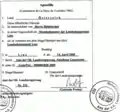
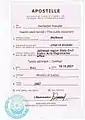
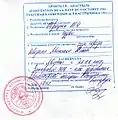
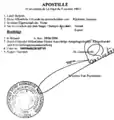
See also
References
- "12: Convention of 5 October 1961 Abolishing the Requirement of Legalisation for Foreign Public Documents". Hague Conference on Private International Law. Retrieved 16 January 2011.
- Permanent Bureau (February 2009). "Conclusions and Recommendations of the Special Commission on the Practical Operation of the Hague Apostille, Service, Taking of Evidence, and Access to Justice Conventions" (PDF). Hague Conference on Private International Law. p. 13.
- "ABCs of Apostilles p. 13" (PDF). Hague Conference on Private International Law.
- "United Kingdom, Competent Authorities". Hague Conference on Private International Law. Retrieved 9 March 2011.
- Authentication Archived 30 July 2010 at the Wayback Machine 2009
- Birth certificate application Archived 4 June 2010 at the Wayback Machine 2010
- Crampton 2007
- Apostiles Archived 24 July 2010 at the Wayback Machine n.d.
- Apostille, MOFA Japan (website in Japanese)
- MEA, India Legalisation of Documents.
- Overview of apostille fees, Hague Conference on Private International Law, October 2016.
- Legalization or apostille of a French document for a foreign authority, Ministry of the Interior of France, 3 September 2021 (in French).
- Certification, Frequently Asked Questions, Ministry of Foreign Affairs of Japan, 22 June 2020.
- Notarial services (legalising documents) in Australia, Australian Department of Foreign Affairs and Trade.
- Authentications: Apostilles & Certifications, Government of Indiana.
- Document Authentication and Apostille, Connecticut Secretary of State.
- Deputy Minister of Foreign Affairs, Canada
- "Convention of 5 October 1961 Abolishing the Requirement of Legalisation for Foreign Public Documents: Status Table". HCCH. 5 October 2021. Retrieved 21 November 2021.
- "Convention of 5 October 1961 Abolishing the Requirement of Legalisation for Foreign Public Documents: Albania Accession". HCCH. Retrieved 1 February 2021.
- "Convention of 5 October 1961 Abolishing the Requirement of Legalisation for Foreign Public Documents: United Kingdom Declarations". HCCH. Retrieved 1 February 2021.
- Declarations by Argentina, Convention of 5 October 1961 Abolishing the Requirement of Legalisation for Foreign Public Documents, Hague Conference on Private International Law.
- "Convention of 5 October 1961 Abolishing the Requirement of Legalisation for Foreign Public Documents: Australia Declaration". HCCH. Retrieved 1 February 2021.
- "Convention of 5 October 1961 Abolishing the Requirement of Legalisation for Foreign Public Documents: Azerbaijan Accession". HCCH. Retrieved 1 February 2021.
- "Convention of 5 October 1961 Abolishing the Requirement of Legalisation for Foreign Public Documents: Belarus Succession". HCCH. Retrieved 1 February 2021.
- "Convention abolishing the requirement of legalisation for foreign public documents: Treaty data". Treaty database of the Netherlands. Retrieved 1 February 2021.
- "Convention of 5 October 1961 Abolishing the Requirement of Legalisation for Foreign Public Documents: Bosnia and Herzegovina Succession". HCCH. Retrieved 1 February 2021.
- "Convention of 5 October 1961 Abolishing the Requirement of Legalisation for Foreign Public Documents: Croatia Succession". HCCH. Retrieved 1 February 2021.
- "Convention of 5 October 1961 Abolishing the Requirement of Legalisation for Foreign Public Documents: North Macedonia Succession". HCCH. Retrieved 1 February 2021.
- "Convention of 5 October 1961 Abolishing the Requirement of Legalisation for Foreign Public Documents: Serbia Succession". HCCH. Retrieved 1 February 2021.
- "Convention of 5 October 1961 Abolishing the Requirement of Legalisation for Foreign Public Documents: Slovenia Succession". HCCH. Retrieved 1 February 2021.
- "Convention of 5 October 1961 Abolishing the Requirement of Legalisation for Foreign Public Documents: Montenegro Succession". HCCH. Retrieved 1 February 2021.
- "Convention of 5 October 1961 Abolishing the Requirement of Legalisation for Foreign Public Documents: Burundi Accession". HCCH. Retrieved 1 February 2021.
- "Convention of 5 October 1961 Abolishing the Requirement of Legalisation for Foreign Public Documents: China Continuation". HCCH. Retrieved 1 February 2021.
- Extensions by Denmark, Convention of 5 October 1961 Abolishing the Requirement of Legalisation for Foreign Public Documents, Hague Conference on Private International Law.
- "Convention of 5 October 1961 Abolishing the Requirement of Legalisation for Foreign Public Documents: Denmark Declarations". HCCH. Retrieved 21 November 2021.
- "Convention of 5 October 1961 Abolishing the Requirement of Legalisation for Foreign Public Documents: Dominican Republic Accession". HCCH. Retrieved 1 February 2021.
- "Convention of 5 October 1961 Abolishing the Requirement of Legalisation for Foreign Public Documents: France Declarations". HCCH. Retrieved 1 February 2021.
- "Convention of 5 October 1961 Abolishing the Requirement of Legalisation for Foreign Public Documents: Georgia Accession". HCCH. Retrieved 1 February 2021.
- Declarations by Georgia, Convention of 5 October 1961 Abolishing the Requirement of Legalisation for Foreign Public Documents, Hague Conference on Private International Law.
- "Convention of 5 October 1961 Abolishing the Requirement of Legalisation for Foreign Public Documents: Germany Declarations/Notifications". HCCH. Retrieved 1 February 2021.
- "Convention of 5 October 1961 Abolishing the Requirement of Legalisation for Foreign Public Documents: India Accession". HCCH. Retrieved 1 February 2021.
- "Convention of 5 October 1961 Abolishing the Requirement of Legalisation for Foreign Public Documents: Kosovo Accession". HCCH. Retrieved 1 February 2021.
- "Convention of 5 October 1961 Abolishing the Requirement of Legalisation for Foreign Public Documents: Kyrgyzstan Accession". HCCH. Retrieved 1 February 2021.
- "Convention of 5 October 1961 Abolishing the Requirement of Legalisation for Foreign Public Documents: Liberia Accession". HCCH. Retrieved 1 February 2021.
- "Convention of 5 October 1961 Abolishing the Requirement of Legalisation for Foreign Public Documents: Moldova Accession". HCCH. Retrieved 1 February 2021.
- "Convention of 5 October 1961 Abolishing the Requirement of Legalisation for Foreign Public Documents: Mongolia Accession". HCCH. Retrieved 1 February 2021.
- "Convention of 5 October 1961 Abolishing the Requirement of Legalisation for Foreign Public Documents: Morocco Accession". HCCH. Retrieved 1 February 2021.
- "Convention of 5 October 1961 Abolishing the Requirement of Legalisation for Foreign Public Documents: New Zealand Declarations". HCCH. Retrieved 1 February 2021.
- "Convention of 5 October 1961 Abolishing the Requirement of Legalisation for Foreign Public Documents: Paraguay Accession". HCCH. Retrieved 1 February 2021.
- "Convention of 5 October 1961 Abolishing the Requirement of Legalisation for Foreign Public Documents: Peru Accession". HCCH. Retrieved 1 February 2021.
- "Convention of 5 October 1961 Abolishing the Requirement of Legalisation for Foreign Public Documents: Philippines Accession". HCCH. Retrieved 1 February 2021.
- Declarations by the Philippines, Convention of 5 October 1961 Abolishing the Requirement of Legalisation for Foreign Public Documents, Hague Conference on Private International Law.
- "Convention of 5 October 1961 Abolishing the Requirement of Legalisation for Foreign Public Documents: Portugal Declarations". HCCH. Retrieved 1 February 2021.
- "Convention of 5 October 1961 Abolishing the Requirement of Legalisation for Foreign Public Documents: Russia Declarations/Notifications". HCCH. Retrieved 1 February 2021.
- "Convention of 5 October 1961 Abolishing the Requirement of Legalisation for Foreign Public Documents: Suriname Succession". HCCH. Retrieved 1 February 2021.
- "Convention of 5 October 1961 Abolishing the Requirement of Legalisation for Foreign Public Documents: Tajikistan Accession". HCCH. Retrieved 1 February 2021.
- "Convention of 5 October 1961 Abolishing the Requirement of Legalisation for Foreign Public Documents: Tunisia Accession". HCCH. Retrieved 1 February 2021.
- "Convention of 5 October 1961 Abolishing the Requirement of Legalisation for Foreign Public Documents: Ukraine Accession". HCCH. Retrieved 1 February 2021.
- Declarations by Austria, Convention of 5 October 1961 Abolishing the Requirement of Legalisation for Foreign Public Documents, Hague Conference on Private International Law.
- Declarations by Estonia, Convention of 5 October 1961 Abolishing the Requirement of Legalisation for Foreign Public Documents, Hague Conference on Private International Law.
- Declarations by Finland, Convention of 5 October 1961 Abolishing the Requirement of Legalisation for Foreign Public Documents, Hague Conference on Private International Law.
- Declarations by Latvia, Convention of 5 October 1961 Abolishing the Requirement of Legalisation for Foreign Public Documents, Hague Conference on Private International Law.
- Declarations by Lithuania, Convention of 5 October 1961 Abolishing the Requirement of Legalisation for Foreign Public Documents, Hague Conference on Private International Law.
- Declarations by Poland, Convention of 5 October 1961 Abolishing the Requirement of Legalisation for Foreign Public Documents, Hague Conference on Private International Law.
- Declarations by Romania, Convention of 5 October 1961 Abolishing the Requirement of Legalisation for Foreign Public Documents, Hague Conference on Private International Law.
- Declarations by Ukraine, Convention of 5 October 1961 Abolishing the Requirement of Legalisation for Foreign Public Documents, Hague Conference on Private International Law.
- United Kingdom - Competent Authority, Convention of 5 October 1961 Abolishing the Requirement of Legalisation for Foreign Public Documents, Hague Conference on Private International Law, 11 February 2021.
- "Convention of 5 October 1961 Abolishing the Requirement of Legalisation for Foreign Public Documents: United Kingdom Extensions". HCCH. Retrieved 1 February 2021.
- United States of America - Competent Authority, Convention of 5 October 1961 Abolishing the Requirement of Legalisation for Foreign Public Documents, Hague Conference on Private International Law, 9 June 2021.
- "Convention of 5 October 1961 Abolishing the Requirement of Legalisation for Foreign Public Documents: Uzbekistan Accession". HCCH. Retrieved 1 February 2021.
- "Convention of 5 October 1961 Abolishing the Requirement of Legalisation for Foreign Public Documents: Vanuatu Succession". HCCH. Retrieved 1 February 2021.
- Permanent Bureau (December 2008). "The application of the Apostille Convention to diplomas including those issued by diploma mills" (PDF). Hague Conference on Private International Law.
- Clarke, Melanie (May 2020). "UK Apostille Services". Vital Consular.
- Consular notarisations for Greece