Arc card
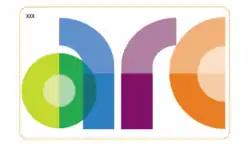
The Arc card is a contactless smart card and automated fare collection system being introduced to transit services in the Edmonton Metropolitan Region.[1] The initial launch started in the last week of August, 2021, when U-Pass holders began receiving Arc Cards from their respective institutions.[2] The second phase of the launch, which will encompass adult-fare users and transit staff, is scheduled to occur sometime in 2021.[2] All other fare groups will be onboarded to the Arc system at some point in 2022 during phase three, with the specific timeframe depending on the results of the previous two phases.[2]
 | |
| Location | Edmonton Metropolitan Region |
|---|---|
| Launched | Q3 2021 (Pilot) |
| Operator | Vix Technology |
| Currency | CAD |
| Auto recharge | Autoload |
| Validity | |
| Retailed |
|
| Website | myarc |
History
In 2003, Edmonton installed new fare vending machines in its LRT network which were capable of accepting credit, debit, and smart cards.[3] Edmonton Transit Service (ETS) later completed a two-month pilot of smart fare technology from Cubic Transport Systems on its LRT network.[4] Known as "ETS Blue," the pilot was approved in 2007 at a cost of $600,000, and involved 200 staff members from the University of Alberta using modified OneCards to tap the readers in the fare vending machines when entering and leaving LRT stations.[4] Participants did not pay their fare during the pilot, which occurred in summer 2009.[4] The demonstration was highly successful, with 99% of participants using their card "all the time" on the LRT, over 25% indicating that they used transit more frequently than before they had a smart card, 100% replacing some of their vehicle trips with LRT usage, and over 90% being satisfied with the technology and wanting it to be expanded across the transit network.[4] Despite this success however, ETS Blue was not trialed beyond August 2009 or expanded to include ETS bus routes. In a report published after the pilot's conclusion, the city identified smart fare technology as a top priority for the Capital Region transit network plan.[4]
Edmonton began looking into smart fare technology once again in 2014, with ETS planning to install the necessary equipment by 2015.[5] In 2015, the Alberta government approved funding for a region-wide smart fare program which was projected to cost approximately $51.6 million.[6] Edmonton, St. Albert, and Strathcona County also contributed funds towards the program.[6] Vix Technology was selected to install the smart fare equipment.[7] Edmonton Mayor Don Iveson expressed hope for smart fare to become publicly available in 2016.[8] The system was later expected to start operating in the second half of 2020, but the launch was later delayed until 2021.[8] The project was further delayed by the closure of the Canada-US border as a result of the COVID-19 pandemic.[6]
The Arc card brand was unveiled on June 8, 2021.[1] At the same time, Edmonton opened applications for the Arc pilot, which will involve up to 600 participants from Edmonton, St. Albert, and Strathcona County.[2] Arc is expected to be fully operational in 2022.[1]
Card use
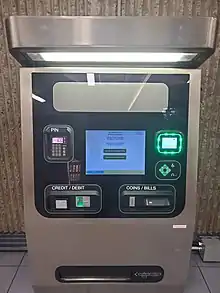
Arc cards and Arc tickets will be available for purchase at fare vending machines located at major destinations throughout the region, such as transit centres and LRT stations, and the Edmonton International Airport.[2] These machines will accept credit and debit cards, and cash.[2] Other locations where Arc cards and Arc tickets can be purchased will be announced later in 2021.[2] Riders will be able to reload their cards at fare vending machines and online, and they will also have the option of enabling 'auto-load' so that their balance is topped up whenever it falls below a specific threshold.[9]
Each rider's balance will be stored on their online account rather than on their card itself, enabling riders to continue using their balance after replacing lost or stolen cards.[1] The program will also include daily and monthly fare capping to reward frequent riders; when someone spends above a certain daily or monthly limit, they will be able to ride for the remaining duration of that period for free.[10] Arc tickets work similarly to Arc cards, but are one-time use only.[2] Once the Arc system is fully live, riders will still be able to pay their fare using cash, tickets, and paper passes.[1]
Rollout
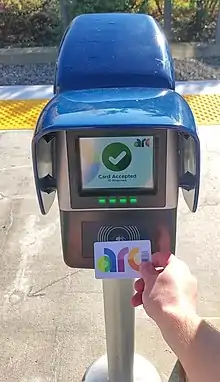
The Arc system is currently in phase one of a three phase rollout.[2] The program's launch was delayed in the summer of 2021; the limited pilot featuring multiple fare categories was changed to a full rollout to U-Pass users, with other fare groups now being excluded.[2]
Phase one: Early launch
Phase one, also known as the early launch, involves the transition of the U-Pass system to Arc Card delivery.[2] Previously, U-Passes were delivered via special stickers placed on student-ID cards.[2] Students at MacEwan University, Norquest College, and the University of Alberta use Arc Cards,[11][12][13] while students attending the Northern Alberta Institute of Technology (NAIT) have student-ID cards with Arc Card technology integrated into them; making NAIT the first post-secondary institution in Canada to have such an arrangement.[14] Students at NAIT and Norquest began using the Arc system in August 2021,[14][12] while MacEwan University and the University of Alberta began distributing Arc Cards in September 2021.[11][13] All four schools completed the transition to Arc-based U-Passes by 1 October, 2021, and students must now scan their cards instead of showing transit staff their student IDs.[2]
Prior to August 2021, the pilot was intended to involve up to 600 adult-fare riders, transit staff, and U-Pass holders who would test the various features of the Arc system during their regular commutes.[1]
Phase two: Pilot test
Phase two of the rollout is intended to start in 2021.[10] It will include adult-fare paying users and transit staff, but riders in these fare categories will still be able to use normal tickets and passes if they choose to.[2]
Phase three
Phase three will launch in 2022, with the specific date being dependent on the outcome of the phase two launch.[2] It will include senior and youth-fare paying users, junior and senior high school students, riders who are eligible for low-income passes, and people who use DATS or regional paratransit services.[2] Useage of Arc Cards and Tickets will initially remain optional for all fare-paying users (excluding U-Pass riders), but this is subject to change at a later date.[2]
Participation
The following transit services will use Arc:[1]
References
- "Going digital: Edmonton reveals Arc card smart fare transit payment system". Global News. Retrieved 2021-06-14.
- Edmonton, City of (2021-06-14). "Arc (formerly Smart Fare)". www.edmonton.ca. Retrieved 2021-06-14.
- Bill Mah, Sarah O'Donnell (August 30, 2003). "New LRT machines to make change". Edmonton Journal.
- City of Edmonton (September 29, 2009). "ETS Smart Card". City of Edmonton. Retrieved June 14, 2021.
- CBC News (February 2, 2014). "City considers smart fare cards to combat fare evasion". CBC News. Retrieved June 14, 2021.
- "Border closure due to COVID-19 puts brakes on Edmonton transit's smart fare system". Global News. Retrieved 2021-06-14.
- Ariel Fournier and Oumar Salifou (June 25, 2019). "Smart fare machines finally installed on select Edmonton buses". CBC News. Retrieved June 14, 2021.
- Dubois, Stephanie (January 27, 2020). "Smart fare rollout for Edmonton transit delayed until 2021". CBC News. Retrieved June 14, 2021.
- Edmonton, City of (2021-06-08). "Coming soon: Arc". Transforming Edmonton. Retrieved 2021-06-14.
- "Tap on, tap off: Edmonton region to pilot Arc smart fare transit payment this summer". edmontonjournal. Retrieved 2021-06-14.
- "SAMU". SAMU. Retrieved 2021-07-31.
- "Your U-Pass, Your Arc, Your Transit". SANQC. 2021-08-16. Retrieved 2021-08-19.
- "U-Pass | University of Alberta". www.ualberta.ca. Retrieved 2021-08-16.
- "U-Pass". NAIT Students' Association. Retrieved 2021-07-31.