Arm wrestling
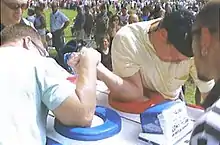
Arm wrestling (also written as armwrestling) is a contest between two opponents facing each other with their bent elbows placed on a table and hands firmly gripped then attempt to force the opponent's hand down to the table top. In the early years different names were interchangeably used to describe the same sport: "arm turning", "arm twisting", "arm wrestling", "twisting wrists", "wrist turning", "wrist wrestling".
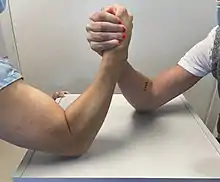 Two people with their arms in a starting position | |
| Players | 2 |
|---|---|
| Skills required | strength, endurance, technique, resistance |
Description
Types
Various factors can play a part in one's success in arm wrestling, technique and overall arm strength being the two greatest contributing factors. Other considerations such as the length of an arm wrestler's arm, muscle and arm mass/density, hand grip size, wrist endurance and flexibility, reaction time, and other traits can lend advantages of one arm wrestler over another. The sport sometimes is used to demonstrate the stronger person between two or more people.
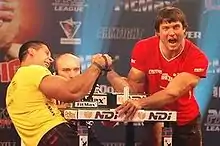
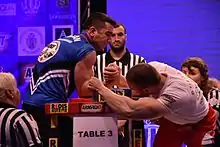
In competitive arm wrestling, a match is conducted with both competitors standing up with arms placed on a tournament arm wrestling table. Arm wrestling tournaments may also be divided along weight classes as well as left and right-handed divisions. There are also rules governing fouls and imposition of penalties, such as when a competitor's elbow leaves a mat where the elbow is meant to remain at all times, when a false start occurs, and attempting to escape arm pinning by breaking the grip with the opponent which may result in a loss.[1] Paraphrasing USAF rules, arm wrestlers must straighten their wrists with less than a one-minute time lapse during competition.[2]
- armwrestling
- stand-up armwrestling
- sit-down armwrestling
- wristwrestling
- stand-up wristwrestling
- sit-down wristwrestling
Tournaments
Organized arm wrestling tournaments arose in the 1950s, while the World’s Wristwrestling Championship, Inc. (WWC) was the first armwrestling organization, organized the first World’s Wrist-wrestling Championship - held in Hermann Sons Hall, the second largest auditorium in Petaluma, California in 1962; later those (WWC's) World championships were known as Petaluma World’s Wrist-wrestling Championships.[3]
The World Armwrestling Federation (WAF) has been the universally recognized global governing body for professional arm wrestling and comprises 80 member countries.[4] However, due to the labeling of referees and competitors that were associated with PAL/URPA with the status of "Not in good standing" thus being suspended from WAF,[5] many countries are jumping ship.
The International Federation of Armwrestling (IFA) is a democratic non-profit sport organization registered in Zurich, Switzerland[6] and is recognized by TAFISA, the Association for International Sport for All.[7]
Competitive styles
_ja_pr%C3%A4ssi_(press)..jpg.webp)
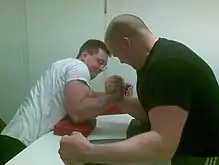
There are many styles moves in arm wrestling. The three most commonly used are: hook, toproll and press.
"The hook" or "hooking" is any move derived from the inside system of arm wrestling. The second generic system or style of arm wrestling is known as outside arm wrestling "the top roll" or "top rolling", while the "triceps press", "shoulder pressing", or "shoulder rolling" is often described as the third generic system or style of arm wrestling.[8]
Common rules
The rules and regulations for arm wrestling are designed to create an even playing field and to prevent broken bones. Different leagues have their own variations, but most use the same table specifications.[1] Below are some of the general arm wrestling regulations:
- The shoulder of both players must be in a square position before the match starts.
- All starts will be a "Ready… Go!" The cadence will vary.
- Competitors must start with at least one foot on the ground. After the "go" players may have both feet off the ground.
- One's opposite hand must remain on the peg at all times.
- A pin cannot be made if the elbow is out of the pocket.
- To make a winning pin, a player must take any part of the opponent's wrist or hand (including fingers) below the plane of a touch pad.
- A false start is a warning. Two warnings equals a foul.
- Competitors will forfeit the match with a second foul.
- If opponents lose grip with one another, a strap is applied and the match is restarted.
- Intentional slip-outs are fouls, which occur when player's palm completely loses contact with the other player's palm.
- Competitors may not touch their body to their hand at any time.
- Shoulders may not cross the center of the table at any time.
- Competitors will always conduct themselves in a sportsperson-like manner while at the tournament.
- The most important arm wrestling rule: the referee's decision is final.
Training
One way to become involved in the sport is to find a local club and join their team. Often a club will have experienced competitors to teach safe and strategic play on the table. Local tournaments take place throughout the US, offering novice and/or amateur divisions for those setting out in the sport.
Associated injury
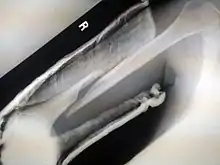
Arm wrestling puts substantial torque/torsion stress on the upper arm's humerus bone, to a degree seen in few other physical activities.[9] Generally speaking, the bones involved in arm wrestling are not designed to accommodate the stresses imposed by the sport, and severe injuries can occur. An arm bone may fail in a diagonal break at or below the shoulder and elbow midpoint, which is known as the 'break arm' position. Common injuries include humeral shaft fractures, shoulder trauma, muscle strain, golfers' elbow, and less commonly pectoralis major rupture.
Top pullers
The Official World Armwrestling Rankings can be found HERE. (xsportnews.com)[10]
The Official U.S. Armwrestling Rankings can be found HERE. (armfighter.com)[11]
The armwrestling historian Eric Roussin, founder of The Armwrestling Archives website, has detailed a chronology of the top pullers along the history for right hand[12] and left hand[13] pullers.
The work is based on the results of the major professional events, including sit-down/stand-up wrist wrestling and sit-down/stand-up armwrestling.
Men (right hand)
In 1966 another organization began to hold World Championships: the International Federation of Arm Wrestlers. Few competitors competed in both, so a parallel ranking was provided. On 1971 both rankings were unified.
| Start Date | #1 Puller | Defeated / (Ahead Of) | Event | Top Spot |
|---|---|---|---|---|
| February 11, 1961 |  Duane “Tiny” Benedix Duane “Tiny” Benedix | California Wristwrestling Championship | 364 days | |
| February 10, 1962 | Earl Hagerman | Duane “Tiny” Benedix | World Wristwrestling Championship | 364 days |
| February 09, 1963 | Duane “Tiny” Benedix | Earl Hagerman | World Wristwrestling Championship | 364 days |
| February 08, 1964 | Joe Schuler [a] | Larry Cory | World Wristwrestling Championship | 1 year, 5 days |
| February 12, 1965 | Arnie Klein | Joe Schuler | World Wristwrestling Championship | 1 years, 3 days |
| February, 1966 | Mike Rowe [b] | Arnie Klein | World Wristwrestling Championship | 1 year, 87 days |
| May 13, 1967 | Larry Finley [a] [b] | Randy Petrini | World Wristwrestling Championship | 278 days |
| February, 1968 | Duane “Tiny” Benedix [b] | (Larry Finley) | World Wristwrestling Championship | 2 years, 90 days |
| May, 1970 | Jim Dolcini [a] [b] | George Witteman | World Wristwrestling Championship | 364 days |
| August 06, 1966 | Lloyd Lampton [c] | Arnie Klein | IFAW World Championship | 2 years, 41 days |
| September, 1968 | Maurice “Moe” Baker [a] [c] | John Torch | IFAW World Championship | 2 years, 241 days |
| May 14, 1971 | Jim Dolcini | Maurice “Moe” Baker | World Wristwrestling Championship | 1 year, 7 days |
| May 20, 1972 | Maurice “Moe” Baker | Jim Dolcini | World Wristwrestling Championship | 364 days |
| May 19, 1973 | Bill Harrison | (Maurice “Moe” Baker) | World Wristwrestling Championship | 364 days |
| May 18, 1974 | Jim Dolcini [a] | George Ludwigsen | WWC National Championship | 2 years, 194 days |
| November 27, 1976 | Virgil Arciero | Jim Dolcini | WPAA World Championships | 1 years, 353 days |
| November 15, 1978 | Cleve Dean | Virgil Arciero | Supermatch (Las Vegas, US) | 1 years, 359 days |
| November 08, 1980 | Virgil Arciero | Cleve Dean | Supermatch (Las Vegas, US) | 336 days |
| October 10, 1981 | Jeremiah Christian | Virgil Arciero | World Wristwrestling Championship | 1 year |
| October 10, 1982 | Virgil Arciero [a] | Cleve Dean | AWI Pro Super Heavyweight World Championship | 111 days |
| January 29, 1983 | Cleve Dean | Virgil Arciero | AWI Pro Super Heavyweight World Championship | 3 years, 179 days |
| July 26, 1986 | Scott Norton | Cleve Dean | Over the Top World Championship | 1 year |
| July 26, 1987 | John Brzenk [a] | Ed Arnold / (Richard Lupkes) | Over the Top World Championship | 174 days |
| January 16, 1988 | Richard Lupkes | John Brzenk | Sands International | 266 days |
| October 08, 1988 | John Brzenk | Richard Lupkes | World Wristwrestling Championship | 189 days |
| April 15, 1989 | Richard Lupkes | John Brzenk | Can-Am Invitational (Barrie, Ontario, Canada) | 1 year, 12 days |
| April 27, 1990 | John Brzenk | Richard Lupkes | Yukon Jack National Championship | 253 days |
| January 05, 1991 | .svg.png.webp) Gary Goodridge Gary Goodridge | John Brzenk | Super Bras de Fer (Paris, France) | 204 days |
| July 28, 1991 | John Brzenk | Gary Goodridge | Yukon Jack National Championship | 3 years, 30 days |
| August 26, 1994 | Cleve Dean | Gary Goodridge / (John Brzenk) | Yukon Jack National Championship | 16 days |
| September 11, 1994 |  Zaur Tskadadze Zaur Tskadadze | Cleve Dean | WAF World Championships | 348 days |
| August 25, 1995 | Gary Goodridge | Cleve Dean / (Zaur Tskadadze) | Yukon Jack World Championship | 2 years, 21 days |
| September 14, 1997 | John Brzenk [a] | Ron Bath | USAA National Pro-Am Championship | 7 years, 6 days |
| September 18, 2004 | Ron Bath | John Brzenk | Strong Arm Calling | 49 days |
| November 06, 2004 |  Alexey Voevoda Alexey Voevoda | John Brzenk / (Ron Bath) | Nemiroff World Cup | 357 days |
| October 29, 2005 |  Andrey Pushkar [a] Andrey Pushkar [a] | Andrey Antonov | Nemiroff World Cup | 35 days |
| December 03, 2005 |  Farid Usmanov Farid Usmanov | (Andrey Pushkar) | WAF World Armwrestling Championships | 140 days |
| April 22, 2006 | John Brzenk | Farid Usmanov | Ultimate Armwrestling III (Las Vegas, USA) | 2 years, 145 days |
| September 13, 2008 | Devon Larratt | John Brzenk | Arm Wars “Deep Water” | 4 years, 262 days |
| June 01, 2013 | Denis Cyplenkov [a] | Andrey Pushkar | A1 Russian Open World Armwrestling Grand Prix | 1 year, 55 days |
| July 26, 2014 | Andrey Pushkar | Denis Cyplenkov | A1 Russian Open World Armwrestling Grand Prix | 4 years, 112 days |
| November 14, 2018 | Levan Saginashvili [a] | Tsvetkov, Georgi | WAF World Championship | 1 year, 196 days |
Notes:
Men (left hand)
| Start Date | #1 Puller | Defeated / (Ahead Of) | Event | Top Spot |
|---|---|---|---|---|
| September, 1977 | John Woolsey | Dean Christensen | NAWA National Championships | 2 years, 7 days |
| September 22, 1979 | Cleve Dean [a] | World Wristwrestling Championship | 7 years, 22 days | |
| October 12, 1986 | Gary Goodridge [a] | (Canada) | 1 year, 131 days | |
| February 20, 1988 | Garvin Lewis | Gary Goodridge | Ontario Provincial Championships | 2 years, 243 days |
| October 20, 1990 | Gary Goodridge | Garvin Lewis | Canadian Stand-Up National Championships | 1 year, 237 days |
| June 13, 1992 | Steve Morneau | (Gary Goodridge), (Garvin Lewis) | Gloucester Fair International Armwrestling Championship | 364 days |
| June 12, 1993 | Gary Goodridge | Steve Morneau | Gloucester Fair International Armwrestling Championship | 364 days |
| June 11, 1994 | Steve Morneau | Gary Goodridge | Gloucester Fair International Armwrestling Championship | 364 days |
| June 10, 1995 | Garvin Lewis | (Steve Morneau), (Gary Goodridge) | Gloucester Fair International Armwrestling Championship | 1 year, 364 days |
| June 08, 1997 | Eric Woelfel [a] | Mairbek Gioev | Golden Bear International Tournament (Russia) | 180 days |
| December 05, 1997 | Alan Karaev | Eric Woelfel | WAF World Championship (India) | 337 days |
| November 07, 1998 | Vakhtang Javakhadze | Alan Karaev | WAF World Championship (Egypt) | 264 days |
| July 29, 1999 | Erekle Gurchiani | Vakhtang Javakhadze | European Armwrestling Championships | 1 year, 1 day |
| July 29, 2000 | Alan Karaev [a] | Vakhtang Javakhadze | World Armsport Championship | 65 days |
| October 02, 2000 | Len Houghton | Earl Wilson | Canadian Nationals | 336 days |
| September 03, 2001 | Dan Victor [a] | (Earl Wilson) | Harley Pull | 230 days |
| April 21, 2002 | Alan Karaev [a] | Cleve Dean | World Armsport Federation World Championship | 165 days |
| October 03, 2002 | Christian Binnie [a] | Eric Woelfel | Harley Pull | 65 days |
| December 07, 2002 | Travis Bagent | Christian Binnie | All-Niagara Armwrestling Championship | 35 days |
| January 11, 2003 | Christian Binnie | Travis Bagent | Reno Reunion Armwrestling Championship | 140 days |
| May 31, 2003 | Travis Bagent | Christian Binnie | AAA Nationals | 1 year, 300 days |
| March 26, 2005 | Earl Wilson | Sylvain Perron / (Devon Larrat) | Mike Gould Classic | 364 days |
| March 25, 2006 | Travis Bagent | Earl Wilson | Mike Gould Classic | 4 years, 264 days |
| December 13, 2010 | Devon Larratt | Travis Bagent | Supermatch - Arm Wars “Sin City” (Las Vegas, US) | 64 days |
| February 15, 2011 | Travis Bagent | Devon Larratt | Supermatch - UAL Backyard Brawl | 241 days |
| October 14, 2011 | Andrey Pushkar | Travis Bagent | Nemiroff World Cup | 258 days |
| June 28, 2012 | Devon Larratt | Andrey Pushkar | Supermatch - PAL Armfight 42 (Las Vegas, US) | 2 years, 119 days |
| October 25, 2014 | Travis Bagent | Devon Larratt | World Armwrestling League Atlantic City Qualifier | 3 years, 240 days |
| June 21, 2018 | Oleg Zhokh [a] | Andrey Pushkar | Lviv Open Cup | 146 days |
| November 14, 2018 | Levan Saginashvili [a] | Osmanli, Ferit | WAF World Championship | 1 year, 196 days |
Statistics
The following table summarizes the accumulated time on the #1 spot. John Brzenk and Cleve Dean have been the most dominant pullers with the right hand. Travis Bagent and Cleve Dean have been ruling more time with the left hand. Very few pullers have succeeded to get the #1 spot with both hands for several years: Cleve Dean, Devon Larratt and Gary Goodridge.
(Minimum 4 years with any hand)
| Puller | Height | Weight | Right Hand | Left Hand | Total |
|---|---|---|---|---|---|
| Duane “Tiny” Benedix | 6'4" / 1.92 m | 260 lb / 118 kg | 4 years, 88 days | 4 years, 88 days | |
| Jim Dolcini | 6’0” / 1.83 m | 200 lb / 91 kg | 4 years, 20 days | 4 years, 20 days | |
| Cleve Dean | 6’7” / 2.01 m | 460 lb / 209 kg | 5 years, 189 days | 7 years, 22 days | 12 years, 211 days |
| Gary Goodridge | 6'3" / 1.91 m | 240 lb / 109 kg | 2 years, 225 days | 4 years, 2 days | 6 years, 227 days |
| Garvin Lewis | 242 lb / 110 kg | 4 years, 242 days | 4 years, 242 days | ||
| John Brzenk | 6'1" / 1.85 m | 198 lb / 90 kg | 13 years, 243 days | 13 years, 243 days | |
| Travis Bagent | 6'3" / 1.91 m | 265 lb / 120 kg | 10 years, 350 days | 10 years, 350 days | |
| Andrey Pushkar | 6'4" / 1.92 m | 276 lb / 125 kg | 4 years, 147 days | 258 days | 5 years, 40 days |
| Devon Larratt | 6’5” / 1.96 m | 278 lb / 126 kg | 4 years, 262 days | 2 years, 183 days | 7 years, 80 days |
In popular culture
- In The Old Man and the Sea (1952), the character Santiago recalls winning an arm wrestling match that lasted for a whole day.
- In the episode "Dead Lift" of the series The Streets of San Francisco (first broadcast May 5, 1977), where Arnold Schwarzenegger plays an important role, one sees his friend Franco Colombu, himself a high-level bodybuilder, and also a competitor of athletic strength and "strong men" contests, make a showdown in a bar.
- At the beginning of the film Predator (1987), the characters played by Arnold Schwarzenegger and Carl Weathers improvise a showdown after a vigorous handshake.[14]
- The film Vendetta dal futuro (1986) features arm wrestling.
- The film Over the Top (1987) features a wrestling champion, played by Sylvester Stallone.
- The film Addams Family Values (1993) opens with a showdown between Gomez and Thing.
- The Fly (1986 film) features an arm wrestling scene in which one competitor's arm suffers a compound fracture.
- In the episode of The Simpsons "Marge's Son Poisoning" (2005), Homer enters an armwrestling tournament.
- The documentary Pulling John (2009), focuses on the battle for pre-eminence between heavyweights John Brzenk, Travis Bagent and Alexey Voevoda.[15]
- The reality TV show Game of Arms (2014) showed teams of American competitors sacrificing to become the nation's best armwrestler.[16]
- In Italy, the term used for arm wrestling is braccio di ferro, and the cartoon character Popeye is also called Braccio di Ferro.
References
- "Regulations – Armfighter.com". Retrieved 2020-02-26.
- "WAF/USAF Armwrestling Rules".
- "World's Wristwrestling Championship - Part 2: 1962-1969".
- WAF MEMBERS. World Armwrestling Federation
- XSportNews. "WAF Executive Board bans PAL / URPA Events • ARMWRESTLING • ARMWRESTLING NEWS XSPORTNEWS.COM". ARMWRESTLING NEWS XSPORTNEWS.COM. Retrieved 2020-02-26.
- "About IFA – International Federation of Armwrestling (IFA)".
- "Armsport Federation News".
- "Basic armwrestling moves".
- Khashaba, A. (2000). "Broken arm wrestler". British Journal of Sports Medicine. 34 (6): 461–462. doi:10.1136/bjsm.34.6.461. PMC 1724269. PMID 11131237.
- "XSportNews.com".
- "Armfighter.com".
- "Chronology of the top armwrestlers of the planet (right arm)". Retrieved 2020-05-29.
- "Chronology of the top armwrestlers of the planet (left arm)". Retrieved 2020-05-29.
- "Guile's Theme Goes with Everything (world's most epic handshake)". YouTube. Archived from the original on 2021-12-12.
- "Pulling John". IMDb. Retrieved 2020-02-26.
- "Game of Arms". IMDb. 25 February 2014. Retrieved 2020-02-26.
External links
 |
Wikimedia Commons has media related to Arm wrestling. |