John Woodroffe
Sir John George Woodroffe (15 December 1865 – 16 January 1936), also known by his pseudonym Arthur Avalon, was a British Orientalist whose extensive and complex published works on the Tantras, and other Hindu traditions, stimulated a wide-ranging interest in Hindu philosophy and yoga.[3]
Sir John Woodroffe | |
|---|---|
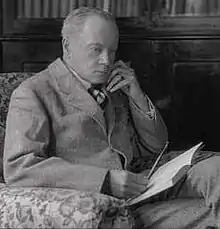 In 1928. Portrait by Lafayette | |
| Born | 15 December 1865 |
| Died | 16 January 1936 (aged 70) Beausoleil, Alpes-Maritimes, France[3] |
| Nationality | British |
| Other names | Arthur Avalon |
| Citizenship | United Kingdom |
| Alma mater | University College, Oxford |
| Occupation | Lawyer; Orientalist |
| Known for | The Serpent Power |
| Parent(s) | James Tisdall Woodroffe, Florence Woodroffe |
Life
Woodroffe was the eldest son of James Tisdall Woodroffe and his wife Florence, daughter of James Hume. James Woodroffe was Advocate-General of Bengal and Legal Member of the Government of India, a Justice of the Peace, and a Knight of St. Gregory. John was educated at Woburn Park School and the University College, Oxford, where he took second classes in jurisprudence and the Bachelor of Civil Law examinations. He was called to the Bar by the Inner Temple in 1889, and in the following year was enrolled as an advocate of the Calcutta High Court. He was soon made a Fellow of the Calcutta University and appointed Tagore Law Professor. He collaborated with Ameer Ali in a widely used textbook, Civil Procedure in British India. He was appointed Standing Counsel to the Government of India in 1902, and in 1904 was raised to the High Court Bench. He served there for eighteen years, becoming Chief Justice in 1915. After retiring to England he served as Reader in Indian Law to the University of Oxford. He died on 18 January 1936 in France.[3]
Sanskrit Studies
Alongside his judicial duties he studied Sanskrit and Hindu philosophy and was especially interested in Hindu Tantra. He translated some twenty original Sanskrit texts and, under his pseudonym Arthur Avalon, published and lectured prolifically on Indian philosophy and a wide range of Yoga and Tantra topics. T.M.P. Mahadevan wrote: "By editing the original Sanskrit texts, as also by publishing essays on the different aspects of Shaktism, he showed that the religion and worship had a profound philosophy behind it, and that there was nothing irrational or obscurantist about the technique of worship it recommends."[4]
Mahānirvāṇatantraṃ
Woodroffe translated the Mahānirvāṇatantraṃ from the original Sanskrit into English under his nom-de-plume of Arthur Avalon: a play on the magical realm of Avalon and the young later-to-be, King Arthur, within the story-cycle of tales known generally as King Arthur and the Knights of the Round Table; specifically according to Taylor (2001: p. 148), Woodroffe chose the name from the noted incomplete magnum opus, the painting 'Arthur's Sleep in Avalon' by Burne-Jones.[5] Moreover, Taylor (2001: p. 148) conveys the salience of this magical literary identity and contextualises by making reference to western esotericism, Holy grail, quest, occult secrets, initiations and the Theosophists:
"This is quite important to know, for here we have a writer on an Indian esoteric system taking a name imbued with western esotericism. The name at any rate seems to hint at initiations and the possession of occult secrets. The Arthurian legends are bound up with the story of the Holy Grail and its quest. This was a symbol of esoteric wisdom, especially to Theosophists who appropriated the legend. Anyone who named himself after King Arthur or the mystic isle of Avalon would be thought to be identifying himself with occultism, in Theosophists' eyes."[5]
Bibliography
His writings (published under his own name, as well as Arthur Avalon) include:
- Introduction to the Tantra Śāstra, ISBN 81-85988-11-0 (1913).
- Tantra of the Great Liberation (Mahānirvāna Tantra), ISBN 0-89744-023-4 (1913).
- Hymns to the Goddess (1913).
- Shakti and Shâkta, ISBN 81-85988-03-X (1918).
- The Serpent Power, ISBN 81-85988-05-6 (1919).
- Hymn to Kali: Karpuradi-Stotra. Luzac & Co., London. 1922.
- The World as Power, ISBN 1-4067-7706-4 (1922).
- The Garland of Letters. ISBN 81-85988-12-9 (1922).
- Principles of Tantra (2 vols) ISBN 81-85988-14-5.
- Kularnava Tantra (Introduction by John Woodroffe). ISBN 81-208-0972-6 (1965).
- Kamakalavilasa by Puṇyānanda.
- Bharati Shakti: Essays and Addresses on Indian Culture.
- India: Culture and Society.
- Is India Civilized? Essays on Indian Culture.
References
- India, Select Births and Baptisms, 1786-1947
- 1881 England Census
- "Obituary: Sir John Woodroffe". The Times. 18 January 1936. p. 14.
- T.M.P. Mahadevan, foreword to; Arthur Avalon, Garland of Letters, Ganesh and Company Madras, 6th ed. 1974 p iii.
- Taylor, Kathleen (2001). Sir John Woodroffe, Tantra and Bengal: 'an Indian soul in a European body?'. SOAS London studies on south Asia. Illustrated edition. Routledge. ISBN 0-7007-1345-X, 9780700713455. Source: (accessed: Monday 3 May 2010), p.148
Further reading
- Shakti and Shakta, by John Woodroffe, Published by Forgotten Books, 1910. ISBN 1-60620-145-X.
- Hymn to Kali:Karpuradi Stotra, by Sir John Woodroffe. Published by Forgotten Books. 1922. ISBN 1-60620-147-6.
- Hymns to the Goddess, Translated by John George Woodroffe, Ellen Elizabeth (Grimson) Woodroffe, Published by Forgotten Books, 1952 (org 1913). ISBN 1-60620-146-8.
- Mahanirvana Tantra, By Arthur Avalon, 1913,ISBN 1606201441.
- Sir John Woodroffe, Tantra And Bengal- An Indian Soul In A European Body?, by Kathleen Taylor. Routledge, 2001, ISBN 0-7007-1345-X.
External links
 |
Wikiquote has quotations related to: John Woodroffe |
- Sir John Woodroffe's representations of Hindu Tantra Colorado University
- Woodroffe
- Works of sir John Woodroffe Sacred texts

Authority control  | |
|---|---|
| General | |
| National libraries | |
| Other | |