Assassination of Nikolay Bobrikov
The assassination of Nikolay Bobrikov happened on 16 June 1904 when Finnish national activist Eugen Schauman shot Governor-General of Finland Nikolay Bobrikov and himself in the stairway of the Government Palace, then known as the main building of the Senate of Finland.
Planning the assassination
The people of Finland saw Bobrikov as the embodiment of the oppression politics of Russia towards autonomous Finland. Bobrikov was a staunch Pan-Slavist and a supporter of Russification of Finland. The Tsar Nicholas II of Russia had also given him dictatorial powers over Finland. This was seen to be in stark conflict with the laws of Finland. As an efficient and decisive man, Bobrikov had decided to integrate the Grand Duchy of Finland into the Empire of Russia. Bobrikov had succeeded in his plans better than his predecessors, which made the people of Finland see him as the Devil incarnate. The assassination of Bobrikov was not Schauman's original idea, but had instead been a general plan in the activist circles of Finland since the early 20th century.[1] Bobrikov's death was hoped to end the oppression politics, or at least turn the emperor's attention to the position of Finland.[2]
Schauman's act was a personal solution which he had made months in advance. In February 1904 he wrote his will and an apology letter to his father Waldemar Schauman, and donated his most important papers to his friends as well as two letters to doctor Gunnar Castrén, which should be opened only "when there is need for it". One was a personal letter and the other was a long letter addressed directly to the emperor Nicholas II, in both of which Schauman explained his actions.[2] Schauman kept the plan secret and did not reveal it to his family or friends. A personal effect had been a personal crisis Schauman had just experienced: a woman Schauman had loved for ten years had cold-heartedly left him[1] and he had had to resign from his job because he was hard of hearing. He had gradually grown hard of hearing since he was 25 years old. Schauman had decided to be at least of some benefit to his country and to show his ability and decisiveness.
Through various ways, Schauman had heard of Finnish activists planning Bobrikov's murder. He was not part of activist groups or movements himself, but was in indirect contact with them through various paths. The student Lennart Hohenthal, a member of the "Gummerus group" of activists led by Magister Herman Gummerus, contacted Schauman whom he remembered from his act of bravery at the cossack riots, and told him about the group's plans. After discussing with Schauman, Hohental gave Schauman time to act until Midsummer, otherwise the Gummerus group would begin to take their own plan into action.[1] The most prominent difference between the plan of the activists and that of Schauman was that Schauman had no plan to escape, but had intended to take his own life as well. The activists saw themselves as being in total war against Russia, so they wanted to avoid needless losses.[1] Schauman, on the other hand, thought his suicide would accommodate his act, as he wrote in his letter to the emperor:
It is terrible to take the life of another person. With my own life I will accommodate my crime. As I have made this decision I have been at peace; calmly and happily I will go to my death.[3]
Carrying out the plan
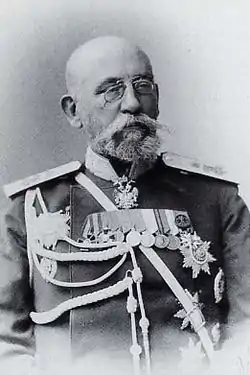
"[It is peaceful on the streets of Helsinki.] Understand my words: on the streets. One can never be certain about the houses in Helsinki."
Bobrikov in an interview of Novoye Vremya a few days before his death.[4]: 322
Practicing for the assassination
Schauman had chosen the main building of the Senate as the site of the assassination, where he had freedom of movement as a former official. Apparently Schauman used the murder of interior minister Dmitry Sipyagin, who had supported Russification of Finland, in April 1902 as a base of his plan. At Schauman's request, his cousin Mary Junnelius living in Saint Petersburg had reported of all actions in the city in her letters, including a thorough description of this murder committed by Stepan Balmashov, a disguised member of the Socialist Revolutionary Party. There had been discussion about the murder at the Schaumans' home, and Eugen Schauman had remembered it. Unlike his father, Eugen Schauman disliked the idea that the murderer should wear a disguise. On the other hand, Lennart Hohenthal had copied this way of carrying out the murder exactly into his plan.[1]
As a former official Schauman knew that Bobrikov would be conducting a session of the economical board of the Senate every Thursday morning at 11:00 AM.[5] He had originally intended to commit the murder already on Thursday 9 June, but failed to slip into the Senate building. This caused the plan to be delayed by a week - the next Thursday would be the last before Bobrikov would start his summer vacation.[2]
On Wednesday 15 June Schauman was again practising his marksmanship at the shooting range of the Finnish Hunting Association. He gave the young Edvard Ellman, who was present at the site, the job of moving a target with a picture of a bearded Russian, with a heart painted on his chest, along on a long piece of string. Schauman left the shooting range satisfied after hitting the target with his Browning FN M1900 pistol enough times. Ellman asked Schauman why he had chosen such a peculiar target, to which Schauman replied: "An enemy that stays still when being shot is not a good one!"[3]
On Wednesday Schauman also met his friend, leader of the Helsinki branch of the Kagal, Candidate of Philosophy - later merchant official - Walter Rydman, who was walking his dog in Kaisaniemi. The two friends sat down on a bench and started discussing Russian oppression politics. Rydman was angered because the public mindset had grown so depressed that it had succumbed under oppression without resistance. Rydman burst out: "There is hardly a man with enough courage to kill Bobrikov!" Schauman replied: "Yes there are such men. Just be calm!"[6]
The day of the assassination
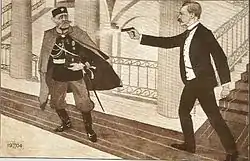
At about 11:00 AM on Thursday 16 June 1904 Governor-General Nikolay Bobrikov was coming to conduct a session of the Senate. He and his entourage walked through the Senate Square. Eugen Schauman was watching Bobrikov from the window of the top floor and heard him step inside alone and start slowly walking up the stairs wearing his uniform and coat, carrying a briefcase and a walking stick. Schauman withdrew from the window and started descending the stairs towards Bobrikov. As Schauman was hurrying down the stairs he met a familiar official, who asked him where he was going, to which Schauman replied "I have no time for that now".[4]
Schauman met Bobrikov on the floor of the staircase on the second floor. Schauman had earlier asked his physician friend, member of the Kagal and Jaeger Birger Runeberg where to shoot for the wounds to be fatal. Schauman drew his Browning FN M1900, stepped in front of Bobrikov and fired three shots at him according to his physician friend's advice. The first shot ricocheted off a button on Bobrikov's uniform and the second off a massive Cross of Saint Vladimir, First Class Bobrikov wore on his chest, scratching his neck. The third and fatal bullet hit the buckle of Bobrikov's belt which shattered. The bullet and parts of the buckle entered Bobrikov's stomach. After this, Schauman stepped back a couple of steps and fired two shots into his own heart.
Schauman died instantly, but Bobrikov remained standing and staggered into the session hall of the Senate. Bobrikov told the senators "I am not wounded", but as he was told his neck was dripping blood, he replied "In that case I am wounded". Bobrikov was first taken to his home on a stretcher, where a priest took his confession and the doctors declared that a surgery was necessary.
Bobrikov was taken to the Chirurgical Hospital in Ullanlinna. Bobrikov had forbidden his Russian entourage from taking him into the Russian military hospital on the edge of the Senate Square. The young, gifted and promising surgeon Richard Faltin, along with professors Hjalmar von Bornsdorff and Ali Krogius, was responsible for Bobrikov's operation. However, the bullet fired on advice from Schauman's physician friend had destroyed Bobrikov's internal organs so badly that even an operation lasting several hours was not enough to save him. Bobrikov died during the following night few minutes past 1 AM.[1][4]: 323–327 Schauman's body was dragged through the stairs of the Senate building into the courtyard.
Aftermath
News of the Governor-General's death soon travelled throughout Helsinki and Finland. The surgeon Faltin who had operated Bobrikov was said to have in this case been satisfied at his own failed operation, even though he had done his best. The public was informed of the operation from the windows of the hospital. Eugen Schauman became a national hero overnight, and pictures of him appeared throughout the city without hindrance. The people celebrated openly without fear of repercussion.
Soon the letter Schauman had addressed to the Emperor of Russia came into publicity, where he explained his actions by blaming Bobrikov for illegalities and wanting to attract the emperor's attention to massive faults in the entire empire, such as in Poland and in the countries around the Baltic Sea. Thus he made a point of having been a loyal subject of the emperor rather than a rebel and maintained his belief in the inherent goodness of the emperor.[5][2] Schauman emphasised he had acted alone and especially that his family had no part in his personal solution.
Several philosophical writings by Schauman were found, which proved him to have been a thinking man. One writing, written a couple of days before the murder, explains Schauman's motive:
Freedom is its own end. With certain, rather small limits, it is an inherent right of all people, which no external force can remove. A person has no right to give this right away from themselves, even less from their children. Freedom is the base of self-esteem, and without it the teaching of a person's chaste responsibility would be nothing but lies and deception. Freedom is a sacred thing and the love of freedom is a natural instinct deeply integrated into our hearts. Do you love your country? Good, remember Ibsen's words: "Even if you had given all, but not your own life, you would have given nothing."[3]
By order of the authorities, Schauman was buried at the Malmi Cemetery into an unmarked poor people's grave with only his immediate family present. There was a Russian military guard present at the grave to prevent displays of honouring Schauman. After circumstances changed, Schauman's body was transferred to the Schauman family grave at the Näsinmäki Cemetery in Porvoo. His reburial in Porvoo on 10 May 1906 became a great national event of grief.[2][7] It showed how large an effect Schauman's act had had on the Finnish people.[1]
Reactions and significance of the murder
The Finns saw the act as an act of national bravery, and Schauman was made into a national hero.[3] The joy in the country was so great that some people forgot about being careful and went as far as to fly their flags. The deputy chancellor of the university, government official Thiodolf Rein declared that the murder had been "an act of self defence made on behalf of everyone".[8] The act was felt to have been an act of national emergency and a sacrificial death. The Finns expected freedom to start when Bobrikov, who had oppressed the rights of the Finnish people, was out of the way. An Eugen Schauman cult was born, strengthening the Finnish resistance to the oppression. Bobrikov was succeeded by Ivan Mikhailovich Obolensky, who treated the Finns in a better way. This convinced the Finnish activists that the Russians understood the same measures as they had used, as it was written in the Eugen Schauman memorial booklet of the Active Resistance Party of Finland.[3]
Päivälehti published an editorial with the title "Juhannuksena" ("On Midsummer"),[9] which described how light defeats darkness after all on Midsummer. Because of this, Päivälehti was shut down permanently. However, the traditional Uusi Suometar newspaper condemned the act by writing about it with the title "Rikos" ("A crime"): "A crime is always a crime, no end purposes can alter this - the people of Finland want peace, it is their wish to resume the circumstances where the emperor and the people in full mutual understanding work for the same and right ends. Because of this we want to do away with responsibility to the disgusting and heinous crime which happened here yesterday."[10] Juho Kusti Paasikivi wrote an editorial in the newspaper condemning the act. The traditional Finns and the clergy condemned the act in general for both political and ethical reasons.[5] When Paasikivi described Bobrikov's murder as a "disgusting and heinous crime" in his editorial, he was met with contempt because of his choice of words.[1] Paasikivi later wrote in his memorial that he himself felt Schauman's act was heroical and he understood its significance, but he had not dared to say this aloud for fear of repercussion by Russia.[3]
Eight months after Bobrikov's murder Lennart Hohenthal shot procurator Eliel Soisalon-Soininen, a Russian-friendly politician, who the activists thought was a supporter of Russification of Finland. Hohenthal had also planned Bobrikov's murder, but after Schauman had done the act before him, Hohenthal chose Soisalon-Soininen as a new target. The example Schauman and Hohenthal had set encouraged young Finnish activists to engage in violence towards Russian authorities and Russian-friendly Finnish politicians. Thus the acts caused even more will to battle until assassinations as a way to rebel against the oppression were thought as old-fashioned. The third and final known act of assassination happened in different circumstances in 1922, when Ernst Tandefelt shot interior minister Heikki Ritavuori. Tandefelt mentioned having been inspired by Schauman and Hohenthal.[1]
Cultural references
The date of the assassination coincides with part of the novel Ulysses by James Joyce. The assassination is briefly mentioned in the novel.[11]
References
- Risto Niku: Ministeri Ritavuoren murha, pp. 30–42. Edita, Helsinki 2004.
- Seppo Zetterberg: Kuka oli Eugen Schauman?, pp. 96–97. In Osmo Apunen: Itsenäisen Suomen historia 1: Rajamaasta tasavallaksi. Weilin+Göös 1991.
- Jussi Niinistö: Suomalaisia vapaustaistelijoita, pp. 13–18. Nimox Ky, Helsinki 2003.
- Polvinen, Tuomo: Valtakunta ja rajamaa. N. I. Bobrikov Suomen kenraalikuvernöörinä 1898–1904. WSOY, 1984. ISBN 951-0-12660-8.
- Jussi Niinistö: Schauman, Eugen (1875 - 1904), online publication of the national biography (for-pay content), 11 October 2000. Helsinki: Finnish Literature Society.
- Rydman-suku: Sukulaisia kagaalissa
- Eugen Schauman, Porvoo. Accessed on 27 August 2012.
- Eino Jutikkala: Suomen Historia, sfnet.tiede.historia
- Juhannuksena. Päivälehti, 24 June 1904, issue 121. National Library of Finland. Accessed on 24 June 2014.
- Etälukio, Suomen historia
- Finnish fans fete new translation of Irish classic, Yle.fi 15 June 2012. Accessed on 12 August 2021.